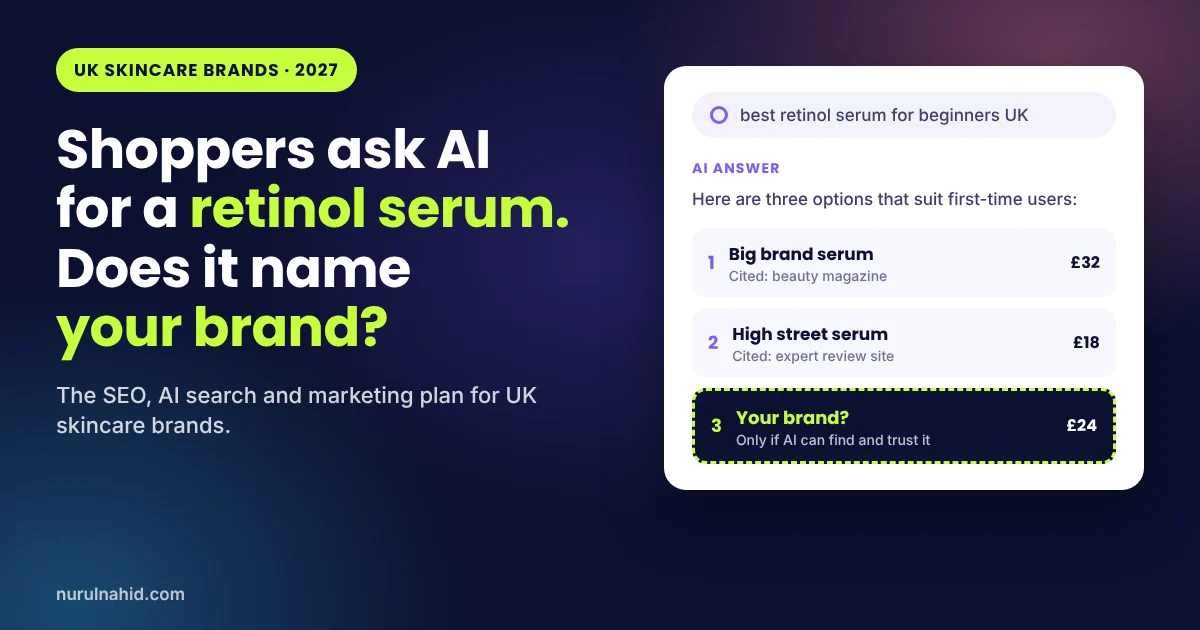
SEO for skincare brands in 2027 comes down to three jobs. Rank your collection and product pages for concern, ingredient and comparison searches.
Earn mentions in the places AI tools read before they recommend a product. Then turn first orders into repeat orders with email, paid and social.
Every claim you publish must also stand up to ASA rules and the UK Cosmetics Regulation. This guide covers all of it, step by step.
I’m Nurul Nahid, an SEO and AI search expert in the UK with 7+ years of experience in SEO, local SEO, e-commerce SEO, GEO, AEO and digital marketing.
I help online stores on Shopify, WooCommerce and custom platforms grow organic revenue through my e-commerce SEO service for UK online stores.
At a glance
- 28.8% of retail sales in Great Britain were made online in September 2026. Source: ONS Retail Sales bulletin, 23 October 2026.
- £28.3 billion is what beauty and personal care added to UK GDP in 2025. Source: British Beauty Council, Value of Beauty 2026.
- 46% of FMCG value sales on TikTok Shop come from beauty categories. Source: NIQ, April 2026.
- Under 2% is the owned-site citation rate for most skincare brands in one 2026 study of 1,920 AI answers. Source: 5W Skincare AI Visibility Index, October 2026 (a PR agency study).
- “Reduces the appearance of fine lines” is likely acceptable. Claiming an actual anti-ageing effect is not. Source: ASA and CAP guidance, 2 February 2026.
Part 1: SEO guide 2027 for skincare brands
Skincare SEO works when your site mirrors how people shop for skin. They start with a concern, learn an ingredient, compare options, then pick a product.
Build one strong page for each of those steps, keep the site fast, and write claims you can prove. That is the whole of Part 1.
How UK shoppers search for skincare
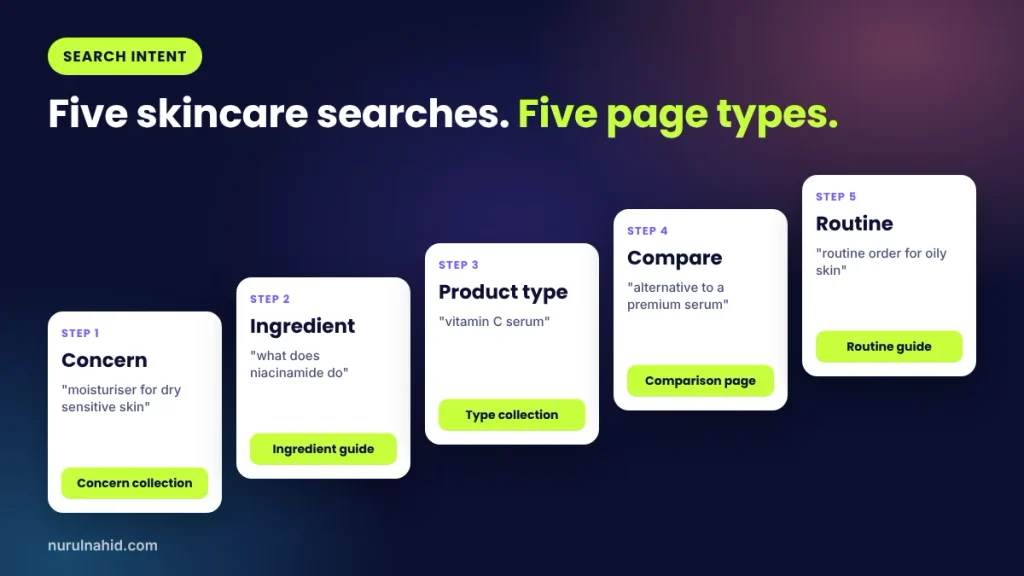
Most skincare searches fall into five intent types. Each type needs a different page.
| Search type | Example search | Best page to rank |
|---|---|---|
| Concern | “moisturiser for dry sensitive skin” | Concern collection page |
| Ingredient | “what does niacinamide do” | Ingredient guide |
| Product type | “vitamin C serum” | Product type collection |
| Comparison and dupes | “alternative to [premium serum]” | Honest comparison page |
| Routine | “skincare routine order for oily skin” | Routine guide with products |
Small brands rarely win the broad head terms first. Large retailers and long-established names hold those results.
Your opening is the specific search. “Fragrance-free moisturiser for rosacea-prone skin” has fewer searches and far less competition than “moisturiser”.
Keyword research for skincare brands
Start with your own customers, not a keyword tool. Read your reviews, support emails and social comments, and write down the exact words people use.
Then group every phrase under four headings: skin type, concern, ingredient and product format. This gives you a keyword map that matches your range.
A simple method:
- List every product with its skin type, concern, hero ingredients and format.
- Pull search queries from Google Search Console for the last 12 months.
- Add Google autocomplete and People Also Ask questions for each ingredient.
- Mark each phrase as collection, product, guide or comparison.
- Give each phrase one target page, so two pages never compete.
I did not have validated UK search volumes for this guide, so check volume and difficulty in your own tool before you commit budget.
My step-by-step keyword research process for UK businesses shows how to size and sort a list like this.
Dupes and alternatives: how to handle the intent
“Dupe” and “alternative to” searches show a shopper who knows what they want and wants a better price or a kinder formula.
You can serve that intent without risky copy. Publish a fair comparison page for your own product.
Include these on the page:
- Full ingredient lists for both products, side by side
- Price per ml, with the date you checked it
- Honest differences in texture, strength and fragrance
- Who each product suits, and who should skip it
Keep comparisons factual and verifiable. Do not call your product “the same as” another, and do not use a rival’s name in a way that could mislead shoppers.
Collection page SEO
Collection pages bring in most non-brand organic revenue for an online store. Treat them as landing pages, not product grids.
Build collections on three axes: concern, skin type and ingredient. A shopper should reach any of them in one click from the menu.
Each collection page needs:
- A clear H1 that matches the search, such as “Moisturisers for Dry Skin”
- A 40 to 60 word opening that says who the range is for
- Filters for skin type, concern, format and price
- A short buying guide below the grid, with links to the ingredient guides
- Three to five FAQs taken from real customer questions
Watch your filters. Faceted navigation can create thousands of thin, duplicate URLs that waste crawl budget.
Let Google index only the filter combinations that match real searches. Canonicalise or block the rest.
Product page SEO for skincare
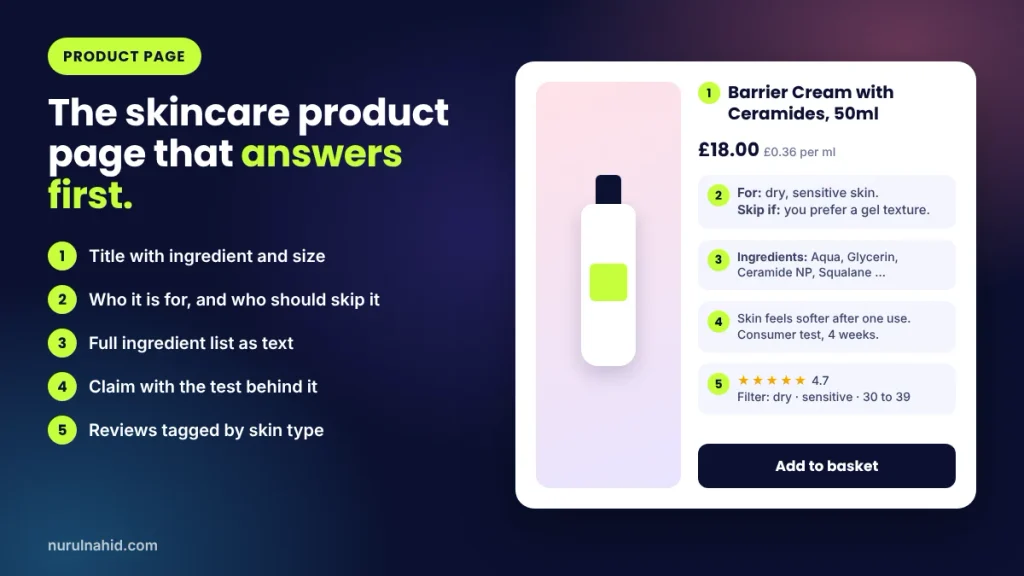
A skincare product page has to answer more questions than most product pages. The shopper is deciding what to put on their face.
Put the answers in plain text on the page, not inside images or hidden tabs that load late.
| Page element | What to include | Why it matters |
|---|---|---|
| Title | Brand, product, key ingredient, size | Matches how people search |
| Who it is for | Skin types and concerns, and who should avoid it | Helps shoppers and AI tools match need to product |
| Full ingredient list | INCI names in order | Trust, ingredient searches and safety checks |
| How to use | Step, amount, AM or PM, what not to mix | Cuts returns and support emails |
| Evidence | Test type, sample size, duration | Supports every claim you make |
| Reviews | Rating plus skin type and age range of reviewer | Makes reviews useful to similar shoppers |
| Size and price per ml | Clear and current | Feeds comparison searches |
Write every description from scratch. Supplier copy and near-identical text across sizes give Google nothing new to rank.
If one product comes in several sizes, Google’s guidance says each variant should have its own distinct URL. Check your theme handles this cleanly.
Claims that rank and stay legal (ASA and CAP)
Your product copy, ads, emails and social posts are all marketing. The ASA applies the CAP Code to all of them.
The rule is simple. Hold documentary evidence before you publish a claim, and keep the claim cosmetic, not medical.
The ASA guidance on creams and its general cosmetics guidance point to a clear pattern.
| Risky wording | Why it is risky | Safer wording |
|---|---|---|
| “Reverses ageing” | Implies a physiological change | “Reduces the appearance of fine lines” |
| “Removes wrinkles” | Suggests the skin’s structure changes | “Skin looks smoother and plumper” |
| “Treats acne” or “heals eczema” | Medicinal claim, which can need a marketing authorisation | “For blemish-prone skin” |
| “Antioxidants protect skin and delay ageing” | CAP says this has not been proven | Describe the ingredient and its cosmetic role |
| “80% saw fewer wrinkles” | Needs a proper consumer test behind it | State the test, sample and duration |
| “Eco-friendly” | Must reflect the whole product life cycle | Name the specific thing, such as recycled glass |
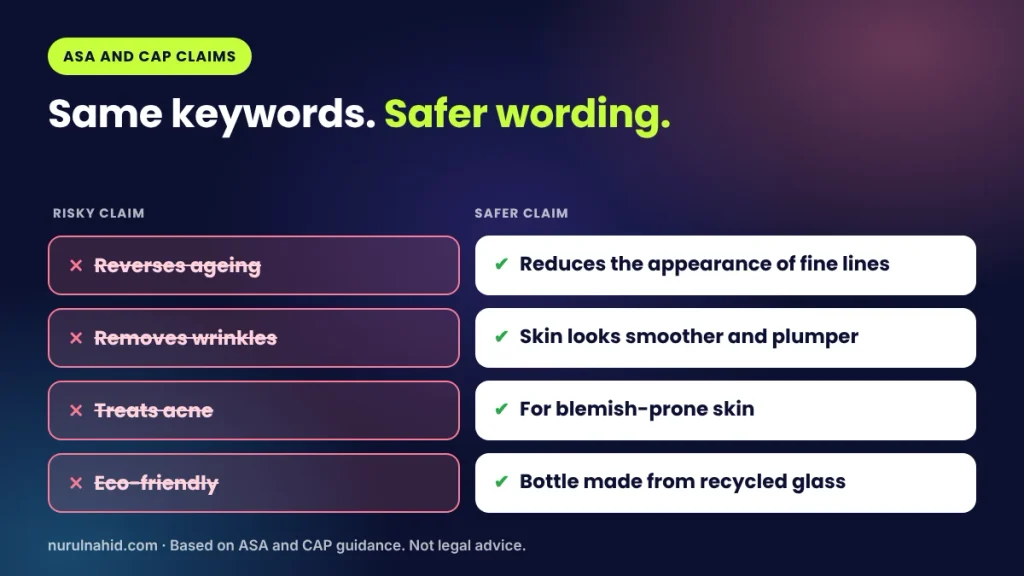
Cumulative claims need extra care. The ASA says claims of gradual improvement over time need a high level of evidence.
This also helps SEO. “Reduces the appearance of fine lines” still contains the words shoppers type, and it keeps you out of an ASA ruling.
This section is general guidance, not legal advice. Ask a regulatory specialist to review new claims before launch.
UK Cosmetics Regulation: what your site should reflect
Skincare sold in Great Britain falls under the UK Cosmetics Regulation. The government’s statutory guidance for Great Britain was updated on 29 June 2026.
The main duties are:
- A Responsible Person established in the UK for every product
- Notification through the Submit Cosmetic Product Notification service before sale
- A Cosmetic Product Safety Report signed by a qualified assessor
- A Product Information File kept for ten years after the last batch
- Labels with ingredients, batch number, durability and warnings
- Claims that do not imply features the product lacks
Northern Ireland follows separate rules, so check both if you ship across the UK.
Why does this belong in an SEO guide? Because the same facts build trust on the page. Show the full ingredient list, the period-after-opening, and the Responsible Person’s details.
Expert review and E-E-A-T
Skincare advice sits close to health, so Google’s quality raters expect real expertise behind it.
Add a named reviewer to every ingredient guide and routine guide. A cosmetic scientist, formulator, pharmacist or dermatologist all work.
Each guide should show:
- Who wrote it and who reviewed it, with qualifications
- The date of the last review
- Sources for any factual statement about an ingredient
- A clear line that the content is not medical advice
Only say “dermatologist reviewed” or “dermatologically tested” if it is true and you hold the proof.
Technical SEO and Core Web Vitals
Skincare sites are image-heavy, and that is where most speed problems start. Large hero videos, review widgets and quiz apps all slow the page.
Google’s “good” thresholds are an LCP of 2.5 seconds or less, an INP of 200 milliseconds or less, and a CLS of 0.1 or less.
Priority fixes for most stores:
- Serve product images as WebP or AVIF at the right size.
- Preload the main product image and lazy-load the rest.
- Remove apps you no longer use, along with their scripts.
- Load reviews and quizzes after the main content.
- Fix redirect chains from discontinued products to the closest live product.
- Keep one clean URL per product and per variant.
Technical work still matters in the AI era. Google’s John Mueller said he expects technical SEO to “remain very relevant”, as Search Engine Journal reported on 2 November 2026.
For a full list, work through my technical SEO checklist for UK websites.
Product and review schema
Product schema tells Google your price, stock and rating in a format it can read without guessing.
Google’s merchant listing documentation requires a name, an image and an offer. It recommends more.
| Property | Status | Skincare note |
|---|---|---|
| name, image, offers | Required | Use crawlable, high-resolution images |
| price, priceCurrency, availability | In the offer | Must match the visible page |
| aggregateRating | Recommended | Only from real, collected reviews |
| brand, gtin | Recommended | Add the GTIN for every size |
| shippingDetails, hasMerchantReturnPolicy | Recommended | Set returns once at merchant level |
| description | Strongly recommended | Plain, factual and unique |
Pair the schema with a Google Merchant Center feed. Google says using both gives the best eligibility for shopping results.
Treat schema as hygiene. It helps machines read your page, but it does not replace good content or real reviews.
Content hub and link building
A content hub is a set of linked guides that proves you know a topic. For skincare, build it around ingredients and concerns.
A simple hub structure:
- One pillar guide per concern, such as dry skin, blemishes or pigmentation
- One guide per hero ingredient, reviewed by a named expert
- Routine guides by skin type, with morning and evening steps
- Comparison pages for the products people weigh against yours
- Each guide links to the matching collection and two or three products
Links still move rankings. Skincare brands earn them best with stories and data, not directory listings.
Ideas that work for this niche:
- Send products to beauty editors with a clear, honest angle
- Offer your formulator as an expert source for journalists
- Publish original data, such as a survey of UK skincare habits
- Support a relevant charity or skin health campaign
- Claim unlinked brand mentions in articles that already name you
My guide to link building for UK websites covers outreach and digital PR in more depth.
Seasonal content calendar
Skincare demand moves with the weather and the calendar. Publish and refresh pages before the season starts, not during it.
| Season | What shoppers look for | Pages to refresh |
|---|---|---|
| January to February | Dry skin, barrier repair, new routines | Moisturiser and barrier collections, routine guides |
| March to May | SPF, lighter textures, holiday prep | Sunscreen collection, SPF guide |
| June to August | SPF, oil control, after-sun care | Oily skin collection, travel sizes |
| September to October | Retinol and exfoliant restarts | Ingredient guides, how-to-layer guides |
| November to December | Gift sets, Black Friday, party prep | Gift collection, bundles, delivery cut-offs |
Keep one permanent URL for each seasonal page. Update it each year so it keeps its links and rankings.
Check the pattern against your own Search Console data. Your range may peak at different times.
Internal links that move shoppers and rankings
Internal links tell Google which pages matter most. They also guide a shopper from learning to buying.
Use a simple rule for every page type:
- Ingredient guides link to the matching collection and two or three products
- Product pages link back to the ingredient guide and the concern collection
- Collection pages link to sister collections, such as dry skin to sensitive skin
- Routine guides link to every product named in the routine
Write anchor text that describes the destination, such as “fragrance-free moisturisers”. Avoid “click here”.
A 20-minute skincare SEO self-audit
You can spot the biggest gaps yourself before you speak to anyone. Open your store and check these ten points.
- Does every collection have a unique intro written for shoppers?
- Does each top product page say who it is for and who should avoid it?
- Is the full ingredient list on the page as text?
- Does any page claim to treat, heal or cure a skin condition?
- Can you find evidence on file for every number in your copy?
- Do ingredient guides show an author, a reviewer and a review date?
- Does the main product image load quickly on a mobile connection?
- Does Google’s Rich Results Test find valid Product markup?
- Do discontinued product URLs redirect to a relevant live page?
- Do filter URLs appear in Google when you search your own domain?
If you answer “no” or “not sure” to three or more, start there. These are the fixes that usually pay back first.
You can learn more about how I approach this work on my SEO services page.
How I can help with skincare SEO
If Part 1 feels like a lot, start with a clear picture of where your store stands today. I check collection structure, product copy, schema, speed and claim wording.
Request a free SEO audit of your store and I will show you the fixes that matter most, in priority order.
Part 2: AI citation guide for skincare brands
AI tools recommend skincare brands they already know, and they back those picks with sources they trust.
Your job is to be known, be clear, and be mentioned in those sources.
You cannot buy a place in the answer with a trick. You earn it with clear product facts, real reviews and coverage on sites AI tools read.
How ChatGPT, Perplexity and Google AI Overviews choose skincare brands
A shopper asks “best moisturiser for dry sensitive skin under £20”. The AI tool reads many sources, then names three to five products.
The 5W Skincare AI Visibility Index gives the best public view of this for skincare. It ran 240 prompts across four AI engines and logged 1,920 answers.
Three findings stand out for smaller brands:
- Clinical positioning wins concern searches. Brands with a clear, clinical message led the acne and sensitive skin prompts.
- Publishers get cited far more than brand sites. Most brands outside the top three saw owned-site citation rates under 2%.
- Engines disagree. One brand appeared in 58.5% of ChatGPT answers and 0% of Claude answers.
Read these with care. 5W is a PR agency that sells AI visibility services, and the page does not state which market it measured.
The lesson still holds. A strong website is not enough alone. Editorial coverage and expert mentions carry much of the weight.
Tell AI tools who your brand is for
AI tools often know what a brand sells but not who it suits. Fix that with one clear positioning line, repeated everywhere.
Use this pattern: “[Brand] makes [product type] for [skin type or concern], with [what makes it different], from [price point].”
A fictional brand might write: “Fern & Fold makes fragrance-free moisturisers for dry, sensitive skin, with short ingredient lists, from £14.”
Put the line on your homepage, About page, collection intros, social bios, marketplace listings and press kit.
Consistency matters. When ten sources describe you the same way, an AI tool can repeat that description with confidence.
Brand awareness counts too. A Graphite analysis reported by Search Engine Journal on 26 October 2026 found that brands ChatGPT rarely names without search tend to stay low with search.
So PR, creators and word of mouth are part of AI visibility. They are how a model comes to know your name in the first place.
What AI shopping agents read on a product listing
AI agents are starting to shop from product catalogues directly. A Search Engine Journal test on 2 November 2026 showed how they choose.
The author gave three AI models the same product lists almost 2,000 times, including eight skincare searches.
What the test found:
- Stated needs filter hard. When the request added a budget and “for oily skin”, 298 of 300 picks stayed under the price limit.
- Listing wording matters. One sunscreen won picks because its listing said “without clogging pores”, despite the lowest rating of its group.
- Claims get repeated. “Clinically proven” appeared in 63 of the models’ reasons, almost always lifted from the listing.
- Models disagree. The three models never agreed on a single top product.
The caveats are real. It tested three models from one company, on US listings, with no shopper history.
For a UK skincare brand, the takeaway is practical. Say who the product is for, in the words a shopper would use, and only make claims you can prove.
If an AI tool repeats your claim to a shopper, the ASA rules still apply to the claim you wrote.
Write pages AI tools can quote
AI tools lift short, clear passages. Give them clean passages to lift.
A study of 193,507 AI answers found cited pages opened with a direct answer more often: 23% against 14% for pages retrieved but not cited.
The same study linked recent dates, tables and prices with more citations. Search Engine Journal covered it on 28 October 2026.
Treat this as correlation, not proof. The data comes from one agency’s clients, and the study cannot show that adding a direct answer causes a citation.
Practical page rules:
- Open each guide with a two-line answer to the main question
- Put the year or the last review date on the page, and keep it honest
- Use tables for comparisons, strengths and prices
- Add first-hand detail, such as texture, test results and photos you took
- State who the product is for and who it is not for
Do not build special pages only for AI. Mueller has said before that there is no reason to create separate markdown pages for Google’s AI search.
My guide to generative engine optimisation explains the wider method.
FAQ and structured data for AI answers
FAQs help because they match the way people ask AI tools questions. Write them from real customer questions.
Good skincare FAQs to answer on product and collection pages:
- Can I use this with retinol or vitamin C?
- Is it suitable during pregnancy? (Give a careful answer and suggest checking with a GP.)
- Is it fragrance-free and suitable for sensitive skin?
- How long does one bottle last?
- What is the period after opening?
Add FAQPage and Product schema so the answers are easy to parse. Keep expectations modest.
The same citation study found a small link between schema and citations. A separate Ahrefs test found no significant lift from adding JSON-LD.
So use schema because it is good practice, not because it promises a mention.
Reviews, Reddit and PR mentions
AI tools form a view of your brand from what others say. Three sources matter most for skincare.
Reviews. Collect reviews on your site and on the retailers and marketplaces you sell through. Ask reviewers for skin type and concern.
Never buy, edit or gate reviews. Fake reviews break UK consumer law and destroy the trust you are trying to build.
Reddit and forums. Shoppers check AI advice against real people. In a May 2026 Reddit survey, half of US respondents said they verify AI recommendations on Reddit before buying.
Reddit is also testing a more logged-in experience, as Search Engine Journal reported on 4 November 2026. Watch how that affects search visibility.
Use skincare communities as research first. Read what people ask, answer openly as the brand where rules allow, and never post fake praise.
PR and editorial. The 5W data shows publishers, expert sites and YouTube carry most skincare citations. Aim for round-ups, expert quotes and ingredient explainers.
One good feature in a respected beauty title can do more for AI visibility than fifty low-quality links.
AI crawlers and your robots.txt
AI tools cannot quote pages they cannot read. Check that your robots.txt does not block search crawlers by mistake.
Mueller noted that AI crawlers can behave differently because some collect training data and others fetch fresh pages.
A sensible setup for most brands:
- Allow search crawlers, including Googlebot and the AI search bots
- Decide separately whether to allow crawlers used only for model training
- Make sure key product facts load as text, not only through scripts
- Review your settings each quarter, as the rules are changing
Google, Microsoft and OpenAI announced a shared plan for an AI training opt-out in late October 2026. It is not live yet, so keep an eye on it.
My guide on how to check if your website is ready for agentic search walks through the checks.
Tracking AI visibility
You cannot manage what you do not measure. AI visibility needs its own simple log, because rank trackers do not cover it well.
Set up a weekly routine:
- Write 10 to 15 prompts a real shopper would ask, such as “best fragrance-free moisturiser UK under £25”.
- Run them in ChatGPT, Perplexity, Gemini and Google AI Mode each week.
- Record whether your brand appears, and in what position.
- Record which sources each answer cites.
- Work out your recommendation rate: appearances divided by total answers.
- Compare the trend with direct traffic, brand searches and sales.
The cited-source list is the most useful part. It tells you which publishers and retailers to approach next.
Expect answers to vary from day to day and from engine to engine. Judge the trend over months, not a single result.
How I can help with AI search visibility
I audit how AI tools describe your brand today, then fix the gaps: unclear product facts, missing FAQs, weak review coverage and thin editorial mentions.
See my AEO service for answer engines and my GEO service for generative search for how the work is structured.
Part 3: Total marketing plan for skincare brands
SEO and AI search bring new shoppers. Email, paid ads, social and marketplaces turn them into customers who reorder.
Skincare is a repeat-purchase category. A plan that only chases first orders leaves most of the profit on the table.
Start with the numbers
Before you spend on any channel, work out what a customer is worth. This sets the most you can pay to win one.
Worked example (the numbers are made up to show the maths, not client data):
| Step | Maths | Result |
|---|---|---|
| Average order value | Given | £38.00 |
| Gross margin at 70% | £38.00 × 0.70 | £26.60 per order |
| Orders per customer in 12 months | Given | 2.5 |
| Margin per customer in 12 months | £26.60 × 2.5 | £66.50 |
| Share you are willing to spend on acquisition | One third | £22.17 |
In this example, the brand can pay up to about £22 to win a customer and still keep two thirds of the margin.
Run the same sum with your own figures. If repeat orders are low, fix retention before you scale ads.
Fix conversion before you buy more traffic
More visitors will not help if the store does not convert them. Skincare shoppers hesitate for a few predictable reasons.
| Shopper worry | What to add |
|---|---|
| “Will it suit my skin?” | Skin type guidance, a short quiz, reviews filtered by skin type |
| “What if I react to it?” | Full ingredients, patch test advice, a clear returns policy |
| “Is it worth the price?” | Price per ml, how long it lasts, minis or trial sizes |
| “How do I use it?” | Routine order, AM or PM, what not to mix it with |
| “When will it arrive?” | Delivery times and costs before checkout |
Bundles and routines raise order value when they solve a real need. A three-step routine for one skin type works better than a random set.
Subscriptions suit products people finish on a schedule, such as cleansers and SPF. Make pausing and cancelling easy, and say so clearly.
Email and SMS
Email is the channel you own. For skincare, it does two jobs: teach people how to use the product, and remind them to reorder.
Build these flows first:
| Flow | Trigger | Purpose |
|---|---|---|
| Welcome | Sign-up | Brand story, skin quiz, first-order help |
| Post-purchase | Order delivered | How to use it, what to expect and when |
| Replenishment | Days since order, by product size | Reorder before the bottle runs out |
| Review request | Three to four weeks after delivery | Collect a review with skin type |
| Win-back | No order in 90 to 120 days | New launch or routine advice |
Time the replenishment email to the product. A 30ml serum used daily lasts a different time from a 200ml cleanser.
Marketing emails and texts need valid consent under UK privacy rules. Check the ICO’s direct marketing guidance before you import any list.
Email copy counts as advertising too. The same claim rules from Part 1 apply to every subject line.
Paid search and Google Shopping
Google Shopping puts your product, price and rating in front of shoppers who are ready to buy. Feed quality decides how well it works.
Feed essentials for skincare:
- Titles that lead with product type, key ingredient, skin type and size
- GTINs for every size
- Correct product category and accurate stock
- Price per unit where it applies
- Images on a clean background, plus texture and scale shots
Separate brand and non-brand campaigns so you can see what new demand costs.
Add negative keywords for medical searches you cannot serve. A cosmetic brand should not pay for “eczema treatment” clicks.
Paid social on Meta
Meta works for skincare when the creative shows real use on real skin. Polished studio shots alone rarely carry a campaign.
Test these creative angles:
- A founder or formulator explaining one ingredient in 20 seconds
- Texture and application shots in natural light
- A customer talking through their routine
- A clear “who it is for” message in the first three seconds
Keep before-and-after images honest. The ASA has upheld complaints where retouching gave a misleading impression of results.
Send paid traffic to the matching collection or product page, not the homepage.
Social, creators and UGC
Organic social builds the brand awareness that both shoppers and AI tools draw on. Creators extend your reach to people who have never heard of you.
Follow the UK rules on creator content. The CMA’s guidance for brands on social media endorsements is clear.
- Gifts count as payment, so gifted posts need an ad label
- The label should be clear and upfront, such as “Ad”
- Put the labelling duty in your creator contracts
- Check posts that mention your brand and fix any missing labels
You can be held responsible for content published on your behalf. Do not leave labelling to chance.
Ask customers for permission before you reuse their photos or videos. Then put the best UGC on product pages, where it also helps conversion.
Track which social platforms send search demand. My post on tracking social media in Google Search Console shows how.
TikTok Shop and marketplaces
TikTok Shop is now a serious beauty channel. NIQ reports that beauty makes up 46% of FMCG value sales on the platform.
NIQ also found that about three in ten TikTok Shop beauty buyers had not bought beauty online in the previous year.
That is new demand, not only a shift between shops.
| Channel | Good for | Watch out for |
|---|---|---|
| Your own store | Margin, data and repeat orders | You must bring the traffic |
| TikTok Shop | Discovery and impulse buys | Lower price points and heavy creator work |
| Amazon | Shoppers already searching to buy | Fees and less customer data |
| Retailer marketplaces | Trust and reach | Margin and listing control |
The regulation follows the product onto every channel. Your Responsible Person, notification and labelling duties apply wherever you sell.
Keep product titles, ingredient lists and claims consistent across channels. AI tools and shoppers both notice when the facts differ.
Your 90-day plan
Ninety days is enough to fix the foundations and see early movement. It is not enough to judge SEO fully, so set fair expectations.
| Period | Focus | Key actions |
|---|---|---|
| Days 1 to 30 | Foundations | Audit site, claims and schema. Map keywords to pages. Fix speed. Set up Merchant Center, email flows and the AI prompt log. |
| Days 31 to 60 | Build | Rewrite top 10 collection pages and top 20 product pages. Publish four ingredient guides with expert review. Launch Shopping and one Meta test. |
| Days 61 to 90 | Earn and measure | Pitch editors and creators. Publish comparison pages. Start review requests. Report on organic revenue, recommendation rate and repeat rate. |
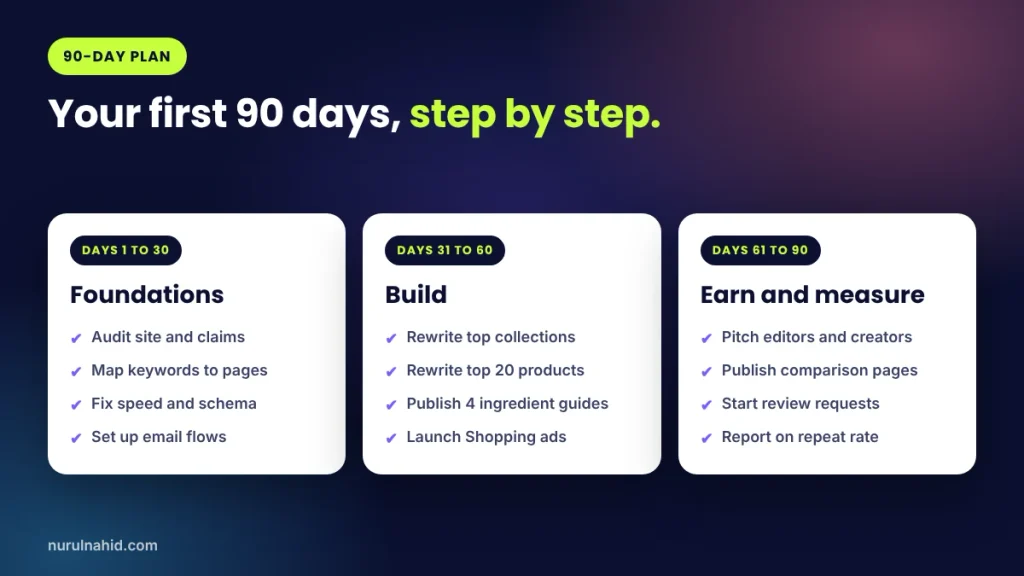
Review the numbers at day 90, keep what worked and cut what did not. My post on how long SEO takes in the UK sets out typical timelines.
What to measure each month
Pick a small set of numbers and review them on the same day each month. Too many metrics hide the ones that matter.
| Area | Metric | Where to find it |
|---|---|---|
| SEO | Non-brand organic clicks and revenue | Search Console and GA4 |
| SEO | Collection pages on page one | Search Console or a rank tracker |
| AI search | Recommendation rate across your prompt set | Your weekly prompt log |
| AI search | Sessions and sales from AI referrals | GA4 referral report |
| Paid | Cost per new customer, by channel | Ad platforms and your store data |
| Retention | Repeat purchase rate at 90 and 180 days | Store or email platform |
| Trust | New reviews per month and average rating | Review platform |
AI referral traffic is still small for most stores, so do not judge it on volume alone. Look at whether those visitors buy.
Budget: where the money goes
There is no single right budget. The split depends on your stage, margin and how many customers already reorder.
Example split for a brand spending £3,000 a month (a worked example to show the maths, not a quote):
| Channel | Share | Monthly spend |
|---|---|---|
| SEO and content | 30% | £900 |
| Paid search and Shopping | 25% | £750 |
| Paid social | 20% | £600 |
| Creators and UGC | 15% | £450 |
| Email and SMS tools | 10% | £300 |
| Total | 100% | £3,000 |
Newer brands often lean more on paid and creators to build awareness. Established brands can shift more into SEO and retention.
For typical agency and consultant fees, see my guide to SEO costs in the UK.
How I can help with the full plan
Channels work best when one person plans them together. I connect search, paid, email and social around one set of numbers and one message.
Have a look at my digital marketing service to see how I plan and report across channels.
Case study: a luxury brand that grew from almost no search traffic to 2,000+ monthly clicks
I do not have a published skincare case study yet, so here is the closest one. It is from a different sector and country.
Carla Schall Design is a luxury calligraphy and engraving brand in Florida. It had a strong offline name and almost no search presence.
The work covered technical SEO, service page content, local SEO, citations and AI search visibility over four months.
Results, taken from Google Search Console:
- 2,000+ monthly organic clicks within four months, from almost none
- Page one for its core calligraphy and luxury stationery keywords
- 20+ service keywords featured in Google AI Overviews and AI citations
The pattern matches what a skincare brand needs: a premium product, a clear niche, strong pages and visibility in AI answers.
Read the full Carla Schall Design SEO case study, or browse all my SEO case studies.
Related guides
- Ultimate Marketing Guide for Jewellery Stores in the UK
- SEO vs GEO: what is the difference?
- Top 5 Shopify SEO experts in London
FAQ: SEO and marketing for skincare brands
How long does SEO take for a skincare brand?
Most brands see early movement on specific, long-tail searches within three to six months. Competitive collection terms usually take longer.
Results depend on your starting point, competition and how quickly changes go live.
How much should a UK skincare brand spend on marketing?
There is no fixed figure. Work out your margin per customer over 12 months, then decide what share you can spend to win one.
The worked example in Part 3 shows the maths.
Can a small skincare brand compete with big names on Google?
Yes, on specific searches. Big brands and retailers hold broad terms like “moisturiser”.
Smaller brands can rank for precise needs, such as a fragrance-free product for a named skin type or concern.
How do I get my skincare brand recommended by ChatGPT?
Make product facts clear on your own site, collect real reviews, and earn mentions in beauty publications and expert sources.
Then track a set of shopper-style prompts each week. No one can guarantee a mention.
What skincare claims can I make in UK advertising?
You can make cosmetic claims you hold evidence for, such as reducing the appearance of fine lines. Avoid medicinal claims and claims of physiological change.
Check the ASA and CAP guidance and take specialist advice.
Do I need a dermatologist to review my content?
It is not a legal requirement for content. A named, qualified reviewer does build trust with shoppers and supports E-E-A-T.
Only state that an expert reviewed a page if they did.
Is TikTok Shop worth it for a skincare brand?
It can be. NIQ data shows beauty is the largest category on TikTok Shop.
It suits lower price points and creator-led content, so test it with one or two products before committing stock.
Should skincare brands use dupe keywords?
You can target “alternative to” searches with honest comparison pages. Compare ingredients, price per ml and texture fairly.
Do not claim your product is identical to another, and do not mislead shoppers about a rival.
Ready to grow your skincare brand?
You built a product people trust on their skin. You should not lose sales because shoppers and AI tools cannot find it.
The problem is rarely the product. It is unclear pages, slow templates, risky claims and too few mentions in the places that count.
I can be your guide. Here is the plan:
- Book a free call. Tell me about your range, your margins and your goals.
- Get a clear audit. I review your SEO, AI visibility and claim wording, and rank the fixes.
- Follow a 90-day plan. We fix the foundations, build the pages and track what moves sales.
The aim is a store that ranks for the right searches, appears in AI answers and earns repeat orders. I cannot promise rankings, and no honest consultant can.
Book a free consultation or message me on WhatsApp.