SEO for activewear brands works best in three steps. First, build collection and product pages that match how people search: by activity, fit and fabric.
Second, fix your technical base and product data so Google and AI tools can read every item. Third, earn proof from reviews, creators and press, then add email, paid and community marketing around it. Online made up 29.4% of GB retail sales in June 2026, so shoppers compare brands before they reach your site. This guide gives you the full plan: search, AI citations and a 90-day marketing plan.
Written by Nurul Nahid, an SEO and AI search consultant in the UK with 7+ years of experience in e-commerce SEO, GEO and AEO.
At a glance
- 29.4% of GB retail sales were made online in June 2026, the highest share since April 2021 (ONS, 2026).
- 11.7% growth in online spending values in Q2 2026 compared with Q2 2025 (ONS, 2026).
- 35% of the UK’s top 100 fashion retailers now charge for returns, up from 23% in 2023 (Ingrid, Return Economics 2026).
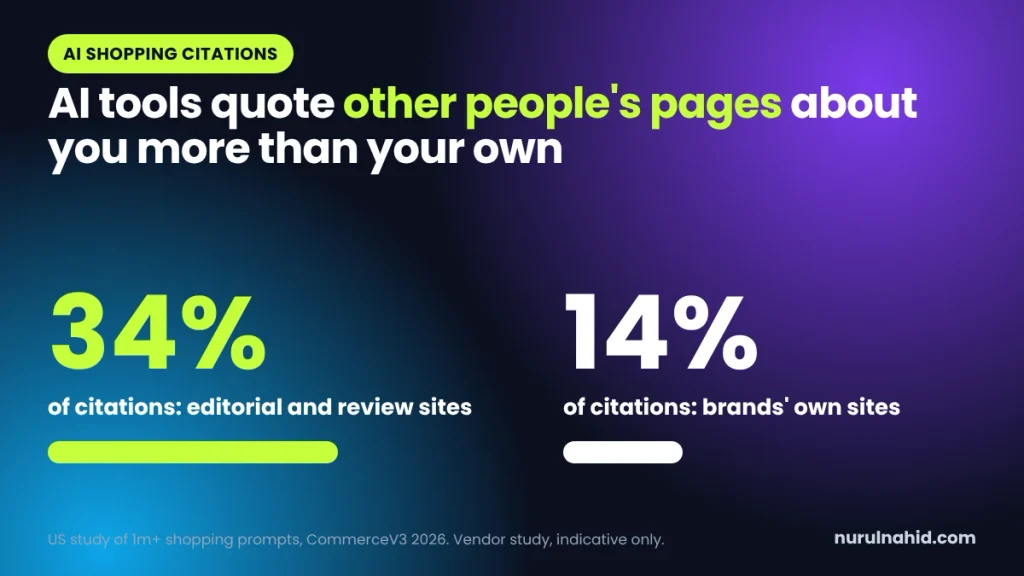
- 14% of AI shopping citations pointed to brands’ own sites in a US study of 1 million+ prompts, while editorial and review sites took 34% (CommerceV3, 2026; the firm sells AI visibility services).
- 27 May 2026: Google announced AI performance insights in Merchant Center, but the first rollout list does not include the UK (Google, 2026).
Part 1: SEO for activewear brands (guide 2027)
Activewear shoppers search by activity, problem and fit, not only by product name. Win those searches with clear collection pages, rich product pages, fast templates and complete product data.
The big names own broad terms like “leggings”. Your openings are narrower, more useful searches.
Why activewear SEO is different
Activewear mixes fashion and performance. Shoppers care how it looks and how it works, so your pages need both emotion and proof.
Three things set it apart from other ecommerce niches:
- Fit drives everything. Sizing doubt is the main reason for abandoned baskets and returns.
- Big brands dominate broad terms. Nike, Adidas and Gymshark take most “leggings” searches, so smaller brands win on specifics.
- Social proof is visual. People trust what they see on real bodies, which makes UGC part of SEO, not only social.
That means your plan should be narrow and specific first. Own a fit, a fabric, an activity or a community, then widen.
Find your niche inside the niche
A smaller brand rarely beats the giants on “gym leggings”. It can beat them on a clear angle that the giants ignore.
Examples of angles that have search demand:
- Tall and petite fits, with inseam lengths shown.
- Maternity, postpartum and menopause-friendly ranges.
- High-support sports bras for larger busts.
- Modest activewear and layering.
- Cold-weather running and cycling kit.
- Sustainable fabrics with clear percentages.
Pick one or two and build a full set of pages around them: a collection, a guide, a size help page and customer stories. Search engines and AI tools then learn what you are known for.
How UK shoppers search for activewear
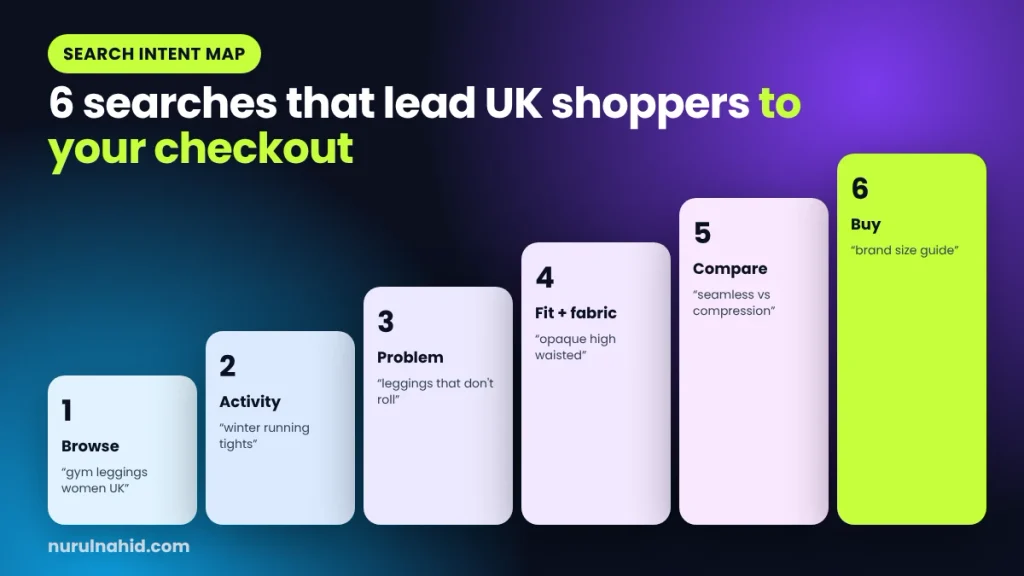
People move from broad to specific as they get closer to buying. Your site needs a page for each step.
| Search stage | Example search | Page that should answer it |
|---|---|---|
| Browse | gym leggings women UK | Collection page |
| Activity | running tights for winter | Activity collection or guide |
| Problem | leggings that don’t roll down | Guide linking to products |
| Fit and fabric | high waisted leggings opaque squat test | Product page with fabric and fit detail |
| Compare | seamless vs compression leggings | Comparison guide |
| Buy | [brand] leggings size guide | Product page and size guide |
Use British terms in titles and copy: gym kit, trainers, joggers, tracksuit, UK sizes. Show prices in pounds, including VAT.
Keyword research for activewear brands
Start with what you already sell. Pull queries from Google Search Console, then add ideas from search suggestions, customer emails and review text.
Group keywords by the page that should rank, not by volume alone. Each page gets one main term and a few close variants.
My UK keyword research guide walks through the process step by step.
| Page type | Example keywords to test | Main intent |
|---|---|---|
| Category | gym leggings, sports bras, running shorts | Browse and compare |
| Sub-category | high impact sports bra, men’s running tights | Narrow the choice |
| Fabric or feature | seamless leggings, sweat wicking t shirts | Check the detail |
| Fit guide | sports bra sizing UK, leggings size guide | Reduce doubt |
| Activity guide | what to wear for hot yoga, winter running kit | Learn, then buy |
These are examples only. Search volume and difficulty were not available for this guide, so validate each term in a keyword tool before you commit.
Collection page SEO
Collection pages carry most of your commercial traffic. Treat each one as a landing page, not a product dump.
Open with a short intro that says who the range is for and what makes it different. Keep the products above it or directly beneath it.
Use this checklist on every collection:
- One clear H1 with the main keyword in natural words.
- A 60 to 100 word intro above the grid, with a longer buying guide below it.
- Filters for size, colour, fit and activity that do not create thousands of crawlable URLs.
- Links to related collections, such as leggings to sports bras and matching sets.
- Unique title tag and meta description that mention a real benefit.
- Pagination and sorting that Google can follow without duplicate pages.
Product page SEO
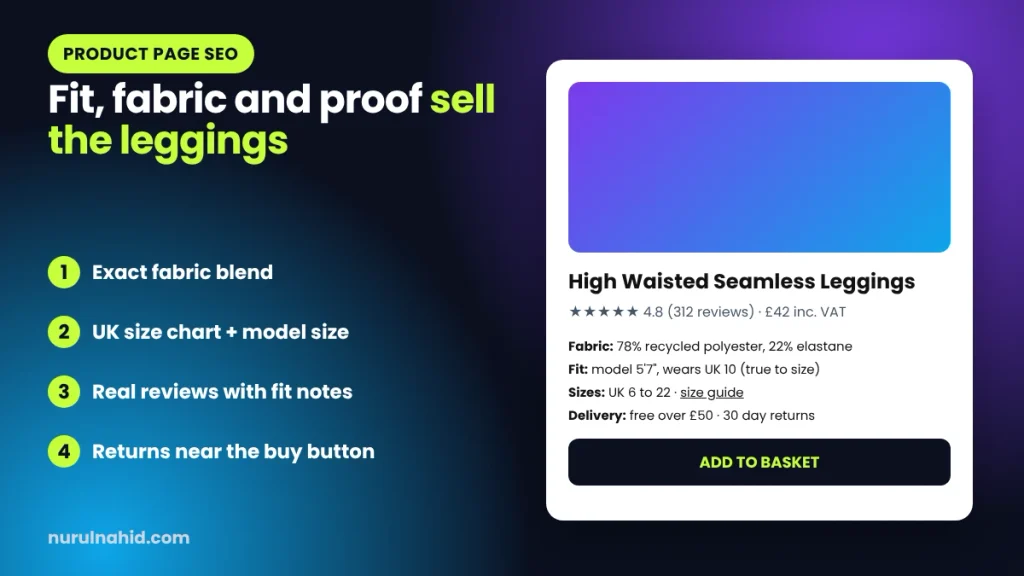
A product page must answer the questions that stop a sale. Fit, fabric, opacity, support level and returns come first.
Write for the person standing in front of the screen unsure about size. Specific details beat adjectives.
| Element | What good looks like |
|---|---|
| Title | Product type, key feature, gender or fit, such as “High Waisted Seamless Gym Leggings” |
| Description | Who it is for, activity, fabric blend, fit notes, care |
| Fit information | Model height and size worn, UK size chart, stretch and rise |
| Fabric | Exact blend, such as “78% recycled polyester, 22% elastane”, plus weight and feel |
| Images | Front, back, movement shots, close-up of fabric, real customer photos |
| Reviews | Verified reviews with fit feedback, such as “true to size” tags |
| Delivery and returns | Cost, speed and return window in plain words near the buy button |
Fit uncertainty is the main driver of fashion returns, and return rates in UK fashion are often put at 25% to 40% (Ingrid, 2026). Better fit content protects margin as well as rankings.
Size guides and fit content that rank
Size guides are among the most useful pages on an activewear site, and most are an image buried in a popup. Build them as real, crawlable pages or on-page sections.
Include a UK size chart in centimetres and inches, how to measure, and fit notes by product type. A sports bra needs band and cup guidance, while leggings need waist, hip and rise.
Add the model’s height and the size they wear on every product. Then add “fits true to size” or “size up for compression” from review data.
This content answers searches such as “sports bra size guide UK” and cuts returns at the same time. Link it from every product page, close to the size selector.
Fabric and performance content
Shoppers want to know how the kit behaves, not how it is described. Fabric detail is your chance to show expertise that big brands skip.
Explain the differences in plain English:
- Nylon blends: soft, smooth and durable, often chosen for leggings.
- Polyester blends: quick drying and good for running tops and shorts.
- Elastane: gives stretch and recovery, and the percentage changes how supportive the fabric feels.
- Bamboo and cotton blends: softer and more breathable, often for studio and everyday wear.
Back each point with your own tests: the squat test, the stretch test, the wash test. Photos and short clips of real tests build trust faster than adjectives.
Handling colour and size variants
Most activewear comes in many colours and sizes. Keep one canonical page per parent product unless a variant has real search demand.
Give each variant its own image, stock status and URL parameter if needed. Tell Google which products are variations of one item using product variant markup.
Do not index thin pages for every colour. A “black seamless leggings” page is fine if people search for it and you can add useful content.
Technical SEO and Core Web Vitals
Activewear sites are image heavy, which makes speed the first thing to check. Google’s good thresholds are LCP of 2.5 seconds or less, INP of 200 milliseconds or less and CLS of 0.1 or less, measured at the 75th percentile of real visits (web.dev).
Focus on the fixes that matter most for fashion stores:
- Compress hero and product images, and serve modern formats such as WebP or AVIF.
- Set width and height on images so the page does not jump while loading.
- Limit third-party scripts from reviews, chat, popups and tracking.
- Lazy-load images below the fold, but never the main product image.
- Control faceted navigation so filters do not create endless crawl paths.
- Keep one XML sitemap of indexable products and collections.
My technical SEO checklist for UK sites covers crawling, indexing and speed in more detail. A hands-on SEO review can show you which of these affect your store.
Product, Review and merchant structured data
Structured data helps Google understand price, stock, sizes, shipping and returns. Google separates two uses: product snippets for pages where people cannot buy, and merchant listings for pages where they can (Google Search Central).
Merchant listings support apparel sizing, shipping details and return information. You can also mark up a store-wide return policy under your Organization data.
Add these to every product template:
- Product name, description, brand, SKU and GTIN where you have one.
- Offer with price in GBP, availability and condition.
- Review and aggregate rating, using only genuine reviews shown on the page.
- Shipping and return details that match the visible policy.
- Size and colour for each variant.
Test with Google’s Rich Results Test and check the Merchant Listings report in Search Console. Mark up only what is visible on the page.
Internal search, filters and crawl control
Filters help shoppers, but they can create thousands of near-duplicate URLs. Decide which filtered pages deserve to rank and block the rest.
A filtered page for “black high waisted leggings” may have real search demand. A page filtered by size 12 and sort by price does not.
Keep a simple rule set:
- Index filter combinations only where people search for them and you have enough products.
- Use canonical tags on all other combinations.
- Keep parameters out of internal links where you can.
- Check Search Console for “Crawled, currently not indexed” and “Duplicate” reports each month.
Also review your internal site search. The terms shoppers type there often show missing pages, such as “maternity leggings” or “tall sizes”.
Seasonal planning for activewear
Demand moves through the year, and search pages take time to rank. Plan content and collections three to four months ahead of the peak.
| Period | Typical demand | Action |
|---|---|---|
| January | New year fitness goals | Refresh beginner guides and starter bundles in November |
| March to May | Spring running and marathon training | Publish running kit and training guides early in the year |
| June to August | Lightweight, outdoor and holiday kit | Update shorts, vests and breathable fabric pages |
| September to October | Back to routine, cooler running | Layering and winter running content |
| November to December | Sales and gifting | Gift guides, size help and clear delivery cut-off dates |
Keep seasonal URLs permanent and update them each year, rather than creating a new page every season. Old pages hold the links and history.
Not sure your store outputs complete product data? Themes and plugins often add partial Product markup, with shipping, returns or size details missing, and the errors only show in Search Console weeks later. In my free SEO audit I check your collection and product templates, structured data, Core Web Vitals and which pages Google actually indexes, then send you a ranked fix list. Get your free SEO audit
A content hub that earns trust
Guides do two jobs. They catch searches before shoppers know which brand to buy, and they give AI tools and journalists something worth citing.
Write from real experience: your own wear tests, fit notes, fabric knowledge and customer questions.
| Content | Example topic | Links to |
|---|---|---|
| Fabric guide | Nylon vs polyester vs bamboo for gym wear | Fabric collections |
| Fit guide | How a sports bra should fit, band and cup | Sports bra collection |
| Activity guide | What to wear for your first half marathon | Running collection |
| Care guide | How to wash leggings so they last | Leggings collection |
| Comparison | High waisted vs mid rise leggings for lifting | Both collections |
Show the author, the date and what you tested. Update the page when your products change.
Links, press and community mentions
Links still help, and brand mentions help AI tools learn who you are. Aim for relevant UK sources, not volume.
Good targets include running clubs, gym and studio partners, fitness and women’s health writers, local event organisers and sports press. Product loans to genuine creators can lead to links, but they must be labelled correctly (see Part 3).
My UK link building guide explains how to earn links without buying them.
Claims you must be able to prove
Activewear marketing leans on words like “sustainable”, “recycled” and “squat proof”. UK regulators expect proof behind them.
The CMA’s fashion guide says broad terms such as “green”, “sustainable” or “eco-friendly” are much more likely to mislead. It asks brands to describe fabrics precisely, for example “recycled polyester” (CMA, 2024).
In January 2026 the CMA added guidance on who is responsible for green claims across the supply chain. Retailers and brands can both be liable (CMA, 2026).
A safe checklist for product copy:
- Say what the fabric is and what percentage is recycled or organic.
- Explain any comparison, such as “uses 30% less water than our previous range”, and keep the evidence on file.
- Avoid leaf icons or green imagery unless the claim behind them is clear.
- Test performance claims, such as opacity, before you publish them.
Branded search and your own name
When people hear about you from a creator or a friend, they search your brand name. That search should show a clean, helpful result.
Check what appears when you search your brand: your site, your socials, reviews, press and any marketplace listings. Claim your Google Business Profile if you have a physical shop or studio.
Make sure your About page says who you are, where you are based, who makes the kit and how to contact you. Trust signals reduce doubt for first-time buyers and give AI tools facts to quote.
Branded searches also act as a health check. If they grow month on month, your creator, press and community work is paying off.
Part 2: How to get activewear brands recommended by ChatGPT, Perplexity and Google AI Overviews
The short answer: AI tools recommend brands they can verify from several independent places. Clear product pages, honest reviews, press mentions and community discussion all feed that picture.
There is no switch to flip. You earn recommendations by being easy to understand and widely mentioned.
How AI tools choose which activewear brands to name
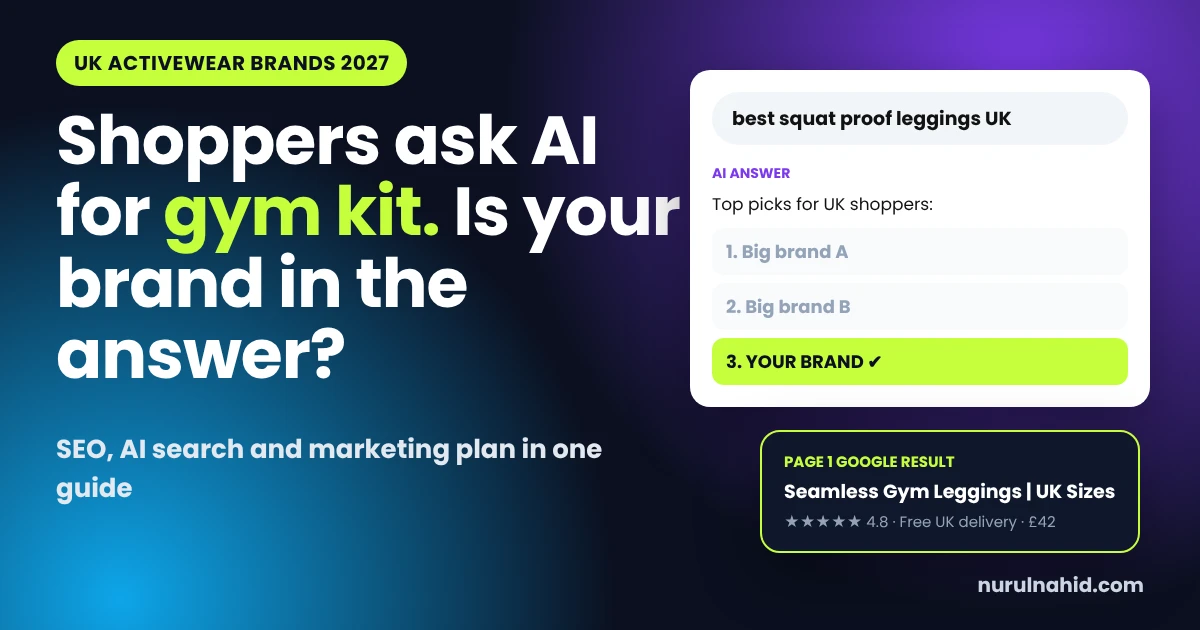
AI answers pull from live search results, shopping data and sources the model already trusts. A shopper asks “best squat proof leggings UK” and the tool assembles a short list.
Early studies show where those lists come from. A US analysis of more than 1 million shopping prompts found that 14% of citations pointed to brand sites, while editorial and review sites took 34% (CommerceV3, 2026).
The firm sells AI visibility services, so treat the exact split as indicative.
The lesson holds either way: your own site is only one of the sources. Other people’s pages about you carry real weight.
| Source type | Why AI tools use it | What you can do |
|---|---|---|
| Your product and collection pages | Facts on fabric, fit, price, stock | Complete, specific, current copy and product data |
| Editorial and review sites | Independent opinion and comparison | Send samples to reviewers and fitness writers |
| Reddit and forums | Honest user experience | Take part openly, never fake accounts |
| Review platforms | Volume of customer feedback | Collect verified reviews on a steady schedule |
| Video and creator content | Demonstrations and wear tests | Support creators with accurate product information |
| Press and lists | Third-party validation | Pitch data, founder stories and range launches |
What shoppers actually ask AI tools
People ask AI tools full questions, often with a constraint. Knowing the pattern helps you write pages that answer them.
Common activewear prompts include:
- “Best squat proof leggings under £50 in the UK”
- “Sports bra for large bust running that doesn’t bounce”
- “Sustainable gym wear brands that ship to the UK”
- “Leggings with pockets that fit a phone”
- “Alternatives to Gymshark with longer inseams”
Each prompt has a product need, a constraint and a place. Pages that state price range, size range, features and UK delivery clearly are easier to match.
Write a short section on each key product page that says who it suits. For example: “Best for lifting and studio classes. Not designed for running in heavy rain.”
Make your pages easy for AI tools to quote
Answer-first writing helps both Google and AI tools. Put the direct answer in the first sentence under each heading, then add the detail.
Product pages should state facts plainly. “Made from 78% recycled polyester and 22% elastane, with a high rise and a 28 inch inseam” is quotable. “Premium performance fabric” is not.
Useful habits for every key page:
- Lead with the answer, then explain.
- Use real numbers: fabric percentages, sizes, weights, prices.
- Name who the product suits and who it does not.
- Keep headings as questions people actually ask.
- Show the date of the last update.
My AEO optimisation service turns these habits into a structured rewrite of your key pages.
Structured data and FAQs: useful, but know the limits
Schema is good hygiene because it removes guesswork about prices, availability and reviews. Keep it accurate and complete.
Do not expect markup alone to win AI citations. An Ahrefs test found that adding schema did not produce a reliable lift in AI mentions, so treat it as a base layer, not a growth lever (Ahrefs, 2026).
FAQ rich results have also gone from Google. Google ended FAQ rich results in May 2026, though the content itself still helps readers and AI tools (Search Engine Roundtable, 2026).
Write FAQs because customers ask them. Place them on product pages for fit, care and delivery, and in guides for wider questions.
Keep your brand facts consistent everywhere
AI tools build a picture of your brand from many pages. If those pages disagree, the picture gets blurry.
Use the same brand name, description, founding date, location and product range everywhere: your site, social profiles, marketplaces, review platforms and press kits. Add an Organization schema block that matches.
Write a short, factual “about” paragraph and reuse it. Include what you make, who it is for and what makes it different, in plain words.
Reviews and customer language
Reviews give AI tools the plain-English evidence that marketing copy cannot. They show fit, comfort, opacity and durability in shoppers’ own words.
Since 6 April 2025, the Digital Markets, Competition and Consumers Act bans fake reviews and hiding negative ones. Fines can reach 10% of global turnover (CMA, 2025).
Collect reviews the honest way:
- Ask every buyer, not only happy ones.
- Send the request after enough wear time, usually 10 to 14 days.
- Ask fit questions: height, size bought, usual size, true to size or not.
- Publish negative reviews and reply helpfully.
- Never pay for or write reviews yourself.
Reddit, communities and PR mentions
Community talk shapes what AI tools say, because real discussions show real opinion. Brands that are honestly recommended on Reddit, in running clubs and in lifting forums tend to appear more often.
Join as a person, say who you are and answer questions. Do not drop links or run fake accounts. Platforms ban that and shoppers spot it fast.
Press and lists matter too. Pitch journalists something specific: wear-test results, a fabric innovation, a customer story or a sizing change. A line in a trusted “best leggings UK” roundup can carry far more weight than another blog post of your own.
Marketplaces and merchant data
Shopping answers draw on product feeds. Keep your Google Merchant Center feed accurate, with correct titles, GTINs, sizes, colours, prices and shipping.
On 27 May 2026 Google announced AI performance insights in Merchant Center. The first rollout list does not include the UK, so check your account before you plan around it (Google, 2026).
If you sell on Amazon, Zalando or similar marketplaces, use the same product names and specifications everywhere. Mixed data makes you harder to describe.
Track your AI visibility
You cannot rank-track AI answers the way you track Google. You can still measure progress with a simple weekly routine.
- Write 20 to 30 prompts real shoppers might use, such as “best sports bra for running UK”.
- Run them weekly in ChatGPT, Perplexity, Gemini and Google AI Mode.
- Log whether your brand appears, in what position and with what description.
- Note which sources are cited and which competitors appear.
- Record the recommendation rate: prompts where you appear divided by prompts tested.
Responses vary between runs, so look at trends over a month rather than a single result. The cited sources list is the most useful part: it tells you which sites to approach next.
A simple 30-day AI visibility sprint
You can start improving AI visibility in a month without a large budget. Keep the work small and measurable.
- Week 1: run your prompt list and record the baseline, including cited sources.
- Week 2: rewrite your top five product or collection pages with answer-first openings and exact fabric and fit facts.
- Week 3: ask 20 recent customers for honest reviews, and pitch two journalists or bloggers with a specific story.
- Week 4: run the prompts again, compare, and note which new sources appear.
Repeat the cycle each month. Small, steady gains in reviews and mentions add up faster than one big push.
Want your baseline before you build the log yourself? I run a prompt audit across ChatGPT, Perplexity, Gemini and Google AI Mode, show which brands are recommended for your shoppers’ questions and list the sources they cite. You then know exactly which pages and mentions to build first. See how my GEO optimisation works
Part 3: A total marketing plan for UK activewear brands
The short answer: use search to capture demand, then use email, paid ads, creators and community to create it. Set a budget, measure on net revenue after returns, and add one channel at a time.
Great product pages only help when people reach them. This part shows how the channels work together.
Set a budget that matches your margin
Many small ecommerce brands plan marketing spend as a share of revenue. Ten per cent is a common starting point, but your own margin decides what you can afford.
Here is a worked example, not a benchmark. A brand with £20,000 in monthly revenue and a 10% marketing budget has £2,000 to spend.
| Channel | Monthly budget | Main job |
|---|---|---|
| SEO and content | £700 | Compounding organic sales |
| Google Shopping and Search | £500 | Capture buyers who are ready |
| Meta ads | £400 | Reach new audiences and retarget |
| Email and SMS tools | £150 | Turn buyers into repeat customers |
| Creators and UGC | £250 | Product seeding, content and proof |
| Total | £2,000 |
Know your break-even before you spend on ads. Break-even ROAS is 1 divided by your gross margin. At a 55% margin that is 1 ÷ 0.55, or about 1.82.
Work it out on net revenue after returns, because a sale that comes back earns nothing. High return rates make this step essential for fashion.
Two returns facts matter for planning. 35% of the UK’s top 100 fashion retailers now charge for returns, up from 23% in 2023 (Ingrid, 2026). If you charge, say so clearly before checkout, as hidden fees damage trust.
Convert more of the visitors you already have
More traffic only pays when the site converts. Small checkout and product page fixes often beat extra ad spend.
Check these first:
- Delivery and returns shown near the buy button, not hidden in the footer.
- Guest checkout and wallet payments such as Apple Pay and PayPal.
- Size help that opens without leaving the page.
- Clear stock messages, such as “only 3 left in size M”.
- Fast mobile pages, since most fashion browsing happens on phones.
- Real customer photos near the first image gallery.
Test one change at a time and give each test enough visits to mean something. Record the result so the team learns what works for your shoppers.
Email and SMS: your highest-return channel
Email and SMS sell to people who already know you, so they usually cost less than ads. Build them before you scale paid spend.
Start with these flows:
- Welcome series: your story, best sellers, fit guide and a clear first-order reason to buy.
- Abandoned basket: a reminder with the product image, size help and returns information.
- Post-purchase: care tips, how to style it, then a review request after 10 to 14 days.
- Back in stock: alerts for sizes and colours that sold out.
- Win-back: a message after 60 to 90 days with new arrivals.
UK rules apply. Under PECR you need consent for marketing emails and texts, with narrow exceptions for existing customers selling similar products. Every message needs a simple way to opt out (ICO).
Paid ads: Google Shopping and Meta
Paid search captures shoppers who are already looking. Meta finds people who do not know you yet. They do different jobs, so judge them differently.
Google Shopping and Performance Max. Your product feed is the ad. Strong titles, accurate prices, sizes and clean images decide how often you appear.
Start with your best sellers and a modest daily budget. Exclude low-margin and high-return products until the account has data.
Meta (Facebook and Instagram). Short video that shows movement, fit and fabric works well for activewear. Test creator content against studio shots.
Use retargeting to follow up product page visitors and basket abandoners. Keep prospecting and retargeting in separate campaigns so you can see what each delivers.
| Metric | What to watch | Warning sign |
|---|---|---|
| ROAS | Against your break-even figure | Below break-even for 2 weeks |
| Cost per new customer | Against first-order margin | Rising while conversion falls |
| Return rate by product | High-return items in ad sets | Ads pushing products that come back |
| Feed errors | Merchant Center diagnostics | Disapproved products |
My digital marketing service covers paid search, email and conversion work alongside SEO, so the channels share data instead of competing.
Social, creators and user-generated content
Activewear sells through belonging and proof. People want to see the kit on bodies like theirs, in real sessions.
Gymshark built its early growth on athlete and creator partnerships and a strong community. You do not need that scale to borrow the principle: show real people using your products and make them easy to find.
Practical ways to start:
- Send product to local run clubs, gym coaches and studio instructors.
- Ask customers for photos and share the best ones, with permission.
- Film simple wear tests: squat, stretch, run, wash.
- Put customer photos on product pages so shoppers see real fit.
- Build a small community, such as a challenge or a group run.
Label paid and gifted content. The ASA and CMA require clear disclosure of ads and incentives, including gifted products. Use “#ad” or the platform’s paid partnership tool at the start of the post, not hidden in a hashtag list (ASA).
Ask creators to follow the same fabric and performance claim rules as your own site. If they say “squat proof”, you need to be able to show it.
Loyalty, referrals and repeat purchase
Winning a second order usually costs less than winning the first. Activewear suits repeat buying because people replace worn kit and build outfits.
Ways to encourage a second purchase:
- Suggest matching pieces on the product page and in the order confirmation.
- Send a size and care guide that helps the first item last.
- Offer early access to new drops to people on your list.
- Run a simple referral scheme with a reward for both sides.
- Ask for feedback and use it to improve the range.
Track repeat purchase rate and customer lifetime value. These tell you how much you can afford to pay to win a new customer.
Measure what matters
Set up measurement before you spend. Without it you will not know which channel earned the sale.
Use GA4 with ecommerce events, Search Console and your platform’s reports. Add UTM tags to email, creator links and ads so each source shows up properly.
A monthly dashboard should show:
- Organic sessions, impressions and clicks for collections and products.
- Conversion rate by channel and device.
- Revenue per visitor and average order value.
- Return rate by product and by channel.
- Email and SMS revenue as a share of total.
- Your AI mention rate from the weekly prompt log.
Look at trends over a quarter. A single week can mislead, especially around sales events.
Common mistakes to avoid
These problems appear often on activewear sites, and each is fixable.
- Thin collection pages with only a grid and no intro or buying help.
- Duplicate product copy copied from the supplier.
- Vague claims such as “eco-friendly” with no fabric detail.
- Heavy pages with oversized images and many scripts.
- Hidden returns information that appears only at checkout.
- Ignoring reviews, or showing only the positive ones.
- Scaling ads before email, tracking and product pages are working.
Fixing the first four usually lifts both rankings and conversion rate. That is why the audit starts there.
Marketplaces and retail partners
Marketplaces give reach but take margin and control. Use them to test products and reach new buyers, not as your only channel.
If you list on Amazon, Zalando or a department store site, keep product names, sizes and specifications identical to your own site. Send those buyers into your email list with a card or insert, where the platform’s rules allow it.
Pop-ups, events and local stockists also help a young brand build trust. A single run-club collaboration can bring dozens of first-time buyers who know someone wearing your kit.
Your 90-day plan
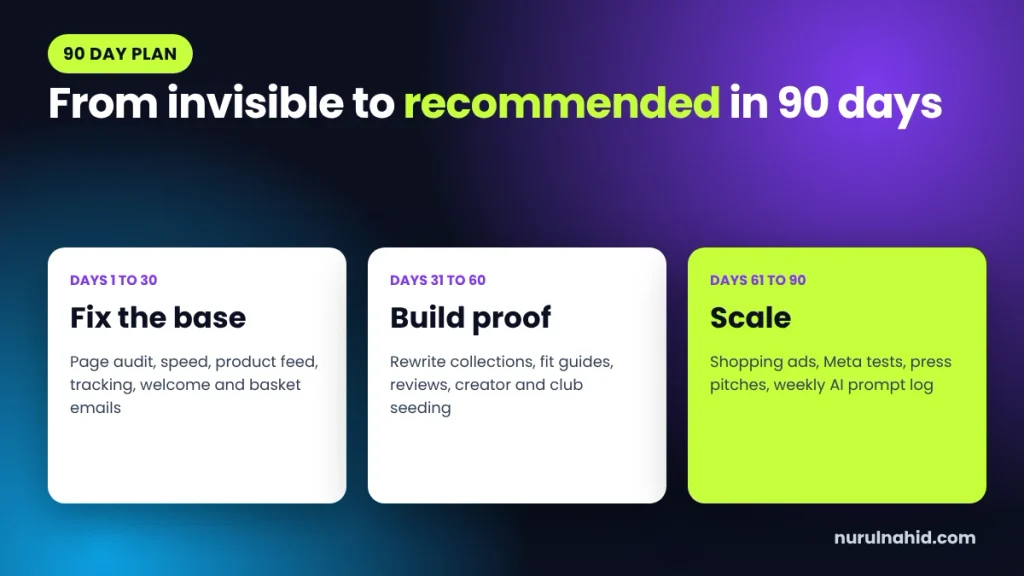
Do not launch everything at once. Add channels in order and keep a weekly rhythm.
| Days | Focus | Key actions |
|---|---|---|
| 1 to 30 | Fix the base | Audit collections and product pages, repair speed and feed errors, set up tracking, launch welcome and basket emails |
| 31 to 60 | Build proof | Rewrite top collections, publish two fit or fabric guides, start a review programme, seed product to 10 creators or clubs |
| 61 to 90 | Scale what works | Launch Google Shopping on best sellers, test Meta creative, pitch two press or list features, run your first AI visibility prompt log |
Review results every week. Keep the numbers simple: organic sessions, conversion rate, revenue per visitor, return rate, email revenue and AI mention rate.
Want this plan built around your own numbers? Your margin, return rate and best sellers change the budget split and which channel goes first. Bring your last three months of sales and ad data to a consultation and we will turn the table above into a plan for your brand. Book a consultation
A real case study from another sector
Most activewear brands ask whether SEO works for a visual, product-led business. This example comes from a different sector, so use it as proof of method, not a promise of your result.
Masha Sakhno is a wedding photographer in Oahu. Like an activewear brand, she sells something people judge by how it looks, so the site needed strong imagery and clear service pages.
Over 12 months her organic users grew from about 220 to 1,400 a month, around five times the traffic. You can read the full story in her case study.
The lesson for activewear: clear pages, consistent structure and steady publishing compound over time.
Frequently asked questions
How much does SEO for activewear brands cost in the UK?
It depends on store size and how much content you need. My published e-commerce SEO pricing starts with a one-off £500 audit and a £800 monthly growth plan, with custom plans for larger stores. Check the e-commerce SEO page for current prices.
How long does SEO take for an activewear store?
Expect early gains in 3 to 4 months on well-targeted pages, with bigger results at 6 to 12 months. Competitive terms like “leggings” take longer than specific ones like “seamless gym leggings for lifting”.
My guide to how long SEO takes in the UK explains the factors.
Do I need blog content as well as product pages?
Yes, but only content that answers real questions. Fit, fabric, care and activity guides support your collections and give AI tools something to quote.
Is Shopify or WooCommerce better for activewear SEO?
Both can rank well. Shopify is simpler to run and fast by default. WooCommerce gives more control but needs more technical care. Choose on how you work, then fix the templates.
How do I get my activewear brand recommended by ChatGPT?
Make your product pages specific, collect honest reviews and earn mentions on trusted sites and communities. Then track a set of weekly prompts to see progress. My GEO guide covers the process.
Does schema markup help AI recommend my brand?
It helps search engines read your product data, but tests show it is not a reliable lever for AI citations. Use it for accuracy and focus effort on reviews, mentions and clear content.
What is a good ROAS for activewear?
A good ROAS is one above your break-even. Divide 1 by your gross margin, using net revenue after returns. At a 55% margin, break-even is about 1.82.
Can I use influencer marketing without breaking UK rules?
Yes, with clear labelling. Gifted products and paid posts must be flagged as ads, and the claims in the content must be true.
Should I charge for returns?
It is a business decision. More UK retailers are doing so, but it can reduce conversion. Test it, state it clearly and improve fit content to cut returns at the source.
Can you help my activewear brand grow online?
Yes. I work with UK online stores on SEO, AI search and digital marketing. Book a meeting and we will look at your store together.
Ready to grow your activewear brand?
You make kit people love. But when a shopper searches “squat proof leggings UK” or asks ChatGPT for a brand, you may not be in the answer.
I’m Nurul Nahid, and I help UK online stores fix exactly that. Here is how we would start:
- Free SEO audit: I review your collections, product pages, speed, product data and AI visibility.
- Your plan: you get a ranked list of fixes and a 90-day plan for SEO, AI search and paid, email and creator channels.
- Growth: we put the plan to work, one channel at a time, and track sales after returns.
Get your free SEO audit or book a consultation. If you prefer, message me on WhatsApp.
Every month you wait, competitors keep collecting the searches and recommendations your brand should win. In 90 days you could have faster pages, stronger collections and a plan you trust.