SEO for jewellery stores means giving every search its own page, proving trust with hallmarking, reviews and clear returns, then earning mentions that AI assistants can quote.
Start with collection pages, product markup and fast mobile pages. Add answer-first guides and honest third-party proof for AI search.
Then run email, Google Shopping and Meta around Valentine’s Day, Mothering Sunday and Christmas. This guide gives the full UK plan for 2027, with a 90-day schedule and a worked budget example.
I’m Nurul Nahid, an SEO and AI search expert in the UK with 7+ years of experience in SEO, local SEO, e-commerce SEO, GEO, AEO and digital marketing.
I help UK online stores, including jewellery sellers, rank product and collection pages through my e-commerce SEO service.
At a glance
- 28.8% of Great Britain’s retail sales were made online in September 2026, down from 28.9% in August (ONS, 23 October 2026). This is all retail, not jewellery alone.
- Online jewellery sellers must show hallmark information. GOV.UK says online retail sites must prominently display explanatory information about the hallmark.
- Fake and hidden-incentive reviews are banned. The ban sits in the Digital Markets, Competition and Consumers Act 2024, and the CMA’s guidance is dated 4 April 2025.
- Answer-first pages were cited more often. In one agency study of 193,507 AI answers, 23% of cited pages opened with a direct answer, against 14% of retrieved pages that were not cited. It is correlation, not proof.
Part 1: SEO guide 2027 for jewellery stores
Jewellery SEO in 2027 comes down to four jobs: one page per search, trust proof on every product page, a clean technical base and answers before buyers ask.
Do those well and you rank, convert and get quoted. The sections below take each job in turn.
Keyword research for jewellery stores
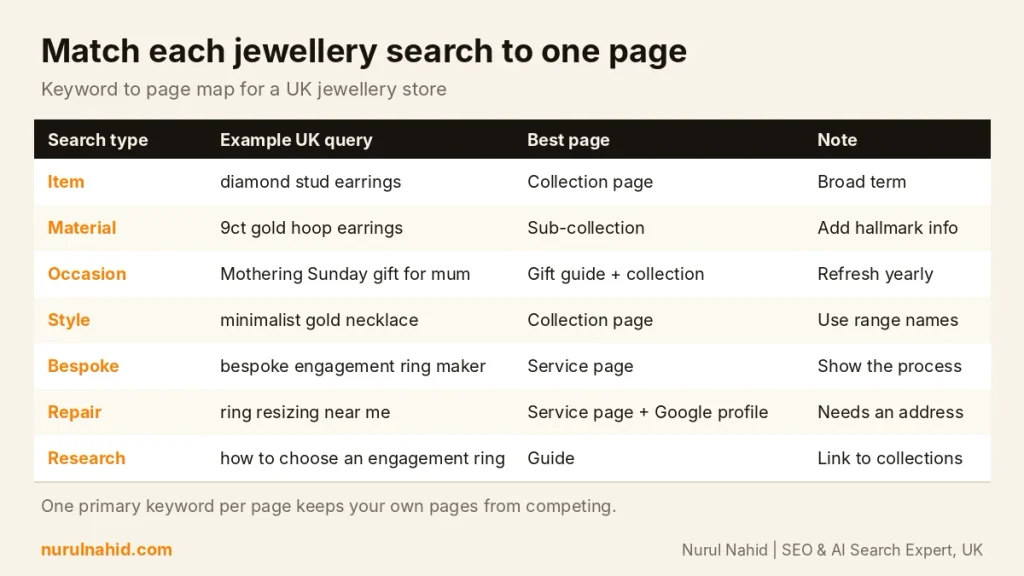
Jewellery shoppers search by item, material, occasion, style, budget and place. Map each type to one page type before you write anything.
| Search type | Example UK query | Best page | Note |
|---|---|---|---|
| Item | diamond stud earrings | Collection page | Broad term, many products |
| Material | 9ct gold hoop earrings | Sub-collection page | Add the hallmark standard |
| Occasion | Mothering Sunday gift for mum | Gift guide plus collection | Refresh every year |
| Style | minimalist gold necklace | Collection page | Use your own range names |
| Bespoke | bespoke engagement ring maker | Service page | Show process and enquiry form |
| Repair | ring resizing near me | Service page plus Google profile | Needs a physical address |
| Research | how to choose an engagement ring | Guide | Link to ring collections |
Keyword volumes were not supplied for this guide. Check volumes in Search Console and a keyword tool before you commit to a target.
Use British terms such as “jewellery”, “bespoke” and “hallmarked”. My UK keyword research guide shows the method step by step.
Give each page one primary keyword. Broad terms go on collection pages and specific terms on product pages, so your own pages do not compete.
Collection page SEO
Collection pages are your best ranking assets. They match broad searches such as “gold hoop earrings” and pass shoppers to products.
Write a unique intro of 100 to 200 words. Cover the metals, styles, price range and who the pieces suit.
Use a clear title formula and keep it under 60 characters.
| Element | Formula | Example format |
|---|---|---|
| Title tag | Item + material + UK + brand | Gold Hoop Earrings UK | Brand |
| H1 | Plain item name | Gold Hoop Earrings |
| Intro | Answer first, then range | Two lines on who it suits |
| Links | Sub-collections, guides | Link to ring size guide |
Add breadcrumbs and link to the buying guide that helps that choice. Let shoppers filter by metal, stone and price without creating thousands of indexable URLs.
Product page SEO
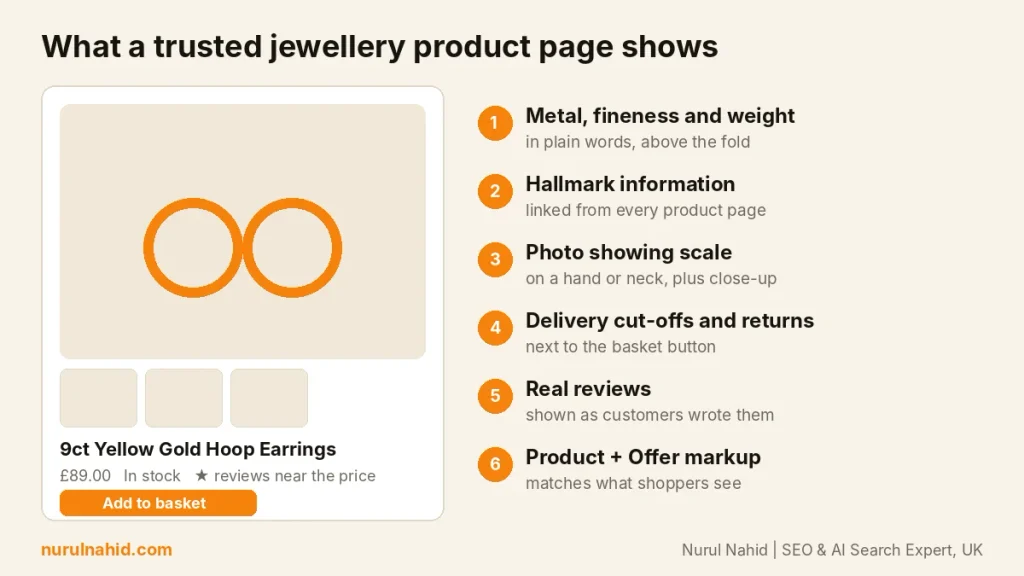
A product page must answer every question a shop assistant would. That also gives search engines the detail they need.
Check each product page against this list:
- Name that states the item and the material.
- Metal, fineness, weight, dimensions and stone details.
- Hallmark information and where it is struck.
- Delivery times, returns and care advice.
- Original copy, not the supplier’s text.
- Several photos, one showing scale on a hand or neck.
- Alt text that describes the piece.
Keep ring sizes as variants on one URL, not separate pages. Decide what happens when a one-off piece sells: keep the page with a clear note, or redirect to the closest collection.
Image SEO and visual search
Jewellery is bought with the eyes, so images carry real search weight. They also feed Google Images and visual search.
Use one background and lighting style across the range. Add a close-up, an on-body shot and one that shows scale.
Name files with words, such as 9ct-gold-hoop-earrings-15mm.webp. Write alt text that describes what the photo shows.
Compress every image and serve a mobile size. Add a short video on key pieces, such as a ring catching the light.
Include product images in your markup or sitemap. Keep the first image sharp, because it is often the one shown in search.
Bespoke, repair and valuation pages
Many jewellers earn more from services than from stock. Give each service its own page: bespoke design, engagement ring commissions, resizing, repairs, remodelling and valuations.
Explain the process, the turnaround, what the customer brings and how pricing works. Add an enquiry form and a phone number.
Use real photos of your own bench work. Add a short FAQ with the questions customers ask on the phone.
These pages answer searches such as “ring resizing” and “bespoke engagement ring”, which collection pages cannot.
Hallmarking and ethical sourcing as trust signals
Hallmarking is both a legal duty and a trust signal. Under the Hallmarking Act 1973, GOV.UK says dealers supplying precious metal items must display an approved dealer’s notice.
For online shops, GOV.UK says the explanatory information about the hallmark must be prominent. See the GOV.UK hallmarking guidance for businesses.
The Assay Offices’ hallmarking guidance notes say the core offence concerns how an item is described. Calling an unhallmarked item gold or silver can be an offence.
The notes give examples. A base-metal watch should be “gold tone”, not “gold”.
Gold-plated silver must be described as silver, with “plated” after the gold term. Read the notes before you write copy.
Create one hallmark information page and link to it from every product page. State the metal and fineness on each item in plain words.
For ethical sourcing, say only what you can prove. Name recycled metal, certified stones or supplier policies where you hold the papers.
This is guidance, not legal advice. Check your wording with your local Trading Standards team.
Technical SEO and Core Web Vitals
Jewellery sites are image heavy, so speed problems start with photography. Compress images, use modern formats and avoid lazy-loading the main product photo.
Check the Core Web Vitals report in Search Console, then fix the slowest templates first. My technical SEO checklist for UK sites lists the fixes in order.
| Issue | Why it hurts jewellery stores | Fix |
|---|---|---|
| Filter URLs | Metal, stone and price filters create endless pages | Canonical or noindex rules |
| Heavy images | Big zoom photos slow mobile pages | Resize and compress |
| Sold-out pieces | One-off items leave dead pages | Keep with a note or redirect |
| Duplicate copy | Supplier text appears on many sites | Write original copy |
| Missing sitemap entries | New products stay unfound | Sitemap with products and collections |
On 2 November 2026, Google’s John Mueller said AI systems build on classic SEO, so technical SEO stays relevant (Search Engine Journal).
He also said AI systems crawl a little differently because their goals differ. Do not build special pages for AI. Make the normal site crawlable and clear.
Product and Review schema
Product structured data tells Google the name, image, price and stock of each item. Google splits it into product snippets and merchant listing experiences.
For merchant listings, Google’s documentation lists name, image and an Offer as required. It recommends properties such as brand, description, colour, GTIN and aggregate rating (Google Search Central).
In September 2022, Google widened merchant listing eligibility to pages that use Product structured data (Google Search Central blog).
Here is the shape of a minimal product block. The product and values are made up to show the format.
{
  "@context": "https://schema.org",
  "@type": "Product",
  "name": "9ct Yellow Gold Hoop Earrings",
  "image": "https://example.co.uk/images/9ct-gold-hoops.webp",
  "description": "Hallmarked 9ct yellow gold hoops, 15 mm diameter.",
  "brand": { "@type": "Brand", "name": "Example Jewellers" },
  "offers": {
    "@type": "Offer",
    "price": "89.00",
    "priceCurrency": "GBP",
    "availability": "https://schema.org/InStock"
  }
}
Keep the markup in step with what shoppers see on the page. Add review markup only for real reviews you display.
The CMA’s fake reviews guidance bans fake reviews and concealed incentivised reviews. It also bans publishing reviews in a misleading way, such as hiding genuine bad ones (CMA guidance).
Schema is hygiene. It helps machines read the page, but it does not replace good pages or real reviews.
Site structure and internal linking
A clear structure helps shoppers and crawlers. Group products by type first, then by material or style.
Keep URLs short and readable, such as /rings/engagement-rings/. Do not change URLs after launch unless you add redirects.
Link from guides to the collections they help sell, and from collections back to the guides. Vary the anchor text.
Add breadcrumbs on every page. Keep key collections within a few clicks of the homepage.
Put every product in at least one collection that the menu or footer links to. Orphan products rarely rank.
Content hub and link building
A small content hub supports your collection pages and earns links. Build it around the questions buyers ask before they spend.
Good hub topics for jewellery stores:
- How to choose an engagement ring.
- Ring size guide and how to measure at home.
- Gold, silver and platinum compared, with hallmark standards.
- Birthstone and gemstone guides.
- Jewellery care and cleaning.
- Gift guides by occasion and budget.
Open each guide with a two-line answer. Then add a table, your own advice and links to the relevant collections.
For links, aim for relevance over volume. UK jewellery trade press, gift guide editors, wedding blogs and local newspapers are realistic targets.
Share something worth citing, such as a hallmark explainer or data from your own sales. Read my UK link building guide before you buy any links.
Local SEO for jewellers with a showroom or workshop
A physical shop can win “jewellers near me” searches in Google Maps. Your Google Business Profile is the main lever.
Choose the right primary category and add services such as repairs, resizing and valuations. Upload real photos of the shop, the bench and the team.
Keep opening hours, holiday hours and the address exact. Reply to every review in your own voice.
Build a local page for each service and area you genuinely serve. See my UK local SEO guide, my Google Business Profile guide and my list of UK local directories.
Matching name, address and phone details across directories helps. My local SEO service covers this for shops with a showroom.
Conversion basics that support SEO
Rankings only pay when visitors buy. Fix the trust gaps that make shoppers leave.
Show delivery cut-offs, returns and payment options near the add-to-basket button. Link to the ring size guide from every ring page.
Put reviews near the price, not only at the bottom. Offer a clear way to ask a question by chat, phone or WhatsApp.
Test one change at a time and watch conversion rate in analytics. Small gains on your top pages beat a big redesign that stalls.
Seasonal calendar for 2027
Gift peaks decide a jewellery store’s year. Plan pages ahead of each date.
| Peak | 2027 date | Pages live by | Focus |
|---|---|---|---|
| Valentine’s Day | Sunday 14 February | Early January | Gifts for her and him, under-budget lists |
| Mothering Sunday | Sunday 7 March | Mid January | Gifts for mum, personalised pieces |
| Black Friday | Friday 26 November | Early October | Offers page, delivery cut-offs |
| Christmas | Saturday 25 December | Mid October | Gift guides, last order dates |
The “live by” column is my working rule of 6 to 8 weeks before each date. It is my own practice, not a published standard.
Update old gift pages each year instead of creating new URLs. The page keeps its history, and its date stays honest.
Common jewellery SEO mistakes
- Copying supplier descriptions.
- Letting filters create thousands of indexable pages.
- Hiding hallmark, delivery and returns information.
- Describing plated or gold-tone items as gold.
- Deleting sold-out pages without a redirect.
- Buying low-quality links.
- Publishing gift guides in the last week before the date.
- Ignoring mobile speed.
Get Part 1 done with an e-commerce SEO specialist
I audit collection pages, product templates, filters, speed and markup, then build a priority list. Start with my e-commerce SEO service or a free SEO audit.
Part 2: AI citation guide for jewellery stores
Nobody can guarantee that ChatGPT, Perplexity or Google AI Overviews will recommend your jewellery store. The reliable route is strong SEO, answer-first pages and honest proof from other sites.
Then measure it every week. A guess about AI visibility is not a plan.
How ChatGPT, Perplexity and Google AI Overviews recommend jewellery stores
AI answers draw on pages the tools retrieve, what they already know about brands and what other sites say about you. Each tool differs, so results vary.
One study gives a useful clue. TJ Digital, an SEO and GEO agency, analysed 193,507 answers from ChatGPT, Google AI Mode and AI Overviews, using data from 78 client companies.
Among pages the AI retrieved, 23% of cited pages opened with a direct answer, against 14% of uncited ones.
The agency says it cannot show that a direct answer causes more citations (Search Engine Journal).
Treat that as a pointer, not a rule. It does match what good jewellery pages already do: answer first, then prove it.
In my 10 November 2026 searches for the best online jewellery stores in the UK, results were mostly roundups by consumer sites and fashion magazines.
Some retailers also published their own “where to buy” guides.
I could not run live ChatGPT or Perplexity prompts for this guide. Run your own tests using the tracking method below.
Large brands tend to crowd best-of lists. A smaller store needs a clear angle, such as handmade, bespoke, ethically sourced or local.
Write pages AI can quote
AI tools and shoppers both prefer pages that answer fast. Use this pattern on guides and collection pages:
- A question as the heading.
- A two or three line answer.
- A table or short list with the detail.
- Your own experience or advice.
Say who each page is for, not only what it sells. “Hallmarked 9ct gold earrings for sensitive ears” is clearer than “beautiful earrings”.
Show prices, materials, delivery dates and returns in plain text, not only in images. Put a clear updated date on guides you maintain.
Match buyer prompts to pages
Buyers ask AI tools full questions, not keywords. Write down the prompts your customers use and name the page that should answer each one.
| Prompt type | Example prompt | Page that should answer |
|---|---|---|
| Gift | Gold earrings gift for mum under £100 | Gift guide and collection |
| Ethical | Recycled gold jewellery UK | Sourcing page |
| Comparison | Gold or silver for sensitive ears | Metals guide |
| Brand check | Is this jeweller reputable | About page and reviews |
| Local | Jeweller near me for ring resizing | Service page and Google profile |
If no page answers a prompt, you have a content gap. Fill it before you chase mentions.
FAQ and structured data as hygiene
Add short FAQs to collection and product pages. Good questions cover sizing, hallmarks, returns, care and last order dates for Christmas.
Mark up an FAQ only if the questions and answers are visible on the page. Use Product, Organization and Article markup where it fits.
I have not seen proof that markup alone lifts AI citations. Keep it accurate and consistent, then spend your effort on content and reputation.
Make your brand easy for AI to understand
AI tools need to know who you are, what you sell and who you serve. Put this on your About page and keep it consistent everywhere.
State your name, location, what you make or sell, materials, price range and who the pieces suit. Name the people behind the brand.
Show proof anyone can verify, such as years trading, trade memberships, awards and press. Do not claim what you cannot show.
Use the same business name and description on your Google profile, social accounts and directories. Add Organization markup with your official links.
Reviews, Reddit and PR mentions
AI answers often reflect what other sites say about a brand. So reviews, press mentions and community discussion matter beyond your own website.
Build these in order:
- Ask every buyer for a review after delivery, on a platform shoppers trust.
- Reply to reviews, good and bad, in a calm and factual way.
- Pitch gift guides, trade press and wedding blogs with real stories and products.
- Take part in relevant forums only as yourself, and say who you are.
Never write reviews for yourself, and never pay for reviews without saying so. The CMA rules above apply to your own site.
Agentic shopping and product feeds
Some AI tools now shop for people. Shopify opened its catalogue to AI shopping agents, and it is testing promoted placements that pay agent developers a commission.
On 30 October 2026, Search Engine Journal reported that this is a Developer Preview, and the extra commission applies only to US campaigns.
Shopify’s documentation does not say whether a larger commission lifts a product in the results (Search Engine Journal).
UK stores need no special action yet. Keep price, stock, GTIN, material and size data accurate on your site and in your product feed.
Control AI crawlers deliberately
Decide which AI crawlers you allow in your robots.txt file, and check you are not blocking them by accident.
Mueller said AI systems crawl for different reasons, such as training or fetching fresh content.
Review your server logs or hosting reports every quarter. See which bots visit, and which pages they ask for.
Tracking AI visibility
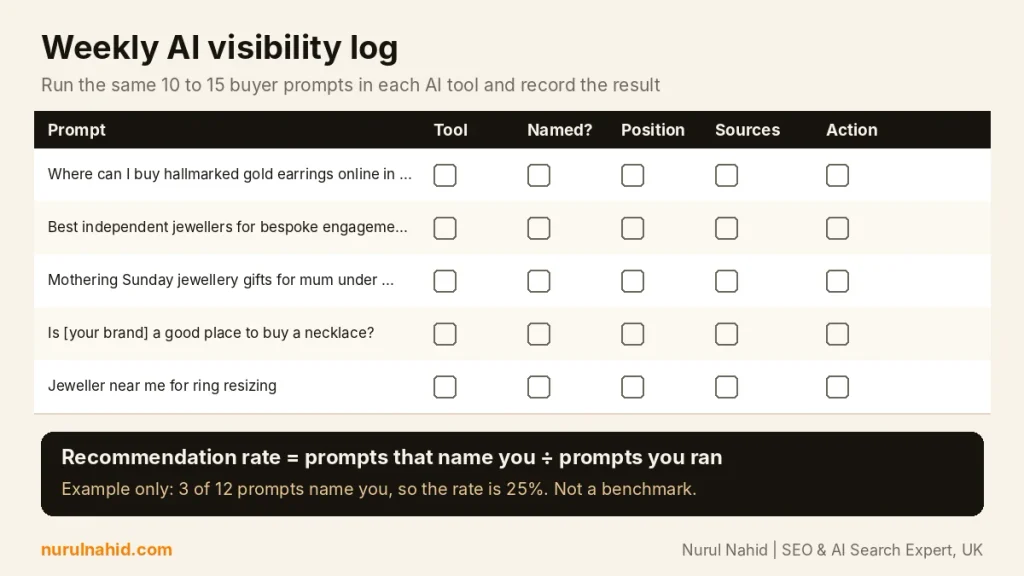
Track AI visibility weekly with a fixed list of 10 to 15 buyer-style prompts. Run the same list in each tool and record the result.
Example prompts for a jewellery store:
- Where can I buy hallmarked gold earrings online in the UK?
- Best independent jewellers for bespoke engagement rings in the UK.
- Mothering Sunday jewellery gifts for mum under £100.
- Is [your brand] a good place to buy a necklace?
Use a simple log:
| Prompt | Tool | Brand named? | Position | Sources cited | Competitors named | Action |
|---|
Your recommendation rate is the prompts that name you, divided by the prompts you ran.
If 3 of 12 prompts name you, the rate is 25%. That is an example of the maths, not a benchmark.
Audit the sources that AI cites about you. Fix wrong facts, and approach the cited sites that your competitors appear in.
Link the log to sales. Check analytics for visits from AI tools and ask “How did you hear about us?” at checkout.
AI referral traffic is usually small, so watch branded search, enquiries and orders too.
Read my GEO guide for the wider method.
Get Part 2 done with an AI search specialist
I check how AI tools describe your store and fix what they get wrong. See my AEO optimisation service and my GEO optimisation service.
Part 3: Total marketing plan for jewellery stores
A jewellery store grows fastest when SEO captures demand, email and text bring buyers back, paid ads cover the peaks and reviews build trust. Judge each channel on profit, not clicks.
Plan around Valentine’s Day, Mothering Sunday and Christmas, then fill the quiet months with content and list building.
Email and SMS
Email and text marketing bring repeat buyers, and jewellery has natural reasons to write: birthdays, anniversaries and gift dates.
| Flow | Trigger | Goal |
|---|---|---|
| Welcome | Sign-up | First order, ring size guide |
| Abandoned basket | Basket left | Recover the sale |
| Post-purchase | Delivery date | Care tips, review request |
| Gift reminder | Date a buyer chose | Repeat gift purchase |
| Back in stock | Request | Capture waiting demand |
In the UK, the ICO says you need consent or a valid soft opt-in to send unsolicited email marketing to individuals. Corporate subscribers can be emailed without consent (ICO guidance).
The soft opt-in does not cover bought-in lists. Keep a record of consent and make unsubscribing easy.
Aftercare, repairs and loyalty
Jewellery has a long customer life. Offer cleaning reminders, resizing, repairs and anniversary gifts.
Send a care guide after delivery and a check-in a few months later. Invite buyers back for the next occasion.
A referral or loyalty offer can work if the terms are clear. Keep any review incentive separate and disclosed.
Paid: Google Shopping and Meta
Use Google Shopping to capture people already searching for a product. Use Meta to introduce gifts and retarget visitors.
Shopping ads depend on product data. Accurate titles, GTINs, prices, stock and images decide whether your products show.
Work out your break-even return on ad spend before you spend. Divide 1 by your gross margin: with a 50% margin, break-even is 2.0.
Start small, test one change at a time and stop what does not pay back. Protect your brand name in search, since competitors may bid on it.
Social media and UGC
Jewellery sells on sight. Short videos of pieces on a hand, polishing, packaging and sizing do more than polished studio shots alone.
Ask customers for photos and get written permission before you reuse them on product pages. Keep reviews and photos real.
If creators promote your pieces, make sure any gift or payment is clearly disclosed.
Marketplaces
Marketplaces such as Etsy, Amazon and Not On The High Street give reach, but you rent the audience. Use them for discovery and send repeat buyers to your own site.
| Factor | Own site | Marketplace |
|---|---|---|
| Customer data | You keep it | Platform keeps most of it |
| Brand control | Full | Limited |
| Reach for new brands | Slow | Faster |
| Margin | Higher | Lower after fees |
Check fees and rules on each platform before you list. They change often.
Christmas trading checklist
- Last order dates for each delivery option, shown on product pages and in the basket.
- Stock levels and availability markup kept current.
- Gift wrapping, gift notes and a gift receipt option.
- A clear returns policy for Christmas gifts.
- Customer service cover for the final fortnight.
- Page speed tested before the traffic arrives.
- Email and ad schedules matched to delivery cut-offs.
Worked budget example
This is an example with made-up numbers to show the maths. It is not a benchmark or a result.
Assume an average order of £120 and a 50% gross margin. Gross profit per order is £60, so break-even return on ad spend is 2.0.
| Line | Monthly budget |
|---|---|
| Google Shopping | £800 |
| Meta ads | £500 |
| Email and SMS tool | £100 |
| Photography and content | £400 |
| Review and PR outreach | £200 |
| Total | £2,000 |
If Shopping returns 3.0, £800 brings £2,400 revenue, which is 20 orders. Gross profit is £1,200, so £400 remains after ad spend.
If Meta returns 2.0, £500 brings £1,000 revenue and £500 gross profit. That only breaks even, so test creative or cut spend.
SEO is a separate cost. See my guides to SEO cost in the UK and how long SEO takes.
KPIs to report each month
| KPI | Where to find it | Why it matters |
|---|---|---|
| Organic revenue | Analytics ecommerce reports | Shows what SEO earns |
| Non-brand organic clicks | Search Console | Shows new demand |
| Collection page rankings | Rank tracker, Search Console | Shows progress on main pages |
| Conversion rate by channel | Analytics | Finds weak pages |
| Google profile calls and directions | Business Profile | Shows local demand |
| Email revenue | Email platform | Shows repeat sales |
| AI recommendation rate | Prompt log | Shows AI visibility |
| Review count and rating | Review platforms | Shows trust |
90-day plan
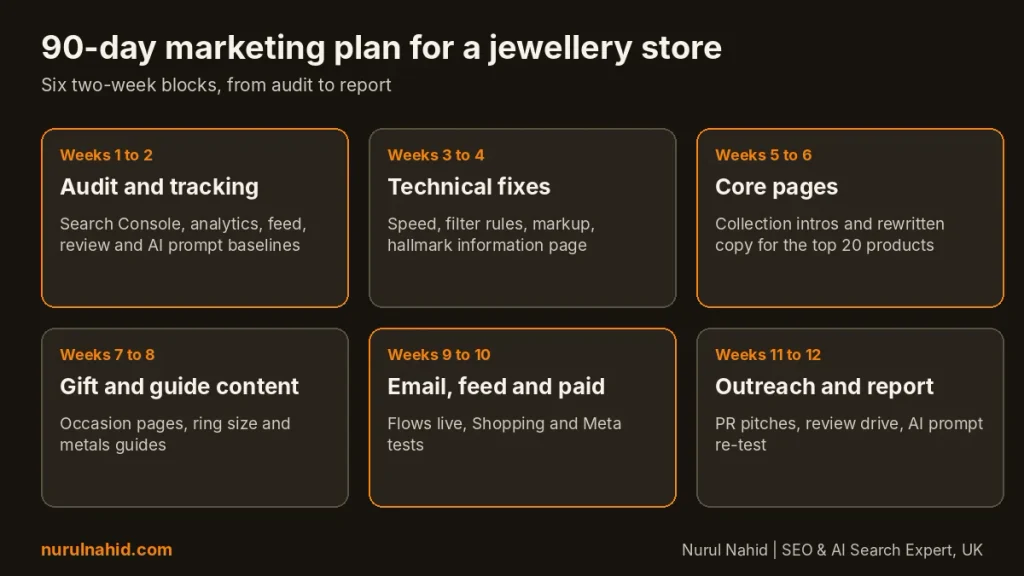
| Weeks | Focus | Output |
|---|---|---|
| 1 to 2 | Audit and tracking | Search Console, analytics, feed checks, review and AI prompt baselines |
| 3 to 4 | Technical fixes | Speed, filter rules, markup, hallmark information page |
| 5 to 6 | Core pages | Collection intros, rewritten copy for top 20 products |
| 7 to 8 | Gift and guide content | Occasion pages, ring size and metals guides |
| 9 to 10 | Email, feed and paid tests | Flows live, Shopping and Meta tests |
| 11 to 12 | Outreach and review | PR pitches, review drive, AI prompt re-test, report |
Start on 4 January 2027 and core pages go live in mid-February, about three weeks before Mothering Sunday on 7 March.
Start in November or December to get the full 6 to 8 weeks.
Get Part 3 done with a digital marketing specialist
I join SEO, email, paid and social into one plan with clear targets. See my digital marketing service to build the plan around your catalogue and margins.
Case study: a luxury brand that went from almost no search traffic to 2,000+ clicks
I have no jewellery case study published yet. The closest is Carla Schall Design, a luxury calligraphy and engraving brand in Florida.
It is a different sector and country, but the buyer is just as premium and trust-led.
The site had almost no search presence and no optimised service pages. Over four months I worked on technical SEO, service page content, local SEO, citations and AI search visibility.
Google Search Console showed more than 2,000 monthly organic clicks within four months, from almost none.
Core keywords reached page one, and 20+ service keywords appeared in Google AI Overviews and AI citations.
Read the full Carla Schall SEO case study or browse all SEO case studies.
Related guides
- Best SEO tools in the UK
- SEO vs GEO: what is the difference?
- How to check your website is ready for agentic search
FAQ: SEO and marketing for jewellery stores
How much does SEO for a jewellery store cost in the UK?
It depends on catalogue size, competition and what needs fixing. My e-commerce SEO page lists a £500 one-off audit and an £800 monthly growth plan, so confirm current pricing on the e-commerce SEO page.
How long does jewellery SEO take to work?
Usually months, not weeks. Nobody can honestly promise a ranking date, because it depends on your site, competitors and how fast fixes go live.
Do I have to show hallmark information on product pages?
GOV.UK says online retail sites must prominently display explanatory information about the hallmark. Check your exact wording with Trading Standards.
Can ChatGPT recommend my jewellery store?
It can, but nobody controls it. Build strong pages, real reviews and third-party mentions, then track a fixed set of prompts every week.
Does schema markup get me into AI answers?
No guarantee exists. Markup helps machines read your pages, so treat it as hygiene alongside content and reputation.
Can I offer a discount for reviews?
Only if you disclose it. The CMA bans concealed incentivised reviews, and you must not hide genuine negative ones.
Should I sell on marketplaces as well as my own site?
Many stores do, for reach. Use marketplaces for discovery, protect your margin and bring repeat buyers to your own store.
Ready to grow your jewellery store?
You make beautiful pieces and want the right buyers to find them. The problem is a crowded market, and a site that does not yet prove your quality.
I’m Nurul Nahid, and I’ll act as your guide. I audit your store, fix the foundations, build the pages and proof that win trust, and give you a clear plan.
Start with a free SEO audit, book a meeting or message me on WhatsApp. Learn more about me.