SEO for online pet stores in the UK works best when you stop chasing “dog food” and own the specific searches big retailers serve badly: breed, age, diet and problem-led queries.
Build deep collection pages, clean product data and honest expert content. Then earn the reviews and mentions that ChatGPT, Perplexity and Google AI Overviews trust.
Finally, turn first orders into repeat orders with email, subscriptions and well-run Google Shopping. That mix is how a smaller UK pet shop grows profitably in 2027.
I’m Nurul Nahid, an SEO and AI search expert in the UK with 7+ years of experience in SEO, local SEO, e-commerce SEO, GEO, AEO and digital marketing.
I help online stores fix their product and category pages, structured data and AI visibility through my e-commerce SEO service, so more pet owners find the right products and buy again.
At a glance: the UK online pet market in numbers
- 62% of UK households own a pet, and there are about 36.5 million pets in total (UK Pet Food Pet Population survey, January 2026 fieldwork).
- Dogs lead with about 15.5 million (41% of households), followed by around 13 million cats (31%). 13% of households keep an indoor fish tank (UK Pet Food, 2026).
- 28.8% of all GB retail sales were made online in September 2026 (ONS Retail sales, released 23 October 2026).
- Subscriptions made up 15.3% of Pets at Home consumer revenue in the quarter to 16 July 2026, up from 14.5% a year earlier (Global Pet Industry, 31 July 2026).
- Google began its November 2026 core update on 10 November, expected to take about two weeks (Search Engine Roundtable, 11 November 2026).
The message is simple. Demand is huge, but repeat buying and trust decide who wins it.
Part 1: SEO guide for online pet stores in 2027
SEO for online pet stores means making your collections, products and guides the best answer for a specific pet, need and budget.
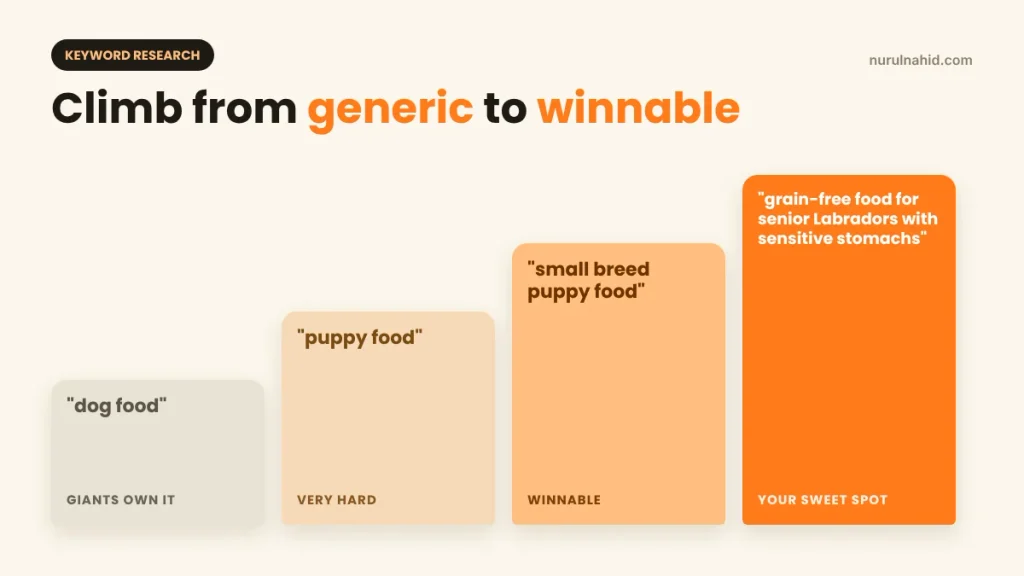
You will not outrank the national giants on “dog food” this year. You can beat them on “grain-free food for senior Labradors with sensitive stomachs”.
Why the giants are beatable on the right searches
Large retailers win short, generic searches because of brand strength and link authority. Their pages are built for everyone, so they rarely answer one owner’s exact situation well.
That is your gap. A specialist store that knows raw feeding, reptile heating or senior cat nutrition can write pages the giants never will.
Think of it this way: your competitors sell a catalogue. You sell an answer to “what should I buy for my pet, right now?”
Keyword research for online pet stores
Start with the way UK owners actually search. They mix species, breed, age, life stage, health need, format and price.
Build your keyword map in five layers:
| Layer | Example UK search | Best page type |
|---|---|---|
| Species and category | puppy food, cat litter, dog harness | Main collection page |
| Breed or size | small breed puppy food, harness for French bulldog | Sub-collection or filtered landing page |
| Life stage and need | senior cat food for kidney care, hypoallergenic dog treats | Sub-collection plus buying guide |
| Diet or method | raw dog food delivery UK, freeze-dried cat treats | Specialist collection |
| Problem and question | why is my dog itching after eating, how much raw food to feed a puppy | Expert guide linking to products |
Use UK spellings and UK terms in every layer. Owners search “flea treatment”, “dog lead” and “litter tray”, not American variants.
Look closely at three signals for each keyword:
- Intent. Is the person ready to buy, comparing, or still learning?
- SERP type. Does Google show product grids, Shopping ads, forums or guides?
- Your stock depth. Only target a collection term if you carry enough choice to satisfy it.
Small catalogues should go narrow and deep. Ten excellent pages for senior dog nutrition will beat a hundred thin pages for everything.
For a full walkthrough of tools and process, read my guide to keyword research for UK businesses.
Collection page SEO: your biggest ranking asset
Collection (category) pages usually match buyer searches better than single products. Treat each one as a landing page, not a product dump.
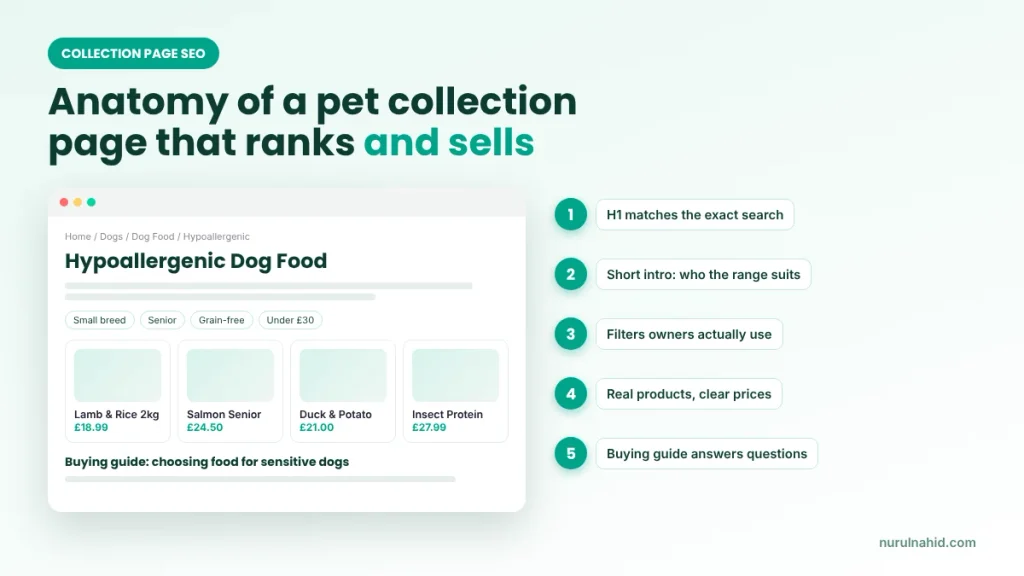
Every key collection page needs:
- A clear H1 that matches the search, for example “Hypoallergenic Dog Food”.
- A short intro above the grid (two or three lines) explaining who the range suits.
- Useful filters: breed size, life stage, protein, grain-free, price, delivery speed.
- A buying guide block below the grid answering the top three to five questions.
- Links to related collections such as “hypoallergenic treats” and “sensitive stomach puppy food”.
- A short FAQ drawn from real customer emails and chat logs.
Keep the copy honest and specific. Explain who each range is for, not only what it is. That detail helps shoppers and also helps AI tools understand your store.
Product page SEO for pet products
Product pages convert the traffic your collections earn. Most pet stores copy the supplier description, which creates duplicate content across hundreds of sites.
Rewrite your best sellers first. A strong pet product page covers:
- Who it is for: species, breed size, age and activity level.
- Full composition and analytical constituents for food and treats, shown as text, not only in an image.
- Feeding guide in a simple table by weight.
- Size guidance for harnesses, beds, crates and coats, with measuring tips.
- Delivery, returns and subscription options stated clearly near the price.
- Real customer reviews and photos, collected honestly (more on the rules in Part 2).
- Related products that complete the job, such as a lead with a harness.
Add original photos where you can. A short video of a dog wearing the harness, or a cat using the scratcher, answers questions that copy cannot.
Specialist content: breed, age, diet and vet-reviewed guides
Content is where a niche pet store beats a generalist. Owners ask detailed questions before they buy, and they trust the store that answers well.
Build topic clusters around the areas you sell:
- Breed hubs: feeding, grooming and kit guides for the breeds your customers own most.
- Life-stage hubs: puppy, kitten, adult and senior guides with product picks.
- Diet hubs: raw feeding, freeze-dried, grain-free, sensitive digestion.
- Species hubs for smaller pets: rabbits, guinea pigs, reptiles and fish.
For anything touching health, use a qualified reviewer such as a vet, a registered veterinary nurse or an animal nutritionist. Name them, show their qualification and date the review.
Write carefully. Do not claim a food or supplement treats a condition.
In the UK, the ASA says direct or implied claims to treat a health condition are likely to be treated as medicinal (ASA pet food guidance, updated 16 April 2026).
Internal linking: connect guides to products
Internal links tell Google which pages matter most and help owners move from reading to buying.
Follow a simple pattern:
- Guide to collection: every buying guide links to the two or three collections it discusses.
- Collection to guide: every key collection links back to its main buying guide.
- Product to product: link complementary items, such as a harness to a matching lead.
- Breadcrumbs everywhere: Home, Dogs, Dog Food, Senior Dog Food.
Use descriptive anchor text such as “senior dog food for sensitive stomachs”, not “click here”.
Point your strongest pages, like the home page and top guides, at the collections that make most money.
Technical SEO and Core Web Vitals for pet stores
Pet stores carry big catalogues, many variants and heavy images. That combination creates technical problems fast.
Focus on these fixes first:
| Problem | Why it hurts | Fix |
|---|---|---|
| Faceted filter URLs (size, flavour, brand) | Thousands of near-duplicate pages waste crawl budget | Index only filters with real search demand; canonical or noindex the rest |
| Variants as separate URLs | Splits reviews and links across duplicates | One main product URL with selectable variants |
| Out-of-stock and discontinued products | Dead pages and lost links | Keep seasonal stock live with “back soon”; redirect discontinued items to the closest match |
| Large product images | Slow mobile loading | Compress, serve WebP, set sizes, lazy-load below the fold |
| App and widget bloat | Slows every page | Audit apps quarterly; remove what nobody uses |
Mobile speed matters here. Many owners shop on their phone while the dog waits for a walk.
Use my technical SEO checklist for UK sites to work through crawling, indexing and Core Web Vitals in order.
Check your robots.txt too. Some stores block AI crawlers by accident through a security plugin or CDN setting.
That can hide your products from AI shopping answers. Decide on purpose which bots you allow.
Seasonal SEO: plan pages before the peaks
Pet demand moves with the UK calendar. Pages published a week before a peak rarely rank in time, so build them two to three months early.
| Moment | What owners search | Page to prepare |
|---|---|---|
| January and spring | new puppy checklist, kitten starter kit | Starter bundles and “first week” guides |
| Spring and summer | flea treatment, dog cooling mat, travel water bottle | Parasite and summer care collections |
| Late October to early November | fireworks anxiety dog, calming products | Calming collection with careful, evidence-based copy |
| Autumn and winter | dog coat for small breeds, heated pet bed | Cold weather collection with sizing guides |
| Christmas | dog advent calendar, gifts for cat lovers | Gift guides by budget and by pet |
Keep the same URL every year and update it. A seasonal page that gathers links over several years becomes very hard to beat.
Product, offer and review structured data
Structured data helps Google show price, stock, delivery and ratings in results. It also gives AI shopping tools clean, consistent facts.
Mark up each product page with:
- Product: name, image, description, brand, GTIN or MPN, SKU.
- Offer: price in GBP, availability, item condition.
- Shipping and returns: delivery cost and time to UK addresses, and your returns window.
- AggregateRating and Review: only from genuine customer reviews shown on the page.
Collection pages can use breadcrumb markup. Guides can use Article markup with the author and reviewer named.
Keep the markup matched to what the page shows. If the price on screen and in the code differ, you lose trust with search engines and shoppers.
Treat schema as hygiene, not a ranking trick. It makes your data readable; the page content and reputation do the persuading.
Content hub and link building for pet stores
Links still matter for competitive pet categories. The best ones come from being useful to people who already write about pets.
Practical link sources for UK pet stores:
- Breed clubs and rescue charities: sponsorships, donation drives, rehoming kits.
- Local and regional press: seasonal safety stories, such as fireworks anxiety or summer heat.
- Pet bloggers and creators: honest product testing with clear ad labelling.
- Original data: a short survey of your customers, for example how many feed raw or mixed diets.
- Expert commentary: your nutritionist or reviewer quoted in trade or consumer press.
Avoid paid link schemes. They are risky, especially while Google rolls out core updates.
My guide to link building in the UK covers outreach templates and how to judge link quality.
Mini audit: score your pet store in 10 minutes
Answer yes or no to each question:
- Do your top five collections each have a unique intro and buying guide?
- Are your best-selling product descriptions rewritten, not copied from the supplier?
- Do food pages show composition and feeding guides as text?
- Are filter URLs controlled so only useful ones are indexed?
- Does every product have Product and Offer structured data?
- Are reviews collected from verified buyers only?
- Does health content name a qualified reviewer and a review date?
- Do mobile product pages load quickly on a normal 4G connection?
Fewer than six yeses means your foundations need work before you spend more on ads or content.
How I help with your pet store SEO
If your store has a big catalogue but flat organic sales, I start with a full audit of collections, product data, filters and speed.
Then I rebuild the pages that can earn sales fastest.
You can start with a free SEO audit, or see how my e-commerce SEO service handles Shopify, WooCommerce and custom stores.
Part 2: How to get your online pet store recommended by ChatGPT, Perplexity and Google AI Overviews
AI assistants recommend pet stores and products they can understand, verify and see praised by others. Clear pages, consistent product data, real reviews and independent mentions are what get you named.
You cannot buy a recommendation in an organic AI answer. You can make your store the easiest, safest choice to cite.
How AI search recommends online pet stores
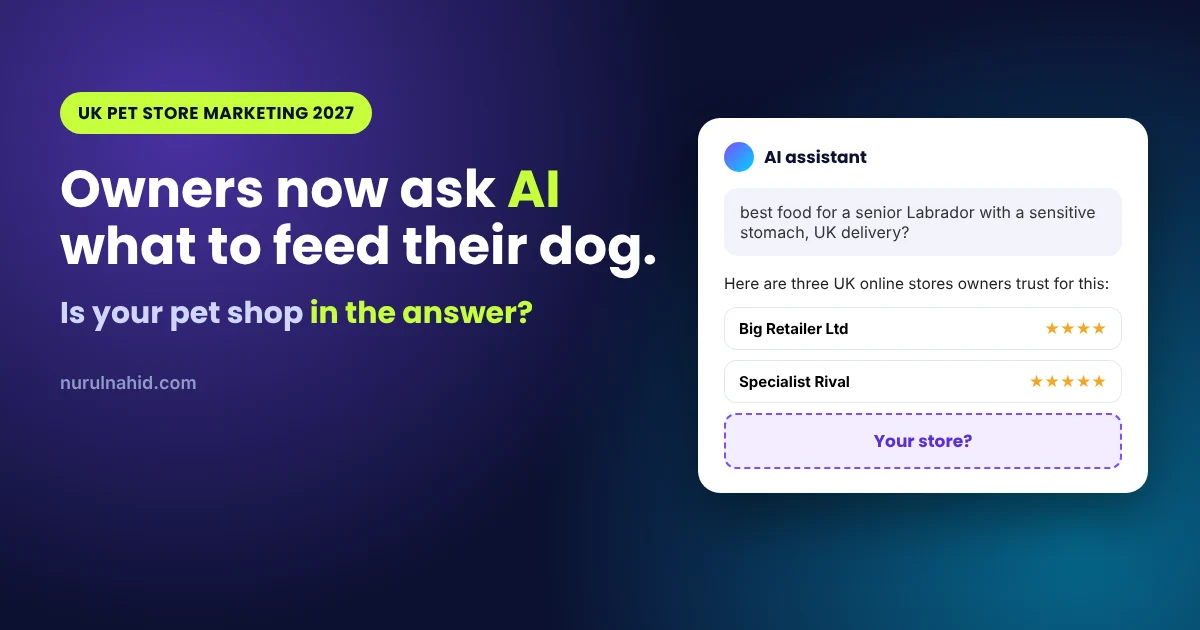
Owners now ask full questions such as “best food for a senior cat with a sensitive stomach, UK delivery”. The AI then pulls from pages it can find and trusts.
Most AI answers lean on three kinds of source:
- Your own pages, if they answer the question clearly and directly.
- Third-party pages: comparison articles, reviews, press and forums.
- Structured product data: feeds and markup with prices, stock and delivery.
There is no separate trick page for AI. The same strong SEO foundations from Part 1 do most of the work.
Write answer-first pages
AI tools often lift the first clear answer on a page. Put it where they can find it.
For each guide or collection:
- Open with a two to three line answer to the main question.
- Follow with the evidence: ingredients, sizing tables, feeding amounts, reviewer notes.
- Add a dated “last reviewed” line on health and nutrition content.
- Use comparison tables with real prices and specifications where true.
- State who each product suits and who it does not suit.
That last point matters. AI often knows what a brand sells but not who it is best for. Spell it out.
What a citation-ready pet guide looks like
Here is an example structure for a guide titled “Best food for senior cats with sensitive stomachs (UK, 2027)”. It is a template to follow, not a real page.
- Two-line answer: what to look for in food for older cats with sensitive digestion.
- Reviewer line: name, qualification and the date it was last reviewed.
- What to look for: protein source, fibre, moisture and portion guidance, explained plainly.
- Comparison table: products you sell, with price per kilo, format and who each suits.
- How to switch food: a simple day-by-day transition plan.
- When to see a vet: clear signs that the problem needs professional advice, not a new food.
- FAQ: three to five real customer questions.
Notice step six. Telling owners when a product is not the answer builds trust with readers, regulators and AI alike.
Make your brand easy to understand
AI tools build a picture of your business from many places. If those places disagree, you look less trustworthy.
Tidy up your brand signals:
- About page: who runs the store, your pet care expertise and what you specialise in.
- Expert profiles: a short bio page for each reviewer or nutritionist, linked from their guides.
- Consistent details: the same business name, address, phone and policies on your site, Google Merchant Center, marketplaces and social profiles.
- Clear specialism: say plainly that you are, for example, a raw feeding specialist or a reptile supplies store.
A clear specialism helps AI match you to specific questions. “Pet shop” is vague; “UK raw dog food delivery specialist” is easy to recommend.
FAQ content and structured data
Collect real questions from customer service, reviews and site search. Answer each one in two or three sentences on the most relevant page.
Good pet store FAQ topics include:
- How do I switch my dog to a new food without upsetting their stomach?
- What size harness does a dachshund need?
- Can I pause or skip my subscription?
- Do you deliver chilled raw food to my postcode?
Mark up FAQs where they appear on the page. Remember that markup alone does not win citations; the quality and clarity of the answer does.
Reviews: collect them honestly and show them well
Reviews are one of the strongest trust signals for both shoppers and AI. In the UK, they are also tightly regulated.
Since April 2025, fake reviews and concealed incentivised reviews are banned practices under the DMCC Act.
The CMA expects businesses to publish a clear policy, assess risks and remove banned reviews (CMA fake reviews guidance CMA208, 4 April 2025).
A simple, compliant review system for a pet store:
- Send a review request seven to fourteen days after delivery (longer for food, so the pet has tried it).
- Ask every buyer, not only happy ones.
- If you offer a reward, disclose it clearly on the review.
- Publish a plain-English review policy and link it near your reviews.
- Show reviews on the product page and in Google via your review platform.
Ask buyers to mention breed, age and the reason they bought. Reviews like “my 12-year-old Lab with a sensitive stomach loves this” are gold for both shoppers and AI.
Reddit, communities and PR mentions
AI answers often cite forums and independent articles. UK owners discuss food, kit and vets in communities and breed groups every day.
Join these spaces as a helpful expert, not a salesperson:
- Answer questions in your specialism with the same care you give customers.
- Disclose that you run a pet store whenever your shop is relevant.
- Never post fake recommendations of your own products.
- Earn independent coverage through expert comment, rescue partnerships and original data.
Independent mentions do two jobs. They build links for SEO and they give AI more trusted sources that name your brand.
Product feeds and agentic shopping
AI shopping is moving fast. OpenAI launched “Businesses in ChatGPT” on 10 November 2026, with a Business Hub showing mentions, profile views and website clicks (Search Engine Roundtable, 10 November 2026).
The rollout starts with eligible US e-commerce businesses. UK stores should watch for wider access rather than rely on it today.
The same report notes that recorded clicks do not confirm visits or sales.
Prepare now so you are ready when it arrives:
- Keep one clean product feed with accurate titles, GTINs, prices, stock and delivery times.
- Keep Google Merchant Center healthy, with no disapprovals on best sellers.
- Make policies easy to read: delivery, returns and subscription terms on plain pages.
My guide on checking if your website is ready for agentic search walks through the technical checks.
Compliance: what AI will not forgive
AI tools avoid recommending sources that look risky. Pet stores have three UK compliance areas to get right.
| Area | Rule in brief | Source |
|---|---|---|
| Veterinary medicines online | Sellers of POM-V, POM-VPS and NFA-VPS medicines online must register with the VMD and show set information on those pages. AVM-GSL products do not need registration. | GOV.UK VMD guidance |
| Pet food and health claims | Hold robust evidence for objective claims; unlicensed products must not be presented as medicinal; comparisons must not mislead or denigrate. | ASA guidance, April 2026 |
| Reviews | Fake and concealed incentivised reviews are banned; publish a review policy. | CMA208 guidance |
This is not legal advice. Check your own products and claims with a qualified adviser or the relevant regulator.
Tracking AI visibility for your pet store
You cannot improve what you do not measure. AI visibility needs its own simple tracking routine.
Set it up in four steps:
- Write 10 to 15 buyer-style prompts, for example “best raw dog food delivery UK” or “where to buy hypoallergenic cat food online UK”.
- Run them weekly in ChatGPT, Perplexity, Gemini and Google AI Overviews, and log whether your store is named.
- Record the sources cited alongside each answer, so you know which sites influence AI in your niche.
- Link it to sales: tag AI referral traffic in GA4 and compare it with orders and new customers.
Your “recommendation rate” is the share of prompts where your store appears. Watch the trend over months, not days.
For the wider strategy behind this, read my GEO (generative engine optimisation) guide.
How I help your pet store get cited by AI
I audit how ChatGPT, Perplexity, Gemini and AI Overviews currently describe your store, then fix the pages, data and mentions behind those answers.
My AEO service focuses on answer-ready content and FAQs, while my GEO service builds the brand signals and citations AI relies on.
Part 3: Total marketing plan for online pet stores
The total marketing plan for an online pet store is simple: win the first order profitably, then earn the second, third and tenth through email, subscriptions and great service.
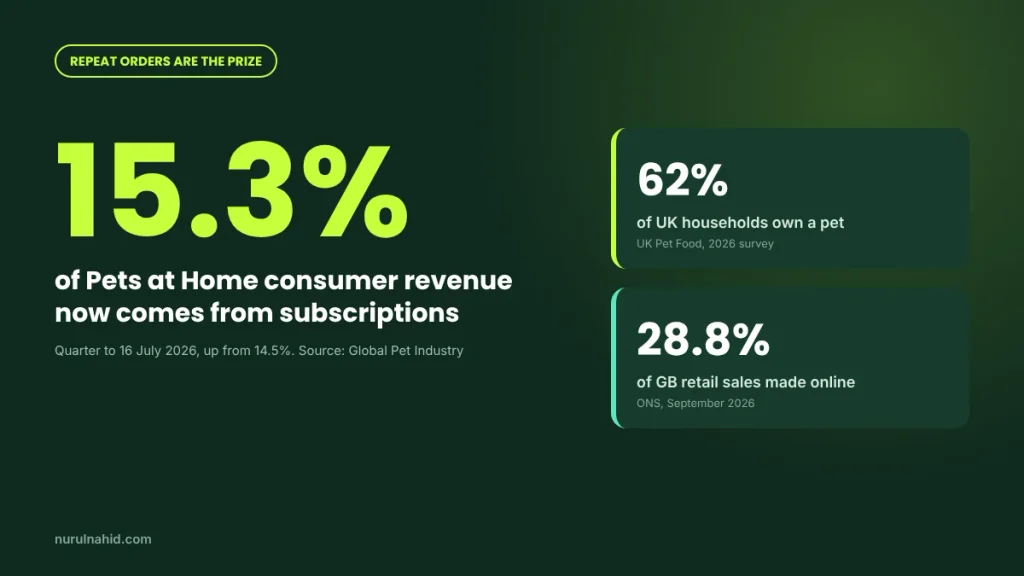
Pet food and consumables are bought again and again. That makes retention your biggest profit lever.
Email and SMS: your repeat-order engine
Email is where pet stores make most of their repeat profit. Owners like reminders that match their pet’s routine.
Set up these automated flows first:
| Flow | Trigger | What to send |
|---|---|---|
| Welcome | Sign-up | Brand story, best sellers for their pet, first-order offer |
| Pet profile | After sign-up | Ask species, breed, age and birthday to personalise future emails |
| Replenishment | Days since food order | “Running low?” reminder based on bag size and pet weight |
| Browse and cart abandon | Viewed or added but did not buy | The product, reviews and delivery details |
| Post-purchase | Delivery | Feeding transition tips, then a review request |
| Birthday | Pet’s birthday | A treat offer and a photo request for UGC |
| Win-back | No order in 60 to 90 days | What is new, plus a reason to return |
Use SMS sparingly for urgent messages, such as dispatch updates or a limited restock. Always get clear consent for marketing messages.
Subscriptions: build them fairly before the 2027 rules
Subscriptions keep food and litter orders flowing. Pets at Home’s subscription share keeps rising, which shows how much owners value convenience.
New UK subscription rules under the DMCC Act are due to start in January 2027.
They include renewal reminders, a cooling-off period after trials convert or contracts renew, and a straightforward cancellation process (Lewis Silkin, 10 August 2026).
Final government guidance was still awaited when that briefing was published, so check the latest position before you change your checkout.
Good subscription design for pet stores:
- Let customers skip, pause and change frequency in two clicks.
- Show the full price and frequency before checkout, not hidden in terms.
- Send a reminder before each delivery with an easy edit link.
- Make cancellation as easy as signing up.
Fair subscriptions keep customers longer. Trapped customers leave bad reviews, and AI reads those too.
Paid ads: Google Shopping and Performance Max
Google Shopping is usually the first paid channel for pet stores because shoppers see the product, price and rating before they click.
Waste is common in this sector.
One agency benchmark of the largest UK pet supply retailers estimated average monthly budget wastage at £8,585 and an average cost per click of £5 (ClickThrough Marketing, Q1 2026, agency study).
Treat those as one agency’s estimates, not industry rules. The lesson still holds: control spend before you scale it.
Practical Shopping setup:
- Optimise feed titles with species, breed size, flavour and pack size.
- Split campaigns by margin: high-margin own-brand lines get more budget than low-margin branded food.
- Separate brand searches so you can see true new-customer cost.
- Exclude out-of-stock items automatically.
- Track new versus returning customers so you do not pay twice for the same buyer.
Meta and social ads
Meta (Facebook and Instagram) works well for discovery, especially for treats, toys, beds and own-brand products with a visual hook.
What tends to work for pet brands:
- Owner-shot video of real pets using the product.
- Problem-led hooks, such as “Dog pulls on walks?” for a no-pull harness.
- Retargeting visitors who viewed a collection but did not buy.
- Lookalike audiences built from repeat customers, not one-off buyers.
Keep claims within ASA rules. Health or behaviour claims need evidence, and adverts showing animals should follow responsible-use guidance.
Social media and UGC
Pet owners love sharing their pets. That gives you a steady stream of real content, if you ask for it properly.
Build a simple UGC loop:
- Ask for photos in post-purchase and birthday emails.
- Get written permission before you repost.
- Feature customer pets on product pages, emails and social posts.
- Label any gifted or paid creator content clearly as advertising.
Short-form video works well for pet stores. Show unboxings, sizing demos, feeding transitions and before-and-after grooming.
Marketplaces: Amazon, eBay and specialist platforms
Marketplaces can bring volume, but they also bring price pressure and fees. Use them deliberately.
| Option | Good for | Watch out for |
|---|---|---|
| Amazon | Reach for branded and own-brand lines | Fees, price competition, little customer data |
| eBay | Clearance and niche accessories | Price-led buyers |
| Your own store | Margin, subscriptions, customer relationship | You must earn the traffic |
A common pattern is to sell a few hero products on marketplaces and use packaging inserts to bring buyers to your own store for refills and subscriptions.
Packaging, inserts and loyalty
Every parcel is a marketing channel you already pay for. Use it.
- Insert a card with feeding tips, a reorder QR code and a request for a review.
- Add a small sample of a complementary product, such as treats with a food order.
- Reward loyalty simply: points per order or a free treat every fifth delivery.
- Thank customers personally on first orders; small stores can beat giants on warmth.
These touches cost little and push the repeat rate up, which is where your profit lives.
Your 90-day marketing plan
Here is a practical first quarter for a small or mid-sized UK online pet store.
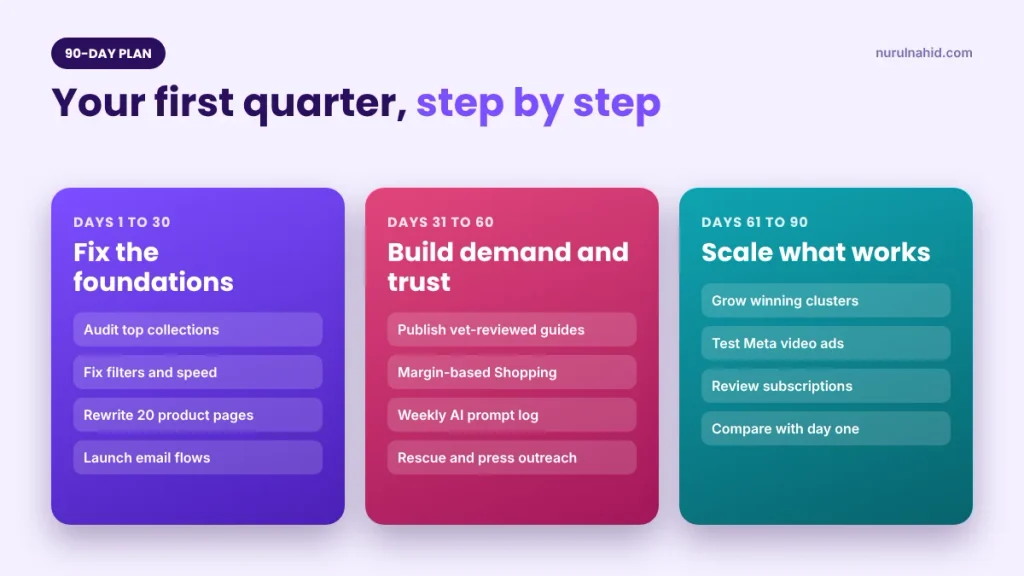
Days 1 to 30: fix the foundations
- Run a technical and content audit of your top collections and products.
- Fix filter indexing, speed issues and structured data.
- Rewrite your top 20 product pages and top 5 collection intros.
- Set up welcome, replenishment and post-purchase email flows.
- Publish a review policy and start honest review requests.
Days 31 to 60: build demand and trust
- Publish two to four specialist guides with a named, qualified reviewer.
- Launch or tidy Google Shopping with margin-based campaigns.
- Start a weekly AI prompt log of 10 to 15 buyer-style prompts.
- Begin outreach to two or three rescues, breed clubs or local press contacts.
Days 61 to 90: scale what works
- Expand content in the cluster that is gaining impressions fastest.
- Test Meta ads with owner-shot video for two hero products.
- Review subscription journeys against the January 2027 rules.
- Compare AI recommendation rate, organic revenue and repeat rate with day one.
The numbers to track every month
Marketing only works if you measure the right things. Track these in one simple monthly sheet:
| Metric | What it tells you |
|---|---|
| Organic revenue from collections | Whether your SEO pages are selling, not just ranking |
| Cost per first order (by channel) | What it really costs to win a new customer |
| Repeat purchase rate at 90 days | Whether email and subscriptions are working |
| Active subscriptions and cancellation rate | Health of your recurring revenue |
| Average order value | Whether bundles and cross-sells are landing |
| AI recommendation rate | How often AI names you for your test prompts |
| Review volume and average rating | Trust signals for shoppers and AI |
Look at trends over three months. One good or bad week tells you very little.
Common mistakes online pet stores make
- Copying supplier descriptions across hundreds of products.
- Letting filter URLs run wild, so Google crawls junk instead of best sellers.
- Making health claims that a food or supplement cannot back up.
- Chasing generic terms that national retailers own.
- Spending on ads before fixing the site, so paid clicks land on slow, thin pages.
- Ignoring repeat orders, even though pet food is bought again and again.
- Hiding subscription cancellation behind emails or phone calls.
Fix these first and every pound you spend afterwards works harder.
Example budget split (illustrative maths, not a quote)
This is an example to show the maths. Assume a store with £3,000 a month to invest and an average order value of £45.
| Channel | Example monthly spend | Share |
|---|---|---|
| SEO and content | £1,200 | 40% |
| Google Shopping | £1,050 | 35% |
| Meta ads | £450 | 15% |
| Email platform, reviews and creative | £300 | 10% |
| Total | £3,000 | 100% |
If Shopping brings 40 first orders, the cost per first order is £1,050 ÷ 40 = £26.25.
If 35% of those customers reorder four more times through email, that is 40 × 0.35 × 4 = 56 extra orders.
At £45 each, that adds £2,520 in revenue with no extra ad cost.
That is why retention changes the whole budget. Swap in your own figures before you decide anything.
For a clearer view of what professional SEO support costs, see my guide to SEO costs in the UK.
How I help with your total pet store marketing
I connect SEO, AI visibility, Shopping, social and email into one plan built around repeat orders, not just first clicks.
My digital marketing service covers the strategy, the setup and monthly reporting, so you always know which channel is paying back.
Case study: from almost no traffic to 2,000+ monthly clicks in four months
This case study comes from a different sector, luxury calligraphy and engraving in Florida, but the method is the same one I use for online stores.
Carla Schall Design had a strong offline reputation and almost no search presence.
The work covered a technical SEO audit and fixes, keyword research, new service pages, local SEO, citations and AI search visibility.
The results, taken from Google Search Console and AI visibility tracking:
- 2,000+ monthly organic clicks within four months, from almost none.
- Page one for all core calligraphy and luxury stationery keywords.
- 20+ service keywords featured in Google AI Overviews and AI citations.
The lesson for pet stores is clear: fix the foundations first, give each product range its own strong page, and build local and AI signals together.
Read the full Carla Schall SEO case study.
Related guides
- Ultimate Marketing Guide for Jewellery Stores in the UK
- The complete SEO guide for UK businesses
- How long SEO takes in the UK
FAQ: SEO and marketing for online pet stores
What is the best SEO strategy for an online pet store in the UK?
Focus on specific breed, life-stage, diet and problem searches instead of generic terms. Build strong collection pages, rewrite key product pages, fix filter indexing and add Product structured data.
Can a small pet shop compete with big retailers on Google?
Yes, on specialist searches. Large retailers dominate generic terms, but a niche store with expert guides, honest reviews and deep collections can win long-tail searches with strong buying intent.
How do I get my pet store recommended by ChatGPT?
Make your pages answer-first, keep product data accurate, earn genuine reviews and get mentioned by independent sites and communities. Track buyer-style prompts weekly to see whether you are named.
Do I need to register to sell flea and worming treatments online?
If you sell POM-V, POM-VPS or NFA-VPS veterinary medicines online, you must register with the Veterinary Medicines Directorate. AVM-GSL products do not need registration. Check each product’s category on GOV.UK.
Can I offer a discount for reviews?
Incentivised reviews must not be concealed under the DMCC Act. If you offer any reward, disclose it clearly, ask all buyers rather than only happy ones, and publish a clear review policy.
What changes for pet food subscriptions in 2027?
New DMCC Act subscription rules are due in January 2027. Expect renewal reminders, cooling-off rights after trials convert or contracts renew, and a simple cancellation route. Check the final government guidance.
How long does SEO take for an online pet store?
Technical fixes can show results within weeks, while competitive collection rankings often take several months. Results depend on your catalogue, competition, site history and how consistently the work is done.
How much should an online pet store spend on marketing?
There is no fixed figure. Start with what you can sustain, put money where margin is strongest, and measure cost per first order and repeat rate before scaling any channel.
Ready to grow your online pet store?
You know your products and your customers’ pets better than any big retailer. What you need now is a clear plan that puts that expertise in front of the right owners.
I’ll guide you through it: audit your store, fix what blocks sales, and build SEO, AI visibility and retention that keep orders coming.
Book a free call or message me on WhatsApp to talk about your pet store.