SEO for home and kitchen stores in 2027 means three jobs done together.
Rank your category and product pages on Google, get your store named when shoppers ask ChatGPT or Google AI Overviews for advice, and back both with Shopping ads, email and reviews.
The stores that win show the energy label, the real dimensions, the delivery and installation terms and the running cost on every page.
They answer buyer questions plainly and earn honest reviews.
This guide walks you through all three parts, step by step, with UK data and rules.
I’m Nurul Nahid, an SEO and AI search expert in the UK with 7+ years of experience in SEO, local SEO, e-commerce SEO, GEO, AEO and digital marketing.
I help online appliance and kitchenware retailers fix product and category pages, product schema and buying guides through my e-commerce SEO service for UK online stores.
At a glance: UK appliance retail in late 2026
| Fact | Figure | Source |
|---|---|---|
| Share of GB retail sales made online | 28.8% in September 2026 | ONS, 23 October 2026 |
| Typical UK household energy price cap | £1,723 a year (1 October to 31 December 2026) | Ofgem, 26 August 2026 |
| Cost per use, air fryer vs electric oven (600g chicken) | 14p vs 20p | Energy Saving Trust, August 2025 |
| Top Which? customer scores for appliance shops | Miele 88%, John Lewis 87%, AO 86% | Which?, October 2026 |
| Average PPC wastage across 11 big UK appliance brands | £316,029 a month | ClickThrough Marketing benchmark, August 2026 |
Part 1: SEO guide 2027 for home and kitchen appliance stores
SEO for home and kitchen stores works when each page matches one buying question.
Category pages answer “which type”, product pages answer “will this fit, what will it cost to run, and when will it arrive”, and guides answer “how do I choose”.
Big retailers own the generic head terms. An independent or mid-size store wins on specific models, sizes, fitting types and real buying help that big sites skip.
Keyword research for home and kitchen appliance stores

Appliance searches follow a clear ladder. Shoppers move from a problem, to a product type, to a size or feature, to a model, and finally to a retailer.
Your keyword plan should cover every step of that ladder, not only the last one.
| Stage | What the shopper types | Page that should rank |
|---|---|---|
| Problem | “fridge freezer making noise”, “cheapest way to cook for one” | Help guide or blog post |
| Type | “integrated dishwasher”, “range cooker”, “air fryer” | Category page |
| Fit and feature | “slimline dishwasher 45cm”, “60cm wide fridge freezer frost free”, “dual basket air fryer” | Filtered category or sub-category page |
| Comparison | “Ninja vs Tower air fryer”, “induction vs ceramic hob” | Comparison guide |
| Model | A full model code copied from a label, “Smeg kettle cream” | Product page |
| Retailer | “Bosch dishwasher with installation”, “next day delivery fridge freezer” | Product page plus delivery and service pages |
Start with your own data. Pull the queries from Google Search Console and the search terms report from your Google Ads account.
Those two lists show the exact words your buyers already use, including model codes your keyword tool may miss.
Then group keywords into four clusters:
- Size and fit terms: width in cm, integrated or freestanding, under-counter, tall, American-style.
- Running cost terms: “energy efficient”, “cheapest to run”, “A rated”, “low energy”.
- Feature terms: quiet, frost free, steam, pyrolytic, smart, dual zone.
- Service terms: delivery, installation, recycling the old appliance, warranty.
Size and fit terms matter more in this niche than almost any other. A dishwasher that is 2cm too wide gets returned, so shoppers search with measurements.
Use UK words throughout. Write “hob”, not “stovetop”, and “fridge freezer”, not “refrigerator”. Write “washing machine”, not “washer”.
For a deeper walkthrough of tools and methods, see my UK keyword research guide.
Collection and category page SEO
Category pages are your money pages. They usually rank for “type” and “fit” searches, which carry strong buying intent.
Most appliance category pages are a grid of products and nothing else. That is the gap you can fill.
A strong category page has five parts:
- A short intro (60 to 120 words) that says who the range suits and what to check first.
- Clear filters for width, height, energy class, noise level, brand and price.
- A small comparison table of three to five popular models, with price and energy class.
- A short buying help block near the bottom, such as “How to measure for an integrated fridge”.
- Links to the right guides and sub-categories, for example from “dishwashers” to “slimline dishwashers”.
Keep categories strict. A shopper looking for “integrated washing machines” should not land on a mixed laundry page.
Filters and faceted navigation
Filters create thousands of URL combinations. Only a few deserve to be indexed.
Index a filtered page only when people search for it. “Slimline dishwashers” and “American fridge freezers” deserve their own indexable pages with their own copy.
Combinations such as “silver, 45cm, under £400, Bosch” usually do not. Keep those crawlable for shoppers but set them to noindex or canonicalise them to the parent.
Check this with real data. If Search Console shows impressions for a filter combination, turn it into a proper landing page.
Product page SEO for appliances
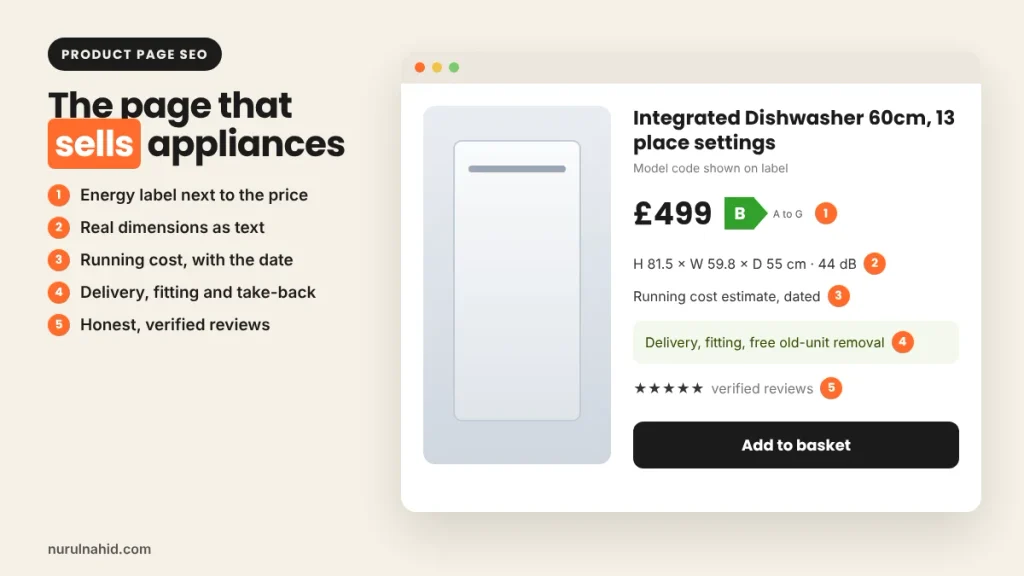
Product pages decide the sale. For appliances they also carry legal duties that many small stores miss.
Start with copy. Most stores paste the manufacturer description, so hundreds of sites share the same words.
Rewrite the opening for your buyer. Say who the model suits, what space it needs and what makes it different from the model next to it.
What every appliance product page needs
- The model code in the title tag and H1, plus the plain product name.
- Exact dimensions (height, width, depth) and the space needed for doors and ventilation.
- The energy label, shown the way the law asks (see below).
- Running cost help, such as annual kWh and a simple cost estimate, with the unit rate you used.
- Noise level in dB, capacity in litres or place settings, and programme details.
- Delivery, installation and removal options, with prices and lead times.
- Your take-back promise for the old appliance.
- Warranty length and who provides it.
- Real customer reviews and Q&A.
Energy labels are a legal rule, not a nice extra
Energy labels apply to dishwashers, washing machines, fridges, ovens, range hoods and other products in scope.
Under the UK energy labelling guidance on GOV.UK, online dealers must show an arrow with the energy class and the range of classes next to the product.
The arrow must link to the full label.
The product information sheet must also be available alongside the product. For any distance sale, this information must reach the shopper before they buy.
Northern Ireland follows EU labelling rules, so check which label applies if you ship there.
Get this right and you gain twice. You stay compliant, and you add exactly the information shoppers and AI tools look for when they compare running costs.
Show your WEEE take-back offer
UK retailers selling electrical goods must give household customers a free way to dispose of the old item.
The GOV.UK guidance on taking back electrical waste says stores must take back waste of the same type as the item sold, whether the customer buys in store, online or by mail order.
Smaller sellers (under £100,000 of electrical sales a year) and online-only sellers can join the Distributor Take Back Scheme instead.
Whichever route you use, explain it on product pages and at checkout.
“We take your old one away” is a strong selling point, and it answers a question shoppers often type into Google.
Site structure and internal linking
A clear structure helps shoppers and search engines find the right page in two or three clicks. Most appliance stores work best with three levels.
| Level | Example | Purpose |
|---|---|---|
| Department | Kitchen appliances, Laundry, Small appliances | Broad browsing |
| Category | Dishwashers, Fridge freezers, Air fryers | Main “type” searches |
| Sub-category | Slimline dishwashers, Integrated fridge freezers, Dual basket air fryers | “Fit and feature” searches |
Link sideways as well as down.
A dishwasher product page should link to its sub-category, to a “how to measure” guide and to matching accessories such as rinse aid or a fitting kit.
Use descriptive anchor text such as “45cm slimline dishwashers”, not “click here”. Your guides should link to the category they help shoppers choose from.
Keep the breadcrumb trail visible on every product page. It helps shoppers move back up a level, and it gives search engines a clear map of your catalogue.
Local SEO for stores with a showroom
Many appliance retailers still have a showroom or warehouse counter. Shoppers spending £1,000 or more on a range cooker or an American fridge freezer often want to see it first.
If you have a physical store, local search can bring in some of your highest-value buyers.
They search phrases such as “appliance shop near me”, “range cookers [town]” or “washing machine repair and sales [town]”.
Set up the basics well:
- Google Business Profile with the right primary category, such as “Appliance store” or “Kitchen appliance store”, and accurate opening hours.
- Product and service photos taken in your own showroom, not stock images.
- A store page on your website with address, parking, brands on display, delivery radius and installation areas.
- Local delivery pages for the towns you serve, written with real detail such as delivery days and installation options.
- Reviews that mention the service, such as delivery, fitting and advice, not just “great product”.
Avoid thin town pages that only swap the place name. Each local page must say something true and useful about that area.
My Google Business Profile guide for UK businesses walks through set-up and optimisation step by step.
Technical SEO and Core Web Vitals
Appliance sites are heavy. They carry large image galleries, 360-degree views, PDF manuals and long spec tables.
Speed problems are common even at the top of the market.
ClickThrough Marketing’s Q3 2026 benchmark of 11 UK online appliance brands reported mobile speed scores ranging from just 2 to 46.
That is an agency report, not an official dataset. Still, it shows that a fast smaller store can stand out.
Focus on these fixes first:
- Compress and resize images. Serve WebP or AVIF and lazy-load gallery images below the first screen.
- Load spec tables as HTML text, not images. Google and AI tools cannot read a spec sheet that only exists inside a picture.
- Cut third-party scripts. Review widgets, chat tools and finance calculators often slow the page most.
- Keep the main product image and price in the first screen on mobile.
My technical SEO checklist for UK sites covers crawl, indexing and speed checks in more detail.
Handle discontinued models properly
Appliance ranges change every year. Old model pages often hold years of links and rankings.
Do not delete them and leave a 404 error. Use one of three options:
- Replacement exists: keep the page live for a while, show “This model has been replaced by…” and link to the new one. Later, redirect with a 301.
- No direct replacement: redirect to the closest sub-category, such as “60cm integrated dishwashers”.
- Parts or manuals still searched: keep a light page with the manual and a link to current models.
Out-of-stock items are different. Keep the page live, show an expected date and offer a back-in-stock alert.
Watch the November 2026 core update
Google began rolling out its November 2026 core update on 10 November 2026, with about two weeks expected for the rollout.
Wait for it to finish before judging any ranking changes. Then compare pages that moved against thin, copied manufacturer text, which is the most common weakness in this niche.
Product, Offer and Review schema
Structured data helps Google read your price, stock, delivery and returns details. It can make your listings eligible for richer product results.
Add Product schema with a nested Offer on every product page. Include the price in GBP, availability, condition, GTIN and brand.
Google also supports return policy details through the MerchantReturnPolicy structured data. You can set a standard policy at organisation level and a different one on specific products.
Since November 2025, Google has also let merchants share shipping and returns policies through Search Console settings or organisation-level markup. Settings made in Search Console take priority over on-page markup.
For appliances, return rules often differ for large items once they are installed. Make sure the markup matches the real terms on your returns page.
Reviews in schema: only real ones
Add AggregateRating and Review markup only for genuine reviews shown on the page.
Never mark up reviews you cannot verify. The UK rules on fake reviews now carry serious penalties, as Part 2 explains.
Treat schema as hygiene. It helps search engines read your data, but it does not guarantee rankings or AI citations on its own.
Content hub: best-of lists, comparisons and the energy-saving angle
Content is where smaller appliance stores can beat the giants. Big retailers have huge catalogues but thin buying help.
Build a hub with three types of content.
1. Comparison and best-of guides
Shoppers ask “which is better” before they ask “where to buy”. Write honest comparisons such as “Integrated vs freestanding dishwashers” or “Best quiet fridge freezers for open-plan kitchens”.
Use a comparison table, real prices, energy classes and noise levels. Say clearly who each option suits.
Update these pages at least twice a year and show the update date. Prices and ranges change fast in this niche.
2. Running cost and energy-saving content
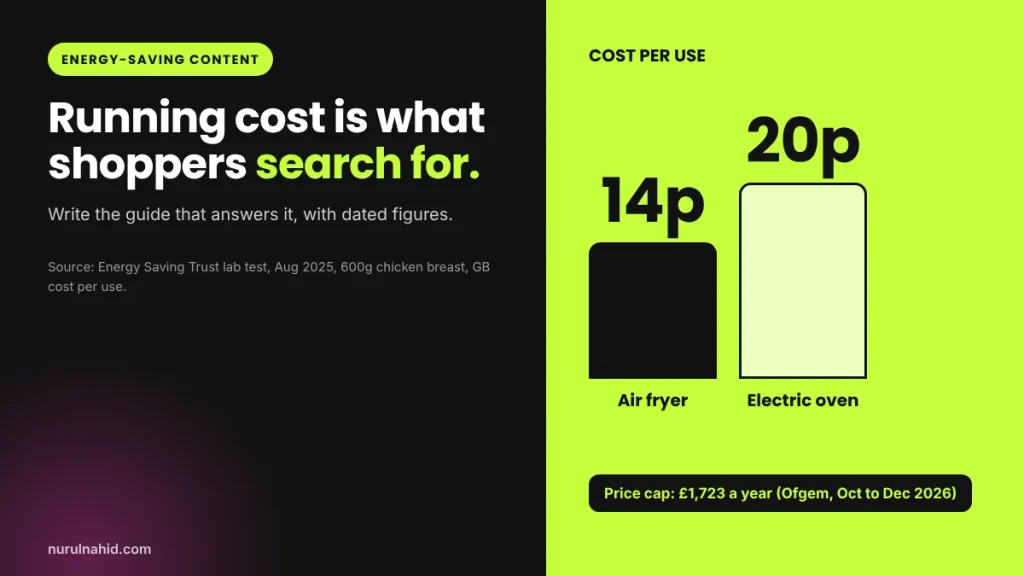
Running costs are a real worry for UK households. Ofgem set the energy price cap at £1,723 a year for a typical household from 1 October to 31 December 2026.
The next cap, for January to March 2027, is due by 25 November 2026. Each cap change is a natural moment to refresh your running cost content.
Lab tests from the Energy Saving Trust found an air fryer cost 14p per use against 20p for an electric oven, when cooking the same 600g of chicken breast.
A microwave cost 4p for a ready-made lasagne.
That is the kind of fact shoppers search for.
Build guides such as “Air fryer vs oven running costs” and “How much does a fridge freezer cost to run per year”.
Show your working. Use the formula power (kW) × hours used × unit rate (p/kWh) = cost, and state the unit rate and date you used.
Be careful with claims. The Energy Saving Trust results apply to specific foods and portions, so never promise a fixed saving on every meal.
3. Fit, care and fix guides
“How to measure for an integrated fridge”, “How to descale a kettle” and “Why is my dishwasher not drying” pull steady traffic all year.
Each one is a natural route to a product or accessory. A descaling guide links to descaler; a fit guide links to the right width filter.
Link building and digital PR for appliance stores
Links still matter for competitive appliance terms. The best links come from real relationships and useful data.
Try these routes:
- Manufacturer dealer pages. Many brands list authorised retailers. Ask your account manager to make sure your store is listed and linked.
- Kitchen fitters and designers. Partner with local fitters who recommend appliances. A “recommended supplier” link is natural and relevant.
- Data stories. Publish your own running cost tests or sales trends, such as “the most bought air fryer sizes this winter”. Journalists cover these each time the price cap changes.
- Local press. Stores with a showroom can earn coverage for openings, recycling drives or community events.
- Student and moving-home guides. University accommodation offices and letting agents often link to “what to buy for your first flat” guides.
Avoid paid link schemes and low-quality guest posts. They carry risk and rarely move appliance rankings.
My guide to link building in the UK explains how to judge whether a link is worth earning.
Part 1 checklist
| Area | Check | Done when |
|---|---|---|
| Keywords | Mapped by stage: problem, type, fit, comparison, model, retailer | Every key page has one main query |
| Categories | Intro copy, filters, mini comparison table, buying help | Top 10 categories updated |
| Product pages | Unique intro, full dimensions, energy label arrow, running cost, delivery and take-back details | Top 50 sellers updated |
| Technical | Images compressed, spec tables in HTML, scripts cut | Mobile pages load the image and price fast |
| Discontinued models | Replacement message, then 301 redirect | No 404s on old model URLs |
| Schema | Product, Offer, return and shipping policies, honest reviews | No errors in Search Console reports |
| Content | Comparison guides, running cost guides, fit and care guides | One new guide every two weeks |
| Links | Dealer listings, fitter partners, data PR | Five relevant links a quarter |
If your store already has these pages but they are not ranking, I can help you find out why.
I work on category structure, product schema, faceted navigation and buying guides for UK online stores.
A good first step is my free SEO audit. I will check your top category and product pages and show you the fixes that matter most.
Part 2: How to get home and kitchen stores recommended by ChatGPT, Perplexity and Google AI Overviews
AI tools recommend appliance stores they can trust and describe clearly.
They lean on independent reviews, comparison sites, forums and pages with plain facts on price, delivery, returns and running costs.
To get your store recommended, make those facts easy to find on your own site, earn genuine mentions elsewhere, and track how often AI names you.
How AI tools choose which appliance stores to recommend
When a shopper asks “where should I buy a fridge freezer with installation in the UK”, the AI tool does not check a ranking list.
It pulls from sources it can read and trust, then writes an answer.
For appliances, those sources usually include:
- Independent surveys and tests, such as the Which? retailer and product reviews.
- Retailer pages with clear prices, specs, delivery and returns details.
- Review platforms and customer feedback.
- Forums and community threads where people share real buying experiences.
- News and trade press that mention stores by name.
Which? is a good example of what AI tools can read. Its best home appliance shops survey, published in October 2026, used 11,685 experiences from 6,433 people.
Miele scored 88%, John Lewis 87% and AO 86%. Which? also checks returns policies and terms, and leaves out stores whose returns information is unclear.
That tells you what “trusted” means in this niche: fair returns, clear terms, good delivery and after-sales service.
AI already sits inside appliance searches
Google AI Overviews now appear on many appliance queries. The same ClickThrough Marketing benchmark reported that 27,400 of Currys’ universal search appearances came from AI Overviews.
AI shopping traffic is still small but growing fast.
Bain & Company research, reported by Retail Times in May 2026, found shopping referrals from ChatGPT more than doubled in a year across the US, UK, Germany and France.
The same report said AI drives up to a quarter of referral traffic for some retailers, but still under 1% of their total traffic.
So treat AI as a fast-growing channel, not a replacement for Google.
Make your pages easy for AI to quote
AI tools pick passages that answer a question directly. A page that hides the answer under a long story is harder to use.
A study by TJ Digital of 193,507 AI answers, covered by Search Engine Journal on 28 October 2026, found that 23% of cited pages opened with a direct answer.
Only 14% of pages that were retrieved but not cited did the same.
Cited pages were also more likely to have a year in the title, a recent update date, tables and prices.
Two cautions matter here. This is a correlation, not proof of cause, and the study comes from an agency that sells AI search services.
Still, the pattern matches good buying advice. Here is how to apply it on an appliance store:
- Open each guide with the answer. “For a family of four, a 13 place-setting dishwasher usually fits best.”
- Add a year and an honest update date to guides that change, such as “Best quiet fridge freezers 2027”.
- Use tables for sizes, energy classes, noise levels and prices.
- Show prices and running costs, with the date they were checked.
- Add first-hand detail. Photos from your showroom, notes from your delivery team, or real measurements from installs.
Say who your store is for
AI tools often know what a business sells but not who it suits. Tell them directly.
Add a short, factual “Who we help” section on your About and Delivery pages.
For example: “We specialise in integrated kitchen appliances for homeowners and kitchen fitters across Essex and Hertfordshire, with two-person delivery and installation.”
That one sentence gives AI a clear reason to recommend you for the right prompts.
Match the content type to the prompt
Different shopper prompts call for different pages. Build the page type that answers each prompt best.
| Prompt type | Example | Page AI is most likely to use |
|---|---|---|
| “Which is best” | “Best quiet dishwasher UK” | Comparison guide with a table and honest picks |
| “Which is cheaper” | “Air fryer vs oven running cost” | Running cost guide with the formula and dated rates |
| “Will it fit” | “Fridge freezer for 60cm gap” | Fit guide plus filtered category page |
| “Where to buy” | “Range cooker with installation near me” | Delivery and installation page, store page, reviews |
| “Is this store good” | “Is [store] reliable?” | About page, review policy, third-party reviews |
Notice that “where to buy” prompts lean on service pages. Many stores have weak delivery and installation pages, which makes it hard for AI to recommend them.
Write a full page for each service: delivery areas, two-person delivery, unpacking, installation, integrated fitting, removal of the old appliance and costs.
Give each page a short answer at the top.
Keep your brand facts the same everywhere
AI tools build their picture of your store from many sources. If those sources disagree, the AI may get your facts wrong or leave you out.
Check that these details match across your website, Google Business Profile, marketplaces, social profiles and directories:
- Business name, address and phone number.
- Delivery areas and delivery days.
- Installation and removal services.
- Warranty and returns terms.
- Brands you are authorised to sell.
Then ask each AI tool “What do you know about [your store name]?” Note anything wrong, and fix the source it most likely came from.
FAQ and structured data: hygiene, not magic
FAQ blocks help both shoppers and AI tools. Write them from real customer questions: delivery days, installation, removal of the old appliance, warranty, and returns for opened items.
Keep each answer short, specific and true. Mark them up with FAQPage schema where it suits the page.
Be realistic about schema.
The TJ Digital study saw a small link between schema and citations, but an Ahrefs test reported by Search Engine Journal found that adding schema to cited pages gave no significant increase.
So add schema because it keeps your data clean and machine-readable. Do not expect it to win AI citations on its own.
Reviews, Reddit and PR mentions
Mentions on other sites help AI tools decide whether to trust and recommend you. For appliances, three sources matter most.
Reviews you can stand behind
Ask every customer for a review after delivery, and again after installation if you fit the product.
Follow the law closely. Since 6 April 2025, fake reviews and concealed incentivised reviews are banned practices under the Digital Markets, Competition and Consumers Act 2024.
The CMA’s fake reviews guidance (CMA208) expects businesses that publish reviews to take steps to prevent and remove fake ones.
It also expects a clear policy on how you handle reviews.
In practice, that means:
- Never buy reviews or write them yourself.
- Never offer a reward only for positive reviews.
- If you give an incentive, make it available for any honest review and disclose it.
- Publish negative reviews too, and reply politely.
- Write and publish a short review policy page.
Forums and community threads
Appliance buyers often check community threads before they spend £500 or more. Answer questions honestly where you have real expertise, and always say you work for the store.
Never post fake “happy customer” comments. It breaks forum rules, it can break consumer law, and it damages trust fast.
Digital PR and expert comment
Journalists cover energy bills, cost-of-living tips and home trends all year. Offer expert comment from your store when the price cap changes or a heatwave hits.
A quote in a national or regional news story is a strong trust signal for both search engines and AI tools.
Let the right AI crawlers read your site
AI tools can only use what they can access. Check your robots.txt file and your firewall or CDN settings.
Some security tools block AI crawlers by default. If OpenAI’s search crawler or Perplexity’s crawler is blocked, your pages may not be used in their answers.
Decide on purpose. You may choose to block AI training while still allowing search crawlers. Just make sure the choice is deliberate, not an accident of a plugin setting.
My guide on how to check if your website is ready for agentic search walks through these checks.
Feed your product data to AI shopping tools
AI shopping answers depend on accurate product data. Your Google Merchant Center feed is the base for Google Shopping, free listings and AI shopping features.
Make each product record complete:
- Full title with brand, product type, key feature, size and colour.
- GTIN, model code and brand.
- Price and stock that match the website exactly.
- Energy class, dimensions and capacity as attributes.
- Delivery cost, delivery time and returns policy.
Mismatched prices between feed and page are a common cause of disapprovals. They also confuse AI tools that compare retailers.
Claim your business profile in ChatGPT
OpenAI has launched a beta business hub called Businesses in ChatGPT, reported by Search Engine Roundtable on 10 November 2026.
Businesses can claim a profile, update their details and see mentions and clicks from ChatGPT to their website. OpenAI notes that clicks do not confirm visits or sales.
Some features, such as a Business Agent, are limited to eligible US businesses for now. Check availability for your store and claim your profile if you can.
Track your AI visibility
You cannot improve what you do not measure. AI answers change each time, so one screenshot proves very little.
Search Engine Journal’s guide to measuring AI search visibility suggests tracking three things: how often you appear, how often you are actually recommended, and whether AI describes your business accurately.
Here is a simple system any store owner can run.
Step 1: Write 12 buyer prompts
Use the questions your customers really ask. For example:
| # | Prompt |
|---|---|
| 1 | Where can I buy an integrated dishwasher with installation in [your area]? |
| 2 | Best UK online shop for range cookers with delivery and removal |
| 3 | Which air fryer is cheapest to run in the UK? |
| 4 | Quietest fridge freezer for an open-plan kitchen |
| 5 | Is [your store name] a good place to buy appliances? |
| 6 | Best place to buy a washing machine with next-day delivery |
| 7 | Independent appliance shops near [your town] |
| 8 | Slimline dishwasher 45cm, which one should I buy? |
| 9 | Who sells [brand] appliances with a long warranty in the UK? |
| 10 | Kitchen appliance package deals for a new kitchen |
| 11 | Air fryer vs oven, which saves more money? |
| 12 | Where to buy a smart oven in the UK |
Step 2: Run them every week
Run each prompt in ChatGPT, Perplexity, Gemini and Google (for AI Overviews). Log the results in a simple sheet.
Record four things per prompt: were you mentioned, were you recommended, which sources were cited, and were the facts about you correct.
Step 3: Work out your recommendation rate
Recommendation rate = prompts where you were recommended ÷ prompts tested × 100.
For example, if you were recommended in 3 of 48 runs (12 prompts × 4 tools), your recommendation rate is 6.25%. Track it each month.
Step 4: Fix the gaps and link to sales
When AI cites a source that does not mention you, that source is your next target. It might be a review site, a comparison guide or a local news story.
Then check AI referral sessions in Google Analytics 4. Tag your enquiry forms and phone numbers so you can link AI visibility to real orders, not just mentions.
This is the work I do through my AEO service for answer engines and my GEO service for generative AI search.
I build the prompt log, audit the sources AI trusts in your niche, and fix the pages and mentions that stop your store being recommended.
Part 3: Total marketing plan for home and kitchen appliance stores
A complete marketing plan for an appliance store joins SEO and AI search to four paid and owned channels: Google Shopping, Meta ads, email and SMS, and social proof from real customers.
Marketplaces can add reach, but your own site should stay the place where margin and repeat customers live. The plan below runs in 90 days and scales with your budget.
Email and SMS: the channel most appliance stores waste
Appliance buyers do not buy every week. That is exactly why email works. Each sale opens a long relationship of care, parts and future upgrades.
Set up these automated flows first:
- Welcome flow. Three emails: your delivery and installation promise, your best buying guides, and your review policy.
- Abandoned basket. Remind the shopper of the model, the delivery date and the take-back offer. Big-ticket buyers often need a second look.
- Price drop and back-in-stock alerts. Very useful for popular models that sell out before sales events.
- Post-delivery care. Send a “getting started” email with set-up tips and a link to the manual.
- Care reminders. Filter changes for fridge freezers and cooker hoods, descaling for kettles and coffee machines.
- Review request. Ask after delivery, and again after installation if you fit the appliance.
- Upgrade timing. Small appliances are replaced more often. A kettle or toaster buyer is a good audience for a matching set.
Use SMS for service messages only, such as delivery slots and engineer arrival times. Shoppers welcome those; they rarely welcome sales texts.
Follow UK rules on consent.
Marketing emails and texts fall under the Privacy and Electronic Communications Regulations (PECR) as well as UK GDPR, so collect clear opt-ins and give an easy unsubscribe.
Paid search: Google Shopping and Performance Max
Most appliance searches with buying intent show Shopping ads at the top. If you sell online, Shopping is usually your first paid channel.
The ClickThrough Marketing Q3 2026 benchmark reported an average cost per click of £3 across 11 big UK appliance brands, from £1 for Beko to £6 for Miele GB.
It also reported average wastage of £316,029 a month across those brands.
Those are big-brand figures, and the report comes from an agency. But they show how easy it is to spend money on clicks that never convert.
Protect your budget with five rules:
- Feed quality first. Full titles, GTINs, energy class and correct prices. A weak feed costs more per sale.
- Split campaigns by margin, not just by category. A high-margin range cooker deserves a different target than a low-margin kettle.
- Add negative keywords for parts, repairs, manuals and “second hand” if you do not sell them.
- Use your Search Console data to find terms that already convert organically, then test them in paid search.
- Promote delivery and installation in your ad copy. Free removal of the old appliance is a strong reason to click.
Performance Max can work well for appliances, but only with a clean feed and conversion tracking you trust. Review search term insights every week.
Meta ads, video and social proof
Appliances are hard to judge from a still photo. Short video does the job better.
Film simple, honest clips:
- A 20-second “how quiet is it” test for dishwashers and fridge freezers.
- A side-by-side air fryer vs oven cook, with the timer and running cost on screen.
- Your delivery team installing an integrated appliance and taking the old one away.
- A showroom walk-through for range cookers and statement fridges.
Use these clips in Meta ads, Reels, TikTok and YouTube Shorts. Retarget people who viewed product pages but did not buy.
User-generated content (UGC)
Real customer photos of appliances in real kitchens build trust fast. Ask for them in your review emails and feature them on product pages, with permission.
If you pay creators or give free products, the content must be clearly labelled as advertising.
The ASA and the CMA both expect ads to be obviously identifiable, so use “#ad” or “Advert” at the start of captions.
Marketplaces: reach without losing your margin
Amazon, eBay and other marketplaces bring huge audiences. They also take fees and own the customer relationship.
Use them with care:
- List end-of-line stock and small appliances that sell on price.
- Keep your best bundles, installation and services on your own site.
- Match prices carefully so you do not undercut your own website.
- Use marketplace reviews to learn which questions buyers ask, then answer those on your product pages.
Remember that WEEE take-back duties apply to distance selling too. Explain your take-back route on marketplace listings as well as your own site.
Bundles, trade buyers and repeat business
Single appliance sales have thin margins. Bundles and trade accounts can lift order value and bring repeat custom.
Kitchen appliance packages
People fitting a new kitchen often need four or five appliances at once.
A package of oven, hob, hood, dishwasher and fridge freezer saves them time and gives you a larger order.
Build package pages for common kitchen sizes and budgets. Show the total price, the saving, the combined energy classes and one delivery and fitting date for everything.
Trade and landlord buyers
Kitchen fitters, builders, landlords and letting agents buy appliances again and again. They care about stock, speed, trade pricing and simple invoicing.
Create a trade page that explains how to open an account, what discounts apply and how delivery to site works. Then promote it through local fitter networks and landlord groups.
For landlords, write guides on reliable, easy-to-clean appliances for rental homes. These pages attract a buyer group most retail sites ignore.
Finance and payment options
Finance options can help shoppers afford larger appliances.
If you offer credit or buy now pay later, show the terms clearly and check the current FCA rules with your finance provider before you promote it.
Measure what matters
Track a small set of numbers every month. They tell you which channels deserve more budget.
| Metric | Where to find it | What it tells you |
|---|---|---|
| Organic clicks to category and product pages | Google Search Console | Whether SEO work is reaching buyers |
| Conversion rate by channel | Google Analytics 4 | Which traffic actually buys |
| Cost per order (paid) | Google Ads and Meta | Whether ads are profitable |
| AI recommendation rate | Your weekly prompt log | Whether AI tools name your store |
| Review count and average rating | Your review platform | Trust and social proof |
| Repeat customer rate | Your e-commerce platform | Whether email and service are working |
Look at trends over three months, not single weeks. Appliance sales swing with weather, energy news and sales events.
The UK appliance marketing calendar
Appliance demand follows the seasons, energy news and life events. Plan content and promotions around these moments:
| Month | Moment | What to promote |
|---|---|---|
| January | New year sales and the January energy price cap | Running cost guides, energy-efficient models |
| March to April | Spring moving season and the April price cap | Package deals for new homes, laundry |
| June to August | Heatwaves | Fans, air conditioners, fridges and freezers |
| September | Students moving into first flats | Small appliances, compact microwaves, kettles |
| October | Price cap change and colder weather | Air fryers, slow cookers, tumble dryers |
| November | Black Friday | Hero products, bundles and pre-order alerts |
| December | Christmas gifts | Small appliances, coffee machines, gift guides |
Heat does move sales. The ONS said June 2026’s heatwave played a part in strong retail demand, including for air conditioning units, as Retail Gazette reported.
Prepare “how to keep cool” and “fridge freezer in hot weather” content in spring, so it is indexed before the first hot week.
90-day marketing plan for an appliance store

This plan suits a store with an existing website and product catalogue. Adjust the pace to your team.
| Phase | Weeks | Focus | Key tasks |
|---|---|---|---|
| Fix | 1 to 4 | Foundations | Technical audit, energy label and take-back checks, Merchant Center feed clean-up, conversion tracking, review policy page |
| Build | 5 to 8 | Pages and content | Rewrite top 10 category pages and top 50 product pages, publish 4 comparison or running cost guides, launch welcome and abandoned basket flows |
| Grow | 9 to 13 | Reach and AI visibility | Shopping and Meta campaigns, first 4 video clips, dealer and fitter link outreach, weekly AI prompt log, monthly report |
By day 90 you should have clean data, stronger pages and a baseline for AI visibility.
Rankings in competitive appliance terms usually take longer, so judge SEO over six to twelve months.
My guide on how long SEO takes in the UK explains realistic timelines in more detail.
Budget: a worked example
This is an example to show the maths, not a forecast for your store.
Say a store spends £3,000 a month on Shopping ads at an average £3 per click. That buys about 1,000 clicks.
If 2% of those clicks become orders, that is 20 orders.
At an average order value of £450, that is £9,000 in sales, or £3 back for every £1 spent on ads.
Now improve the product pages so the conversion rate rises from 2% to 2.5%. The same £3,000 now brings 25 orders and £11,250 in sales.
That is why SEO and page quality matter even for paid campaigns. Better pages lower the cost of every sale across every channel.
A simple starting split for many appliance stores:
| Channel | Share of monthly marketing budget |
|---|---|
| SEO and content (pages, guides, technical fixes) | 35% |
| Google Shopping and Search | 35% |
| Meta and video | 15% |
| Email, SMS and reviews tools | 10% |
| AI visibility tracking and PR | 5% |
Move money towards whatever shows the lowest cost per order after the first 60 days. For a breakdown of UK pricing, see my guide to SEO costs in the UK.
If you want one person to plan and run this across SEO, ads, email and AI search, that is what my digital marketing service covers.
I start with your current numbers, then build the 90-day plan around the channels most likely to bring profitable orders for your store.
Seven mistakes that hold appliance stores back
These are the problems I see most often on appliance and kitchenware sites. Each one costs sales quietly.
- Copied manufacturer descriptions. Your page reads like hundreds of others, so search engines and AI tools have no reason to pick it.
- Missing or hidden energy labels. It is a compliance risk, and it removes the running cost detail shoppers want.
- Dimensions buried in a PDF. Shoppers cannot check fit quickly, so they leave or return the product later.
- Vague delivery and installation terms. “Delivery from £X” with no days, areas or fitting details loses big-ticket buyers.
- Deleting old model pages. Years of links and rankings vanish with a 404 error.
- Feed and website prices that do not match. Google may disapprove products, and AI tools see conflicting facts.
- Chasing reviews the wrong way. Rewarding only five-star reviews breaks UK law and damages trust.
Fix these seven before you spend more on ads. Every campaign works better when the pages it points to are strong.
Case study: AI search visibility for a luxury product business
I have not yet published an appliance-store case study, so here is the closest example of the same AI search work in a different sector.
Carla Schall Design is a Florida luxury calligraphy and engraving business. Over four months, the work covered technical SEO, service pages, local SEO, citations and AI search visibility.
Search Console data showed growth to 2,000+ monthly organic clicks from almost none. The business reached page 1 for core calligraphy and luxury stationery keywords.
More than 20 of its service keywords began appearing in Google AI Overviews and AI citations.
The sector is different, but the method is the same one this guide sets out in Parts 1 and 2.
You can see more examples on my case studies page.
Related guides
- Ultimate Marketing Guide for Jewellery Stores in the UK
- Squarespace vs Shopify for e-commerce
- GEO (Generative Engine Optimisation) guide
FAQ: SEO and marketing for home and kitchen appliance stores
What is SEO for home and kitchen stores?
It is the work of making your category pages, product pages and buying guides rank on Google and get used by AI tools.
For appliances it covers model and size keywords, energy label details, product schema, site speed and honest reviews.
How can a small appliance store compete with Currys, AO and Argos?
Focus on specific models, sizes and fitting types, plus local delivery and installation. Big retailers own broad terms, but they often have thin buying help.
Detailed comparisons, running cost guides and real service details are where smaller stores win.
Do I have to show energy labels on my website?
Yes, for products in scope. GOV.UK guidance says online dealers must show an arrow with the energy class and range of classes next to the product, linked to the full label.
The product information sheet must also be available.
How do I get my store recommended by ChatGPT?
Make your key facts easy to find: delivery, installation, returns, prices and who you serve.
Earn genuine reviews and mentions on trusted sites, let AI search crawlers access your pages, and track a set of buyer prompts every week.
Is schema markup enough to get cited by AI?
No. Product, Offer, return policy and FAQ schema help search engines read your data, but studies disagree on whether schema increases AI citations.
Treat it as hygiene alongside clear, quotable content.
Should I sell on Amazon as well as my own website?
It can help with reach and end-of-line stock. Keep bundles, installation and your best service on your own site, and keep prices consistent so you do not undercut yourself.
How long does SEO take for an appliance store?
Technical and page fixes can show results within a few months. Competitive appliance rankings usually take six to twelve months of steady work.
Results depend on your site, competition and budget, so no one can promise a timeline.
What do I need to tell customers about recycling old appliances?
Tell them how you meet your WEEE take-back duty.
That might be in-store take-back, a collection when you deliver, or membership of the Distributor Take Back Scheme. Explain it on product pages and at checkout.
Should I write my own product descriptions?
Yes, at least for your best sellers. Copied manufacturer text appears on hundreds of sites.
Rewrite the opening to say who the model suits, what space it needs and how it compares, and keep the full spec table below.
What should an appliance store blog publish?
Publish content that helps people choose and look after appliances: comparisons, running cost guides, fit and measuring guides, and care guides.
Each article should link to the category or product it helps shoppers choose.
What marketing budget does an appliance store need?
There is no fixed figure. Many stores split spend between SEO and content, Google Shopping, Meta video, and email.
Start with clear tracking, then move budget to the channel with the lowest cost per order.
Ready to grow your appliance store?
You know your products, your delivery routes and your customers better than anyone.
The hard part is getting the right shoppers to find you on Google and in AI answers before they reach a big retailer.
That is where I can help.
I will review your categories, product pages, feed and AI visibility, then give you a clear plan for the fixes and campaigns that matter most.
Without a plan, you keep paying for clicks that do not convert. With one, every page and every pound works harder.
Book a free consultation or message me on WhatsApp to talk about your store.