If your business has ever felt invisible on Google Maps despite being a genuinely great business, there is a good chance you are making one specific, avoidable mistake, and it is not the one most business owners assume.
It is not your reviews. It is not your website. It is your Google Business Profile sitting incomplete, inconsistent or inactive, and in 2026 that mistake costs you more than it ever has, because Google Maps itself has quietly become an AI product.
This guide breaks down exactly what that mistake looks like, why it matters so much more this year specifically, and the precise steps to fix it in about 10 minutes, followed by the deeper local SEO work that keeps it fixed.
What Is the #1 Google Maps Mistake in 2026?
The mistake is treating your Google Business Profile as a one-time setup task instead of an active, ongoing data feed.
In practice, that shows up as a handful of very specific gaps. Missing or incorrect primary and secondary categories. Outdated hours that do not reflect bank holidays, seasonal changes or a recent move. Inconsistent name, address and phone details across your website, directories and social profiles. And a profile that has not had a new photo or post added in months.
None of these individually sound catastrophic. Together, they are the single biggest reason a genuinely strong local business quietly loses customers to a weaker competitor with a better-maintained listing.
Nearly 41 percent of small local businesses currently operate with incomplete profile information, and around 34 percent have never posted a single update to their Google Business Profile at all. That is not a small, fringe problem. That is roughly a third to two-fifths of your local competition leaving the door open for you, if you are the one who actually fixes this.
Why This Mistake Is Costing You More in 2026 Specifically
Google Maps has not worked the way it did even two years ago, and most business owners have not caught up with what changed.
Google Maps Is Now an AI Product, Not a List of Pins
In March 2026, Google rolled out Ask Maps, a Gemini-powered conversational feature that lets a customer describe exactly what they need in plain English rather than typing a short keyword. Instead of “plumber near me,” a customer can now ask something closer to “a plumber near me who can come out today and has good reviews for boiler repairs.”
Ask Maps reads your Google Business Profile, your reviews, your photos, your listed services and your hours, then decides whether your business genuinely fits that specific question. A business with thin, generic or outdated profile data simply does not get selected, regardless of how good the actual service is.
Gemini Now Manages Business Profiles Directly
In June 2026, Google began rolling out a direct integration between Gemini and Google Business Profile, allowing business owners to connect their listing so Gemini can read reviews, customer questions and performance data, then draft updates, posts and review replies using that real business context.
This matters for one important reason. Google is explicitly signalling that a Business Profile is no longer just a static map pin. It is structured business intelligence that AI systems, including Gemini, Google AI Overviews and Google AI Mode, now treat as a primary data source when deciding which business to recommend for a given query.
An incomplete profile is not just an incomplete listing anymore. It is a business quietly excluding itself from the exact AI-generated recommendations customers are increasingly relying on to make a decision.
Attributes Are Now Doing Double Duty
Filters like “wheelchair accessible,” “outdoor seating,” “women-owned” or “free parking” have always helped customers narrow down a search. In 2026, Gemini and Google’s AI Overviews also read those same attributes to answer conversational queries such as “find a pet-friendly cafe near me with parking.”
If those fields are left empty, a business does not just miss a filter. It disappears entirely from filtered and AI-driven searches, even when it would have been a perfect match.
The Data Behind Why This Matters So Much
If you want the numbers rather than just the logic, they are stark.
A fully complete Google Business Profile earns 7 times more clicks than an incomplete one, and generates 70 percent more location visits. Complete profiles also appear 80 percent more often in discovery searches, meaning searches where someone finds you without already knowing your business name.
Category selection alone, just choosing the correct primary and secondary categories, produces around 17 percent stronger local visibility on its own, making it one of the single highest-leverage fields on the entire profile.
Zoom out further and Google Business Profile signals account for roughly 32 percent of local pack ranking factors overall, more than on-page website signals, review signals or backlinks individually. That means the profile itself, not your website, is currently the single most influential lever most local businesses have available to them, and it is completely free to fix.
Verification compounds all of this. Verified profiles generate up to 4 times more website visits than unverified ones, and consumers report being 2.7 times more likely to trust a business with a complete, claimed and verified listing.
The 10-Minute Fix
Here is the exact sequence I walk clients through. None of it requires technical skill, and most of it takes less time than reading this article.
Minute 1 to 2: Check Your Primary and Secondary Categories
Log into your Google Business Profile and confirm your primary category is the single most accurate description of your core business, not a broader or slightly-off alternative. Add relevant secondary categories that genuinely apply, since correct categorisation alone produces one of the strongest visibility gains available.
Minute 3 to 4: Confirm Your NAP Data Matches Everywhere
Check that your business name, address and phone number on your Google Business Profile match exactly, character for character, with your website footer, your social profiles and any directory listings you appear on. Inconsistent NAP data is one of the quiet, ongoing signals that erodes trust with Google over time.
Minute 5 to 6: Update Hours, Including Exceptions
Confirm your standard hours are correct, then add any upcoming bank holiday or special hours. An outdated hours field is one of the fastest ways to lose a customer who shows up expecting you to be open.
Minute 7: Fill In Every Attribute That Genuinely Applies
Go through the full attributes list and tick every one that honestly describes your business, from accessibility features to payment options to service style. Remember these fields now feed directly into how Gemini and AI Overviews match your business to conversational, filtered searches.
Minute 8: Add One New Photo
Upload one current, genuine photo, ideally of your team, your premises or recent work. Profiles with regularly refreshed photos are read by Google as active and trustworthy, and photos alone are linked to a 42 percent increase in requests for directions.
Minute 9: Publish One New Post
Add a short update, an offer, a recent project or a seasonal note. This is one of the simplest signals that tells Google, and now Gemini, that your business is currently active and worth surfacing.
Minute 10: Reply to Your Most Recent Review
Respond to whichever review is most recent, thanking a positive reviewer by name or addressing a negative one constructively. Review engagement is a direct trust signal, and it also gives Gemini fresh, real customer context to draw from when generating recommendations.
Ten minutes, done properly, moves a genuinely neglected profile from invisible to active. It will not out-rank a competitor who has spent years building authority, but it closes the single biggest, fastest gap most London businesses are currently leaving wide open.
Related Mistakes That Almost Always Travel With This One
In practice, the core mistake rarely shows up alone. A handful of related habits tend to compound it, and worth checking while you are already in your profile dashboard.
Duplicate or Conflicting Listings
Businesses that have moved premises, rebranded, or been managed by more than one person over the years often end up with a second, older listing still live somewhere on Google. This splits reviews, confuses NAP consistency, and actively works against the profile you are trying to build. A quick search of your business name on Google Maps will reveal whether a duplicate exists.
Ignoring the Q&A Section
The Questions and Answers feature on a Google Business Profile is public, and anyone can post a question or an answer, including competitors or bad-faith actors. Business owners who never check this section leave inaccurate or outdated answers sitting live indefinitely, which Gemini and Google AI Overviews may treat as current, accurate information about the business.
Treating the Description Field as an Afterthought
Nearly 29 percent of local business profiles still lack a business description entirely, and profiles with a full, roughly 750-character description see around 2.5 times more impressions than those without one. This field is one of the few places a business gets to describe itself in its own words, and it is one of the most commonly skipped.
Never Updating Service and Product Lists
If your Business Profile still lists services you stopped offering years ago, or is missing services you now specialise in, Ask Maps and similar AI features have no way of knowing you are the right match for a relevant customer question. This list should be reviewed at the same cadence as your hours and categories.
Letting Photos Go Stale
A profile with photos from years ago, an old shopfront, a team that has since changed, or a menu that no longer reflects current offerings, signals inactivity even if the business itself is thriving. Regularly refreshed, genuine photos consistently outperform a large batch of images uploaded once and never touched again.
Why Mobile and “Near Me” Behaviour Makes This Worse
The way people actually search locally has shifted heavily toward mobile, and that shift raises the stakes on profile accuracy even further.
Roughly 46 percent of all Google searches now carry local intent, and mobile “near me” searches have grown by roughly 900 percent over the past two years. Of the people who run a local search on mobile, around 76 percent visit a physical business location within 24 hours.
That is an extraordinarily short window between search and decision. There is no time for a customer to dig past an outdated hours field or a missing service list to figure out whether you are actually open or actually offer what they need. If the profile does not answer that instantly, they move to the next result.
The Local Pack itself, the map with three highlighted listings, now appears in roughly 93 percent of all local intent searches and is frequently the only part of the results page a mobile user engages with before making a decision. For a large share of your potential customers, your Google Business Profile is not a supporting asset alongside your website. It is the entire interaction.
Quick Reference Checklist
Bookmark this section and run through it every few weeks. It is the same 10-minute fix from earlier, condensed into a repeatable maintenance list.
Primary category matches your core business exactly, with relevant secondary categories added.
Name, address and phone number match exactly across your website, directories and social profiles.
Hours are current, including upcoming bank holidays or seasonal changes.
Every genuinely applicable attribute is filled in, from accessibility to payment options.
At least one new, genuine photo has been added within the last month.
At least one new post has gone live within the last two to four weeks.
The most recent review has a thoughtful, specific reply.
The Q&A section has been checked for outdated or inaccurate public answers.
The business description is complete and reflects current services.
No duplicate or old listings exist under a previous address or business name.
If you can tick every item on that list right now, you are already ahead of a meaningful share of your local competition. If you cannot, that is exactly where the next 10 minutes of your day are best spent.
How to Quickly Audit Your Local Competitors
Once your own profile is fixed, the fastest way to understand your realistic ceiling is to check what the businesses currently beating you are doing differently.
Search the exact term a real customer would use, such as “accountant in Shoreditch” or “family dentist near me,” from a location close to your business. Open the top three Local Pack results and compare their category selection, photo count, review volume and recency, and whether they are actively posting.
More often than not, the gap between your business and the business outranking you is not a mystery once you see both profiles side by side. It is usually two or three of the exact fields covered in the 10-minute fix above, just done more consistently over a longer period of time.
Why This Matters Even More in London Specifically
London is one of the most saturated local search markets in the UK, which means the margin between showing up and being invisible is thinner here than almost anywhere else in the country.
With dozens of competitors often fighting for the same Local Pack position within a single postcode, a competitor who has simply kept their profile complete and active will consistently beat a stronger business with a neglected one. The businesses winning locally in London right now are rarely the biggest. They are the ones who treated this as ongoing maintenance rather than a one-off task.
If you want the fuller picture of what gives a London business an edge beyond just the Google Business Profile, I cover that in more depth in why ranking in London is harder than almost any UK city, and the complete strategy sits under my Local SEO service.
Beyond the 10-Minute Fix: What Keeps a Profile Winning
The 10-minute fix solves neglect. It does not build the ongoing authority that keeps a profile consistently ahead of competitors who are also paying attention.
That deeper layer includes a genuine review generation system rather than sporadic, unprompted reviews. It includes posting on a consistent weekly or biweekly schedule rather than once and forgetting. It includes photo refreshes tied to real seasonal or business changes rather than a single upload years ago. And increasingly, it includes making sure your profile data is structured cleanly enough for Gemini and Google AI Overviews to confidently use it inside a generated recommendation, not just a traditional map listing.
This is exactly where Local SEO and GEO now overlap directly. I broke down that broader shift, including how AI is reshaping local visibility beyond just Google Maps, in how Gemini’s new AI features are reshaping Local SEO.
Why Work With Me on This
There is no shortage of agencies offering “Google Business Profile management” as a generic add-on service. Most of them treat it as a checklist item rather than what it actually is now, which is one of the primary data sources feeding AI-driven local recommendations.
Why It Matters Who Manages This
I have spent 7+ years in SEO, which means I was managing local visibility long before Ask Maps or Gemini’s Business Profile integration existed, and I have adapted the approach as those tools changed rather than bolting AI onto an old strategy. That distinction matters, because a profile optimised only for the old Local Pack algorithm is not automatically optimised for how Gemini reads and recommends businesses today.
I run Google Business Profile audits and rebuilds for clients directly, checking category accuracy, NAP consistency, attribute completeness and posting cadence as a standard part of every Local SEO engagement, not as a one-off extra.
How I Work
Every local client starts with a full profile and competitor audit, benchmarking your current categories, completeness, review velocity and photo activity against the businesses actually beating you in your postcode. From there, I build a maintenance system, not just a one-time fix, so the profile keeps improving instead of quietly decaying again within a few months.
You can see the results this produces in my case studies, and the full local strategy on my Local SEO service page.
Where I Work
I am UK-based and work with local businesses across England, with particular depth in London, where local search competition is some of the most saturated in the country. Working in the same market and time zone as my clients means I understand exactly which categories, attributes and competitors matter in a specific London postcode, not a generic template applied anywhere.
You can read more about my background on my About page.
Frequently Asked Questions
What is the single biggest mistake businesses make on Google Maps?
Leaving their Google Business Profile incomplete, inconsistent or inactive. That includes missing or incorrect categories, outdated hours, mismatched name, address and phone details across the web, and long gaps without a new photo, post or review reply.
How often should I update my Google Business Profile?
At minimum, check it monthly for accuracy, and aim to add a new photo or post at least every two to four weeks. Profiles that are updated regularly are read by Google, and now Gemini, as more active and trustworthy than ones that sit static for months at a time.
Does Google Business Profile really matter more than my website for local search?
For local intent searches specifically, yes, in most cases. Google Business Profile signals account for roughly a third of local pack ranking factors, more than on-page website signals alone, which makes it one of the highest-leverage, lowest-cost assets a local business owns.
What is Ask Maps and does it affect my business?
Ask Maps is a Gemini-powered conversational feature in Google Maps, launched in March 2026, that lets users ask natural-language questions rather than short keywords. It reads your profile, reviews, photos and attributes to decide whether your business fits a specific request, which means thin or generic profiles are far less likely to be recommended.
Can I really fix this myself in 10 minutes?
The immediate fixes covered in this guide, categories, hours, NAP consistency, attributes, a photo, a post and a review reply, genuinely take about 10 minutes for most single-location businesses. Sustaining and building on that over time is where ongoing, dedicated attention makes the real difference.
Is this different for multi-location businesses?
Yes. Multi-location businesses face the same core mistake at scale, often with inconsistent categories or NAP data across dozens of locations at once. The fix follows the same principles, but usually requires a more structured, centralised process rather than a single 10-minute pass.
Do duplicate Google Business listings actually hurt me?
Yes. A duplicate or old listing splits your reviews across two profiles, confuses your NAP consistency, and can actively work against the main profile you are trying to build authority on. It is worth searching your own business name periodically to check none exist.
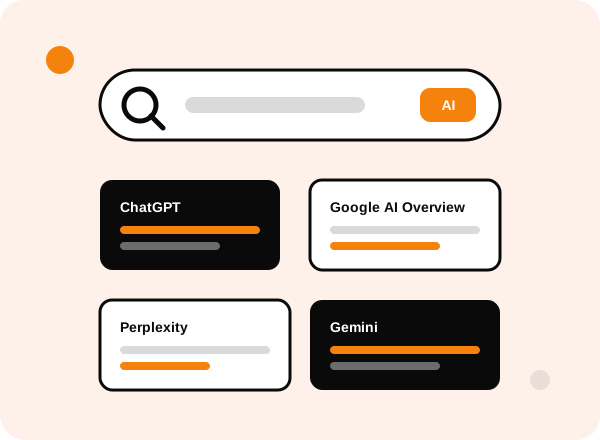
Will fixing my profile help with ChatGPT and Perplexity too, not just Google Maps?
Indirectly, yes. A complete, active Google Business Profile is one of the clearest third-party trust signals available for a local business, and generative engines increasingly weigh exactly that kind of verifiable, structured business data when deciding whether to mention a business in a local recommendation.
Final Thoughts
The businesses winning on Google Maps in 2026 are rarely the biggest or the most established. They are the ones who treated their Google Business Profile as a living asset instead of a one-time setup task, especially now that Gemini and Ask Maps are reading that same data to decide who gets recommended.
Ten minutes of focused work today can close a gap that has likely been costing you customers for months. Keeping that advantage as AI continues reshaping local search is the part worth getting real support with.
Book a free strategy call and I will show you exactly where your Google Business Profile currently stands against your closest local competitors in London.