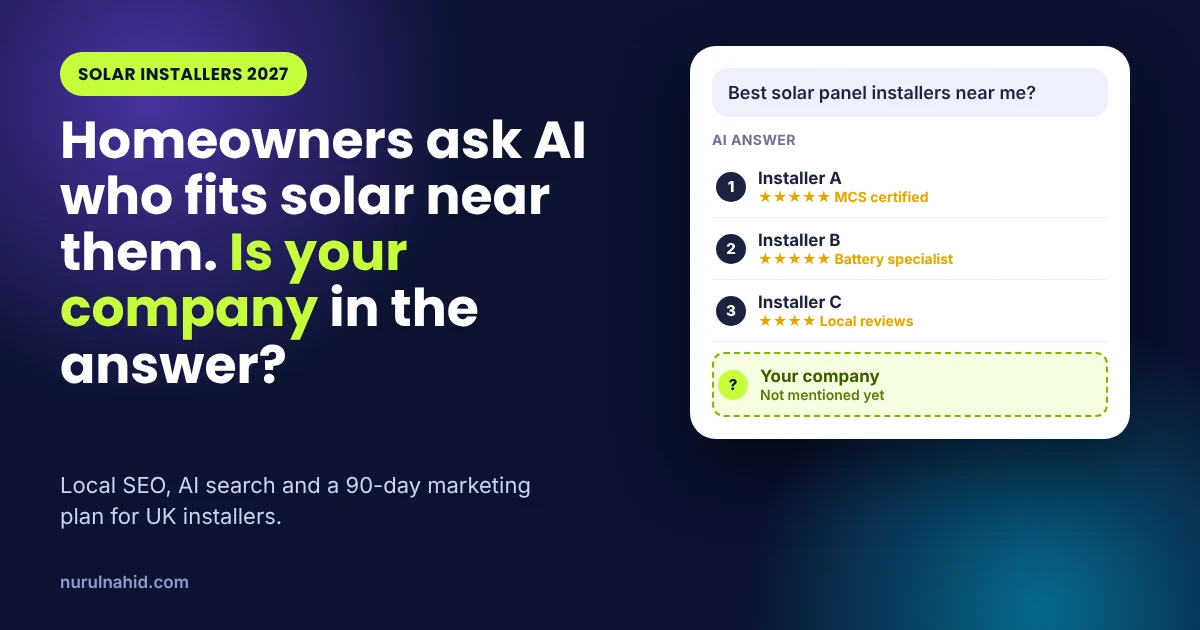
SEO for solar panel installers in 2027 means three jobs done well. Win the Google map pack in your service area and become the installer AI tools name.
Then turn every enquiry into a booked survey.
Demand is at record levels, cheap finance now needs an MCS installer, and the 0% VAT window closes on 31 March 2027.
The installers who show proof, answer questions clearly and reply fast will take the biggest share.
I’m Nurul Nahid, an SEO and AI search expert in the UK with 7+ years of experience in SEO, local SEO, e-commerce SEO, GEO, AEO and digital marketing.
I help trades and local service firms turn Google Maps, local search and AI answers into calls and booked jobs through my local SEO service.
Solar installer marketing at a glance (November 2026)
| Fact | What it means for your marketing | Source |
|---|---|---|
| 269,000 UK solar installations in 2025, 37% up on 2024, with about 255,000 on rooftops | More buyers, but also more installers chasing them | DESNZ, May 2026 |
| Nearly 172,000 installations in January to July 2026, with growth in every UK nation and English region | Your local area is growing, wherever you work | DESNZ, Aug 2026 |
| Warm Homes Loan Scheme launched 26 October 2026: up to £15,000 for solar and £15,000 for a battery, MCS installer required | Finance content and MCS proof now sell surveys | GOV.UK factsheet, Oct 2026 |
| 0% VAT on residential solar and battery installs ends 31 March 2027, then 5% | A real, honest deadline for Q1 2027 campaigns | HMRC VAT Notice 708/6 |
| Google Maps named a tracked business in 66% of local searches, AI tools in 32% to 38% | Maps rank alone does not make you visible in AI | BrightLocal vendor study, Sep 2026 |
| ## Part 1: SEO for Solar Panel Installers in 2027 (Local SEO Guide) |
Solar SEO in 2027 is local SEO with a trust layer. Google needs a complete Business Profile and one strong page per service and area.
It also needs clear proof: MCS status, reviews and real installs.
Get those right and you rank for “solar panel installers near me” and the town searches that bring paid surveys, not tyre-kickers.
Why 2027 is a different market for UK solar installers
Demand is not the problem. DESNZ reported 269,000 solar installations in 2025, the highest year on record, with nine of the ten best months falling in the past year.
The growth is spread out. Government data from August 2026 showed rises in every UK nation and English region, led by Wales at 18% and the East Midlands at 17%.
Four changes shape what homeowners search for next year:
- Cheap finance with a condition. The Warm Homes Loan Scheme needs an MCS-certified installer for solar and battery work.
- A VAT deadline. Residential solar and batteries are zero-rated until 31 March 2027, then 5%.
- Plug-in solar. Kits of up to 800W became legal in Great Britain on 27 August 2026 and are sold in big retailers.
- New-build rules. The Future Homes Standard takes effect on 24 March 2027 with a 12-month transition, so most new homes will get solar.
Each change creates new questions. If your site answers them first, you capture buyers before they reach a lead-gen site.
How homeowners search for solar panels
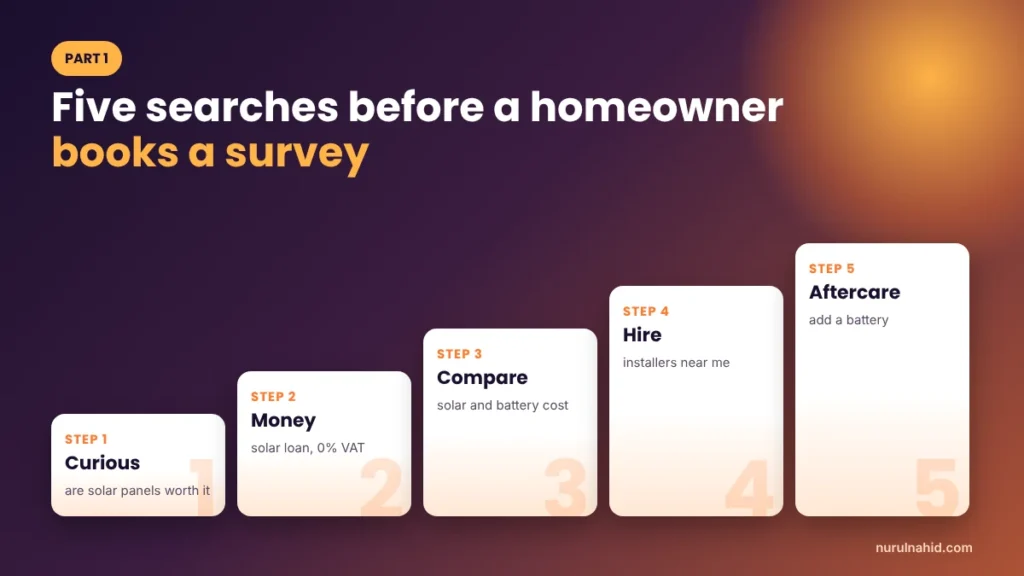
Solar is a considered purchase. Buyers move through five search stages, and your site needs a page for each one.
| Stage | Typical searches | Page you need |
|---|---|---|
| Curious | are solar panels worth it UK, solar panels in winter | Honest guide with local examples |
| Money | solar panel loan, 0% VAT solar, Warm Homes Loan solar | Finance page with eligibility notes |
| Compare | solar and battery cost, best solar battery UK, plug-in vs rooftop solar | Comparison pages and price ranges |
| Hire | solar panel installers near me, solar installers [town], MCS solar installer [county] | Service and location pages, Google Business Profile |
| Aftercare | solar panel cleaning, solar panel repair, add battery to existing solar | Maintenance and retrofit pages |
Most installers only build the “Hire” pages. The “Money” and “Aftercare” stages are where smaller firms can win without a big budget.
The keyword map for a solar installer website
Map one main keyword to one page. Two pages chasing the same term split your rankings and confuse Google.
| Page | Primary keyword | Supporting terms |
|---|---|---|
| Home | solar panel installers [region] | MCS solar installer, solar company |
| Solar PV installation | solar panel installation [town] | domestic solar, rooftop solar |
| Battery storage | solar battery installation [town] | add battery to solar, battery retrofit |
| Solar and battery packages | solar and battery cost UK | system sizes, what affects price |
| Finance | solar panel finance | Warm Homes Loan solar, 0% VAT solar |
| Commercial solar | commercial solar installers [region] | business solar, roof-mounted PV |
| Maintenance | solar panel repair [town] | inverter replacement, bird proofing |
| Location pages | solar panels [town] | solar installers near [town] |
Keyword volumes vary by area. Check yours in Google Keyword Planner before you build, and read my UK keyword research guide for the method.
Google Business Profile set-up that wins the map pack
Your Google Business Profile (GBP) is the most visible thing you own. Many homeowners judge you from it before they ever open your website.
Use this checklist:
- Primary category: Solar energy equipment supplier or Solar energy company, whichever best matches your main work. Add secondary categories only for services you really offer.
- Service area: List the towns you actually cover. Do not stretch it across the country.
- Services: Add each service with a short, plain description: solar PV, battery storage, EV charger, maintenance.
- Photos: Upload real roof shots, inverter set-ups and team photos every month. Stock images build no trust.
- Posts: Post one finished install a week with the town, system size and roof type.
- Messaging and calls: Turn on messaging only if someone will answer within the hour.
- Reviews: Ask every customer after the handover visit. Reply to each review with the town and job type.
My Google Business Profile UK guide covers set-up, verification and suspensions step by step.
A review system that keeps working
Reviews feed your Maps ranking, your click rate and what AI tools say about you. One burst of reviews, then silence, looks odd to buyers.
Build it into the job:
- At handover, tell the customer you will send a review link that evening.
- Send the link by text with their first name and the town.
- Remind once after a week if they have not left one.
- Reply to every review within two days, good or bad.
- Ask again after the first summer of generation, as a separate check-in, not a review push.
Ask every customer, not only the happy ones. Choosing who to ask can give a misleading picture of your service.
Service and location pages that are not thin
Google’s spam policies target pages mass-produced for every town with only the name swapped. Many solar agencies still build these, and they rarely last.
A strong location page includes:
- A short answer: do you cover this town, and how fast can you survey?
- Local proof: one or two real installs nearby, with roof type and system size.
- Local factors: common roof types, conservation areas, DNO approvals the customer may wait for.
- Two or three reviews from that area.
- A clear next step: book a survey, call or WhatsApp.
Ten honest pages beat a hundred copied ones. Start with the towns that already bring you jobs.
Trust signals that Google and homeowners check
Solar buyers worry about rogue traders. Citizens Advice and the ICO have both warned about cold calls and fake “grant” offers in this sector.
Show trust everywhere, not just in the footer:
- MCS certification number on every service page, with a link to your listing on the MCS installer search.
- The MCS Customer Commitment. The Energy Saving Trust explains that MCS contractors must give it to customers before a contract is signed. Say you do this.
- Consumer code or TrustMark membership if you hold it, with links to your public listing.
- Insurance-backed warranties described in plain words: what is covered and for how long.
- Named team members with their roles and qualifications.
Reviews need care too. The CMA’s fake reviews guidance bans fake reviews and concealed incentivised reviews, and businesses must have a policy.
So never buy reviews, never hide an incentive, and never post only the five-star ones on your site.
Technical SEO for installer websites
Most installer websites lose leads through slow mobile pages and broken forms, not missing keywords.
Check these first:
- Speed on mobile. Compress roof photos and drone images. A 6MB hero image can cost you the survey.
- Forms that work. Test every quote form weekly. Send a copy of each lead to two inboxes.
- Click-to-call and WhatsApp buttons that stay visible on mobile.
- Indexing. Make sure every service and location page is indexed in Search Console.
- Schema as hygiene. Add LocalBusiness and Service markup so details stay consistent. It does not guarantee rankings or AI citations.
- Calculators. If you run a savings calculator, show its assumptions on the page.
Use my technical SEO checklist for UK sites to audit your own site in an afternoon.
Content that wins enquiries in 2027
Write the content your sales team already explains on the phone. Each answer is a page.
Topics with clear demand right now:
- “Should I install before the VAT change on 1 April 2027?” Explain the deadline and your lead times honestly.
- “Can I get a Warm Homes Loan for solar?” Explain how it works and that you are MCS certified.
- “Plug-in solar or rooftop solar?” Compare the 800W limit with a full roof system. Plug-in buyers may become rooftop buyers later.
- “Can I add a battery to my existing panels?” Retrofit is a strong market for homes that installed years ago.
- “How do I get paid for exported electricity?” Explain the Smart Export Guarantee and what it needs.
- “What happens on installation day?” Show the steps, scaffold, inverter location and handover.
Video helps here. A two-minute install walk-through can sit on the page, your GBP and YouTube.
Project galleries that rank and sell
Your past installs are your best content. Most installer sites hide them in a slider with no words.
Give each notable job its own short page or post:
- Town and roof type (slate, tile, flat, east-west split).
- System size, panel and inverter brand, battery if fitted.
- One challenge you solved: shading, a conservation area, a long cable run.
- Photos before, during and after, named with the town and job type.
- The customer’s review, with their permission.
These pages rank for long searches like “solar on slate roof [town]”. They also give AI tools real, first-hand detail to cite.
Commercial solar SEO is a separate funnel
Business buyers search differently. They look for payback, roof surveys, grid connection and finance, and the decision often involves a finance director.
Build commercial pages that answer:
- Which business types you serve: farms, warehouses, schools, offices.
- How you handle grid connection applications with the network operator.
- What a feasibility survey includes and how long it takes.
- How you report generation after handover.
Note that the 0% VAT relief applies to residential accommodation, not commercial premises, so keep the two sets of pages clearly apart.
Local links and citations that move rankings
Links from your own area and industry count more than random directory links.
Good sources for solar installers:
- Your MCS installer listing and any consumer code listing.
- Local business groups, chambers of commerce and Federation of Small Businesses branches.
- Suppliers and manufacturers that list approved installers.
- Local news when you install for a school, church or community building.
- Partner trades such as roofers and electricians who refer work.
Keep your name, address and phone number the same on every listing. My guide to UK local directories lists the ones worth your time.
Compliance check before you publish anything
The ASA is watching solar ads closely. In March 2026 it upheld a complaint against Hive’s claim of cutting bills “by up to 94%”.
The ASA said the ad hid the model’s assumptions about tariffs, system size, batteries and usage. A website link did not fix that.
The ASA’s Greener Homes guidance adds three more rules:
- Headline prices must reflect what customers are likely to pay.
- Grant or funding ads must show eligibility criteria in the ad itself.
- Lead-generation ads must say they collect details to pass on.
This applies to your website copy, landing pages and social posts, not just paid ads. If you show savings, show the assumptions next to them.
Ten-minute self-audit for your solar website
Score one point for each “yes”. Under seven means you are leaving surveys on the table.
- Does your GBP list every service you offer, with real photos from the last 30 days?
- Does your home page say where you work and that you are MCS certified, above the fold?
- Do you have separate pages for solar, batteries and finance?
- Does each page answer the main question in the first two lines?
- Can a mobile visitor call or WhatsApp you with one tap?
- Have you tested your quote form this week?
- Do your savings figures show their assumptions next to them?
- Have you had a new Google review in the last two weeks?
- Are your name, phone and address the same on every listing?
- Can you name which channel brought each install last month?
Measure SEO by surveys and installs, not traffic
Traffic does not pay for scaffolding. Track the steps that lead to money.
| Step | Where to measure | Healthy sign |
|---|---|---|
| Visibility | Search Console, GBP Performance | More impressions for town and service terms |
| Enquiries | Calls, forms, WhatsApp, GBP messages | Rising enquiries from organic and Maps |
| Surveys booked | Your CRM or a simple sheet | More surveys from organic than from paid leads |
| Installs | CRM | Cost per install falling month on month |
Tag every enquiry with its source when it comes in. Without that, you cannot tell which channel paid for the van.
If you want this built properly, my SEO services cover the GBP audit, keyword-to-page mapping and the technical fixes that stop surveys.
You get a clear list of what to fix first, in order of impact on booked surveys, before any monthly work starts.
Part 2: How to Get Your Solar Company Recommended by ChatGPT, Gemini, Perplexity and Google AI Overviews
AI tools recommend installers they can verify. They check your Google Business Profile, your website, reviews and other trusted sites, then name the firms whose facts agree everywhere.
You cannot buy a place in the answer. You earn it with consistent details, answer-first pages and real third-party mentions, then you track it weekly.
What changed in AI search in November 2026
The last few weeks brought changes that matter for local trades:
- Google’s November 2026 core update started on 10 November, the third core update this year, as reported by Search Engine Journal.
- A new AI Mode model. Google made Gemini 4 Hydrogen the default in AI Mode on 12 November and uses it for some AI Overview answers.
- ChatGPT Business Hub. OpenAI opened a beta on 10 November that lets eligible businesses claim a ChatGPT profile and see 28 days of mentions and clicks.
- AI local pack tests. Search Engine Roundtable reported Google testing an AI Overview local pack without action buttons, photos and reviews (10 November). Treat it as a test.
The message is simple. Homeowners can now meet you inside an AI answer before they see your website, so your facts must be right everywhere.
How AI tools choose which local installers to name
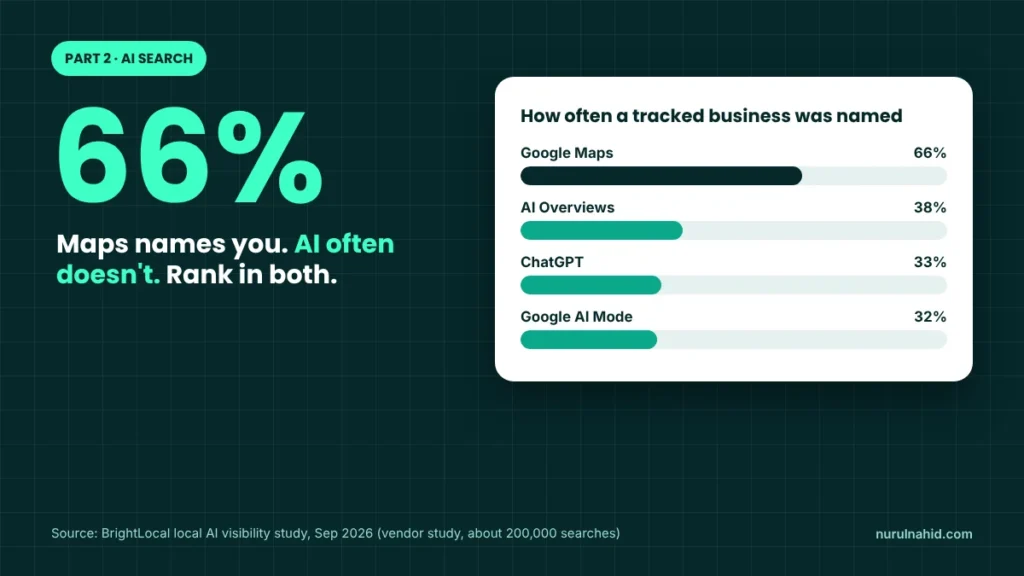
BrightLocal studied about 200,000 local searches across ChatGPT, Google AI Mode and AI Overviews. Its September 2026 study is vendor research, mostly US examples, so treat it as a guide.
Key findings:
- Google Maps named a tracked business in 66% of searches. AI Overviews did so in 38%, ChatGPT in 33% and AI Mode in 32%.
- ChatGPT named about four businesses per answer. AI Overviews named about two or three.
- Business websites made up 42% of all citations. Google Business Profile was the largest single source at about 28.6%.
- Repeat searches of the same prompt overlapped only 20% to 33% of the time.
So a top-three Maps ranking does not guarantee an AI mention. And because answers change between runs, you must measure over many prompts, not one screenshot.
Make your business facts match everywhere
AI tools cross-check details. If your hours, services or areas differ between sites, they trust you less.
Fix these first:
| Place | What to check |
|---|---|
| Google Business Profile | Name, phone, service area, services, hours, photos |
| Bing Places | Same details. Bing data powers Microsoft Copilot answers |
| Apple Business Connect | Same details for Siri and Apple Maps users |
| MCS installer listing | Trading name and technologies match your site |
| ChatGPT Business Hub | Claim it if you are eligible, then match the details |
| Facebook, Checkatrade, Trustpilot, Yell | Same name, phone and service list |
| Your website | An About page that says who you serve, where, and since when |
Write one “facts sheet” with the exact wording, then copy it into every profile. It takes an afternoon and removes most mismatches.
Write answer-first pages AI can quote
Google’s own guide to generative AI features in Search, first published in May 2026, says these features run on its core ranking systems. Normal SEO still applies.
The guide also asks for original, first-hand content rather than generic summaries. For an installer, that is easy to show.
Build each key page like this:
- Answer in the first two lines. “Yes, we install solar batteries on existing systems in Leicester. Most retrofits take one day.”
- Who it suits. Say who the service is for: terraced homes, farmhouses, small businesses.
- Real numbers with conditions. Price ranges, system sizes and timescales, with what changes them.
- Proof. A recent local install with photos and the customer’s own review.
- A dated update line. “Updated November 2026” when you really update it.
AI tools often know what a company does but not who it is for. Saying “we specialise in older terraced homes in Norfolk” gives them a reason to recommend you.
Example: an answer block AI can quote
This is a sample format, not real company data. Adapt the facts to your business.
Can you add a battery to my existing solar panels in Leicester? Yes. We fit batteries to most existing systems across Leicestershire, and most retrofits take one day.
A survey checks your inverter, consumer unit and space. We are MCS certified, so a Warm Homes Loan Scheme lender can finance the job, subject to their checks.
It answers first, says where, names the conditions and gives a reason to trust. That is what AI tools and homeowners both need.
Fix what AI gets wrong about your company
AI answers sometimes show old phone numbers, closed offices or services you no longer offer. Your weekly prompt log will catch these.
When you find an error:
- Find the source it came from. Perplexity and AI Overviews usually show links.
- Correct that source first: an old directory, a stale Facebook page, a past press story.
- Update your own About and service pages so the right fact is clear.
- Re-check the same prompt over the next few weeks.
You cannot edit an AI answer directly. You can only fix the sources it reads.
Earn third-party mentions the honest way
AI answers lean on trusted sources beyond your own site. You need other people talking about you.
Good, honest routes:
- Reviews on several platforms. Google first, then one or two others your customers already use.
- Local press. A school, sports club or farm install is a real local story.
- Supplier case studies. Panel and battery brands often feature installers.
- Community groups. Answer solar questions in local Facebook groups without spamming links.
- Partner trades. Roofers, electricians and builders who name you on their sites.
Google’s guide warns that artificial “mentions” are less useful than people think. Skip paid listicles and fake forum posts.
Let AI crawlers read your site
To appear in Google’s AI features, a page must be indexed and eligible to show a snippet. Check that your robots.txt and noindex tags do not block key pages.
For other AI tools, decide which crawlers you allow. Most local installers benefit from being readable, because a hidden site cannot be recommended.
My guide on whether your website is ready for agentic search walks through the checks.
What not to spend money on
Google’s guide lists tactics it calls unnecessary for Google Search:
- llms.txt files or special AI markup.
- Chopping content into small “chunks” for AI.
- Rewriting pages with odd phrasing for AI.
- Special schema “for AI”. Structured data is still useful for rich results, but it is not an AI shortcut.
Other AI platforms may use some of these. But for most installers, the money is better spent on photos, reviews and honest pages.
Track your AI recommendation rate every week
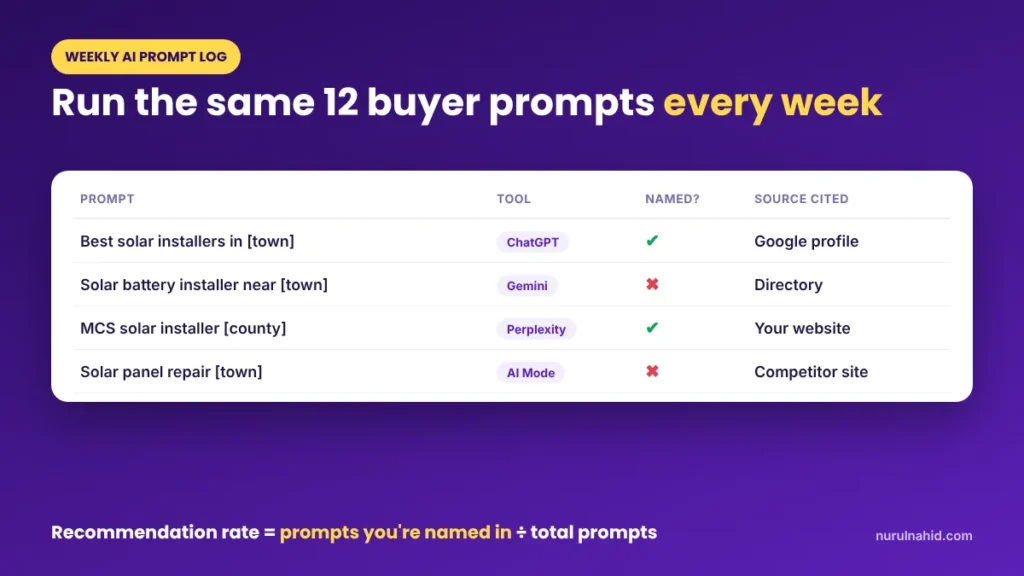
You cannot improve what you do not measure. Run the same buyer prompts every week and log the results.
Sample prompt set for a solar installer (swap in your own towns):
| # | Prompt | Tool |
|---|---|---|
| 1 | Best solar panel installers in [town] | ChatGPT |
| 2 | Who installs solar batteries near [town]? | Gemini |
| 3 | MCS certified solar installer [county] | Perplexity |
| 4 | Is [your company] a good solar installer? | ChatGPT |
| 5 | Solar panel installers near me with good reviews | Google AI Mode |
| 6 | Can I get a Warm Homes Loan for solar in [town]? | Google AI Overviews |
| 7 | Add a battery to existing solar panels [town] | ChatGPT |
| 8 | Commercial solar installers [region] | Perplexity |
| 9 | Plug-in solar or rooftop solar for a semi-detached house? | Gemini |
| 10 | Solar panel repair [town] | Google AI Mode |
| 11 | Who are the most trusted solar companies in [region]? | ChatGPT |
| 12 | How much do solar panels and a battery cost in [town]? | Google AI Overviews |
Record four things for each prompt: were you named, which competitors were named, which sources were cited, and was anything about you wrong.
Your recommendation rate is the share of prompts where you are named. Compare it month on month, and link it to enquiries that mention AI on the phone.
Getting named by AI is part SEO, part reputation and part data clean-up. I build this for local businesses through my GEO optimisation service.
I pair it with AEO optimisation, so your answers about cost, finance and batteries are the ones AI quotes.
Part 3: The Total Digital Marketing Plan for UK Solar Installers
A solar marketing plan needs three layers: SEO and AI visibility for steady enquiries, and paid ads for fast volume in peak months.
The third layer is referrals and follow-up, which turn more enquiries into installs.
The weakest link is usually not traffic. It is slow replies, no follow-up and no tracking from enquiry to install.
Pick channels by job value and buying cycle
A solar and battery install is a high-value job with a long decision time. Use each channel for the job it does best.
| Channel | Best for | Watch out for |
|---|---|---|
| Local SEO and GBP | Steady high-intent enquiries at low cost per lead | Takes months to build |
| AI visibility | Being named when buyers ask AI tools | Hard to measure without a prompt log |
| Google Search ads | Fast volume for “installer near me” and town terms | Price and grant claims must follow ASA rules |
| Meta and YouTube | Showing real installs, retargeting site visitors | Lead forms bring low-intent enquiries if not qualified |
| Email and WhatsApp follow-up | Keeping slow buyers warm | Consent rules under PECR |
| Referrals and partners | Highest-trust leads | Needs a real system, not a one-off ask |
| Shared lead-gen sites | Filling gaps while SEO grows | Same lead sold to several installers |
Relying on one channel is risky in a seasonal trade. The aim is to cut your dependence on shared leads month by month.
Google Ads for solar without breaking the rules
Search ads work well for solar because the intent is clear. But this sector draws close ASA attention.
Practical rules:
- Bid on town and service terms. Avoid broad “solar panels” terms that attract DIY and plug-in shoppers.
- Send each ad group to a matching landing page, not your home page.
- If you mention the Warm Homes Loan, say it is a loan through participating lenders, subject to checks.
- Never say “free solar panels” unless the offer is truly free for the person reading.
- Use call extensions in working hours only, and make sure someone answers.
Add negative keywords for “plug-in”, “DIY”, “jobs” and “training” unless you sell those.
Meta and YouTube: show the install, not the slogan
Social ads work when they show real proof. A 30-second clip of scaffolding, panels going up and the app showing first generation beats any designed graphic.
Content that works for installers:
- Before and after roof shots with the town and system size.
- A customer explaining why they chose you, filmed on their phone.
- Short answers to common questions: winter output, battery size, VAT deadline.
- Retargeting ads for people who visited your finance or battery pages.
Keep every savings claim qualified, exactly as on your website.
Referrals and partnerships
Referred customers already trust you. Build a simple programme rather than hoping for word of mouth.
- Ask for a referral at handover and again after the first good generation month.
- Offer a clear thank-you, and disclose it if a referral leads to a review.
- Partner with roofers, electricians, builders and estate agents in your area.
- Offer EV charger and battery add-ons to past solar customers.
If you also do roofing work, my roofers SEO page shows how to market both services without splitting your brand.
Speed to lead: answer every call
A homeowner who calls three installers often books the first one that answers. Missed calls during roof work are a quiet, expensive leak.
Fixes that cost little:
- A call answering service or a team member on calls during working hours.
- An instant text-back when a call is missed.
- A WhatsApp reply within 15 minutes during the day.
- Online survey booking for people who prefer not to call.
Use my free missed-call calculator to see what unanswered calls may be costing you each month.
Nurture the long buying cycle
Many solar buyers take weeks to decide. A short, useful follow-up sequence keeps you in the running.
A simple five-touch sequence after a quote:
- Same day: quote summary in plain words, plus a short video of a similar install.
- Day 3: answers to the three most common worries (winter output, roof, warranty).
- Day 7: a local customer review or case story.
- Day 14: finance options, including any Warm Homes Loan route, with eligibility notes.
- Day 30: a friendly check-in and an offer to re-survey if plans changed.
Only send marketing messages where you have consent. The ICO fined two firms £550,000 in September 2025 for automated calls, one of them selling solar panels.
Never buy cold-call lists. They damage your brand and break the law.
Worked example: what one install costs to win
This is an example to show the maths, not a client result. Swap in your own figures.
- Monthly marketing spend (SEO, ads and tools): £2,000
- Enquiries in the month: 50
- Survey rate (enquiries that book a survey): 40%, so 20 surveys
- Close rate (surveys that become installs): 30%, so 6 installs
- Cost per install: £2,000 ÷ 6 = about £333
Now improve only the reply speed so the survey rate rises to 50%. That gives 25 surveys and 7.5 installs, so cost per install falls to about £267.
No extra ad spend, just faster answers. This is why tracking each step matters more than chasing more clicks.
Shared lead sites: when to keep them and when to step back
Lead-gen sites can fill your diary fast. The catch is that the same enquiry may go to several installers, so you compete on price from the first call.
A sensible approach:
- Keep them while your own SEO and GBP are still building.
- Track their cost per install separately from your own channels.
- Reduce spend as your own enquiries grow, one month at a time.
- Never let them be your only source. A policy change can empty your diary overnight.
Example budget split for a small installer
This is an example to show the logic, not a recommendation for every business. It assumes a £2,500 monthly marketing budget.
| Area | Example share | Example amount |
|---|---|---|
| Local SEO, content and GBP | 40% | £1,000 |
| Google Search ads | 35% | £875 |
| Meta and YouTube retargeting | 10% | £250 |
| Call handling and tracking tools | 10% | £250 |
| Referral thank-yous and reviews tools | 5% | £125 |
In peak months you might shift more into ads. In quiet months, shift it back into content and video for the next season.
The numbers to review every month
| KPI | Why it matters |
|---|---|
| Enquiries by source | Shows which channel is working |
| Survey rate | Shows reply speed and lead quality |
| Close rate | Shows sales process and pricing fit |
| Cost per install by channel | The number that decides your budget |
| Google reviews gained | Feeds Maps rankings and AI trust |
| AI recommendation rate | Shows progress in AI answers |
Five numbers on one sheet, reviewed once a month, will guide better decisions than any dashboard you never open.
A seasonal calendar for solar marketing
| Period | Focus |
|---|---|
| December to January | Content on winter output and planning, finance pages, GBP clean-up |
| February to March 2027 | Honest VAT deadline campaigns, with real lead times and survey slots |
| April to June | Peak season ads, install videos, review drive |
| July to September | Battery retrofit offers to past customers, commercial pitches |
| October to November | Plan next year, refresh location pages, check AI prompt log |
Do not invent urgency. If your survey calendar is full before 31 March, say so and set honest expectations.
The 90-day marketing plan for solar installers
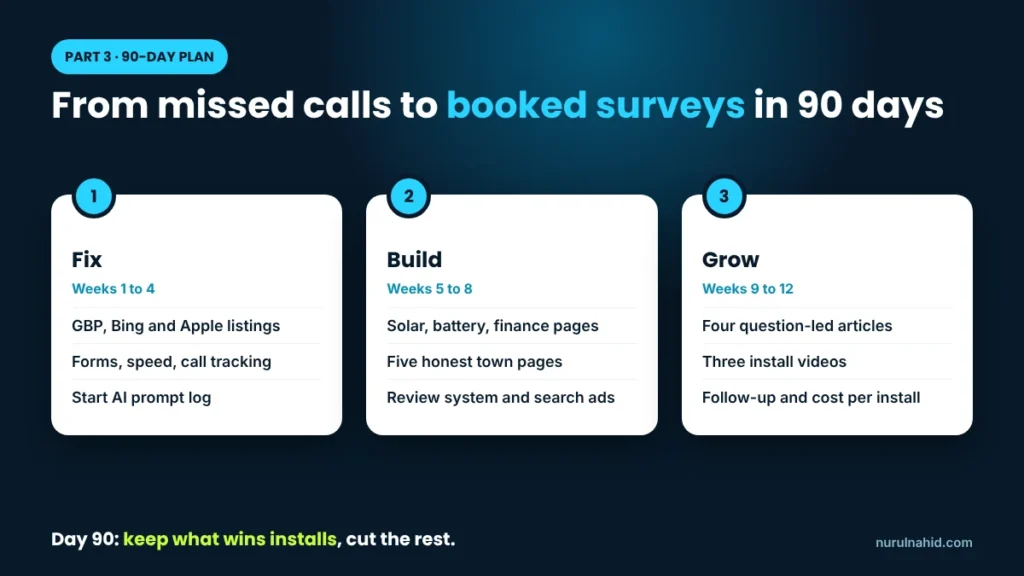
| Weeks | Actions | What success looks like |
|---|---|---|
| 1 to 4 | Fix GBP, Bing and Apple listings; write the facts sheet; audit site speed and forms; set up call tracking; start the weekly AI prompt log | Clean listings, working forms, every enquiry tagged by source |
| 5 to 8 | Build or rebuild the top service pages (solar, battery, finance); add five honest location pages; start the review request system; launch one tightly targeted search campaign | More Maps impressions, steady reviews, first organic enquiries |
| 9 to 12 | Publish four question-led articles (VAT deadline, Warm Homes Loan, plug-in vs rooftop, battery retrofit); film three install videos; start the five-touch follow-up; review cost per install | Higher survey rate, first AI mentions, a clear view of cost per install by channel |
After 90 days, keep what works and cut what does not. SEO keeps building, so the cost per lead from organic usually falls over time.
Pulling all this together is hard when you are also running installs. Through my digital marketing service I plan the channel mix for your area.
I also set up tracking from enquiry to install and run the campaigns that fit your budget.
Case study: 599 leads in six months for a home-service business
This case study is from a different sector and country: an HVAC and air duct cleaning firm in Texas. I include it because the playbook matches what solar installers need.
The business: Lara’s Air Duct Cleaning, a home-service company serving Richardson and the wider Dallas area, with 10+ years of experience.
The work (November 2025 to April 2026):
- Five Google Ads search campaigns plus call-only mobile ads.
- Meta lead campaigns aimed at local homeowners, with retargeting added later.
- 48 location and service pages, schema, fixed meta issues and an XML sitemap.
- 40+ citations, Bing Places, weekly GBP posts and replies to every review within 24 hours.
The results reported on the case study page:
- 599 qualified leads: 310 from Google Ads, 171 from Meta and 118 from organic search.
- An average cost per lead of $10.75 across all channels.
- Google Business Profile calls up 66.7%, from 27 to 45.
- 13 AI mentions and 32 citations tracked across Google AI Mode, ChatGPT, AI Overviews and Gemini.
Read the full Lara’s Air Duct Cleaning case study, or browse all my case studies.
Related guides
- Local SEO for business owners: the basics every trade should have in place.
- Ultimate marketing guide for roofers in the UK: useful if you fit solar and do roofing work too.
- Ultimate marketing guide for loft conversion specialists: another high-value home upgrade with a long buying cycle.
FAQ: marketing for solar panel installers
How long does SEO take for a solar installer?
Many local businesses see early Maps and enquiry movement in three to six months, but it varies. Competitive cities usually take longer.
My guide on how long SEO takes in the UK explains what affects the timeline.
How much does SEO cost for a solar company in the UK?
It depends on how many areas you cover and how strong local competitors are. Compare quotes on deliverables and reporting, not just price.
See my breakdown of SEO costs in the UK.
Does MCS certification help my marketing?
Yes. The Warm Homes Loan Scheme requires an MCS-certified installer, and most Smart Export Guarantee tariffs ask for an MCS certificate. Show your MCS number on every service page.
Can I mention the 0% VAT deadline in my ads?
Yes, if it is accurate. The zero rate for residential solar and batteries runs to 31 March 2027, then 5% applies. Do not invent false urgency about your availability.
Will plug-in solar hurt rooftop installers?
Plug-in kits are capped at 800W, far below a typical rooftop system. Many buyers start small and upgrade later, so useful plug-in content can bring future rooftop customers.
Can I outrank lead-generation websites?
Often, yes, for town and “near me” searches. Lead-gen sites are strong on broad terms, but a well-reviewed local firm with good location pages can win the map pack.
How do I get my solar company mentioned by ChatGPT?
Keep your details the same everywhere, earn reviews on several platforms, write answer-first pages, and claim your ChatGPT Business Hub profile if eligible. Then track a fixed prompt set weekly.
Should I use schema or llms.txt for AI search?
Use schema for accurate business details and rich results. Google says neither schema nor llms.txt is needed for its AI features.
Other AI tools may differ, so treat both as hygiene, not shortcuts.
Ready to win more solar surveys in 2027?
You fit great systems. The hard part is being the installer homeowners find, trust and call first, while you are up on a roof.
That is where I come in. I check what Google, Maps and AI tools say about you, fix the gaps and build a plan that turns searches into booked surveys.
Here is how to start:
- Get a free SEO audit of your website and Google Business Profile.
- Book a meeting to go through the findings and your 2027 goals.
- Or message me on WhatsApp with your website and service area.
Spring 2027 will be busy. The installers who fix their visibility this winter will be the ones answering the phone in April.
Sources
- DESNZ, Britain continues to break clean power records, 28 May 2026.
- DESNZ, First regional solar breakdown as installations hit record highs, 27 August 2026.
- GOV.UK, Warm Homes Loan Scheme: factsheet, 27 October 2026.
- HMRC, VAT on energy-saving materials and heating equipment (Notice 708/6).
- GOV.UK, Households can save as plug-in solar panels come to market, 26 August 2026.
- UK Parliament, Written statement on the Future Homes and Buildings Standards, 24 March 2026.
- Ofgem, Smart Export Guarantee.
- ASA, Ruling on Centrica Hive Ltd, 4 March 2026.
- ASA, Greener Homes: building on facts, not fibs, September 2025.
- CMA, Short guide for businesses publishing consumer reviews, April 2025.
- ICO, Energy firms fined £550,000 for unlawful marketing calls, September 2025.
- Energy Saving Trust, Protecting consumers: MCS Customer Commitment, 2026.
- Google Search Central, Optimising your website for generative AI features on Google Search, updated July 2026.
- Search Engine Journal, SEO Pulse: core update, ChatGPT Business Hub and AI Mode’s new model, 14 November 2026.
- BrightLocal, Local AI visibility study, September 2026 (vendor study).