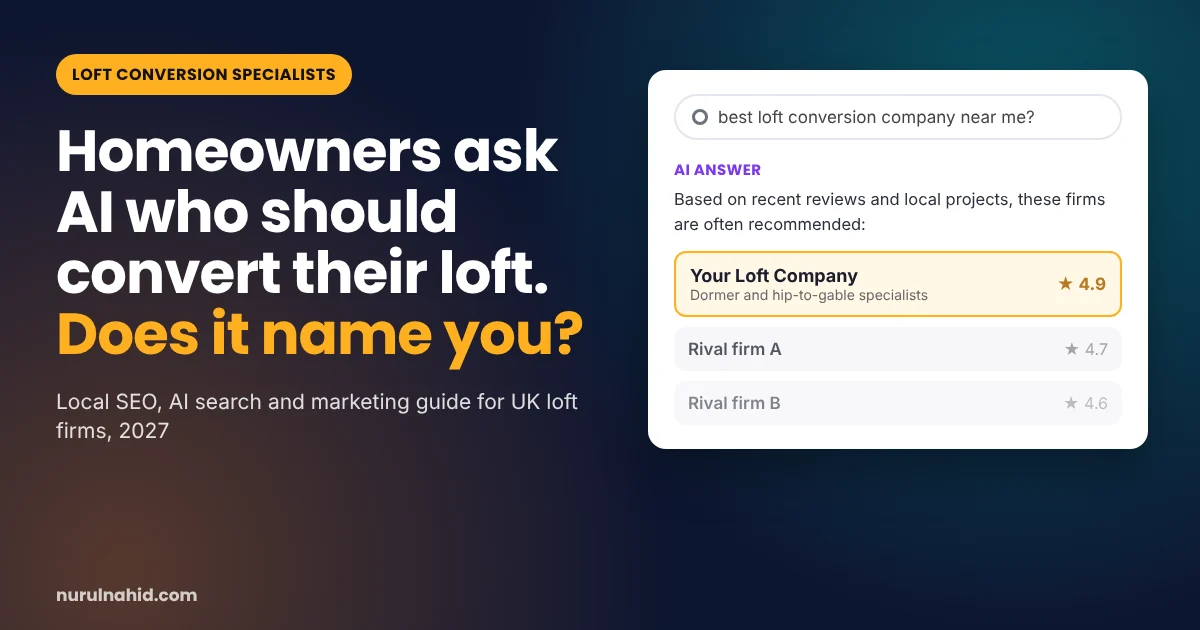
SEO for loft conversion specialists in 2027 means three jobs done together. Rank your service pages and Google Business Profile in the towns you cover.
Get named when homeowners ask ChatGPT, Perplexity or Google AI Mode who to trust. Then turn that attention into booked surveys with ads, referrals, fast call handling and clear tracking.
Loft jobs are high value and slow to decide. So the firms that win publish honest cost, planning and building regulations content, collect fresh reviews every month, and answer the phone first.
I’m Nurul Nahid, an SEO and AI search expert in the UK with 7+ years of experience in SEO, local SEO, e-commerce SEO, GEO, AEO and digital marketing.
I help trade and home improvement firms turn Google Maps, organic search and AI answers into qualified calls, through my local SEO service for UK trades.
At a glance: loft conversion marketing in numbers
- Demand is real. Checkatrade reported more than 65,000 job searches for loft conversion projects on its site in 2024 (Checkatrade, 2025).
- Reviews decide shortlists. 97% of consumers read reviews for local businesses, and 74% only consider reviews from the last three months (BrightLocal Local Consumer Review Survey, Feb 2026, US sample of 1,002 adults).
- AI is now a discovery channel. In the same survey, 45% used ChatGPT or other AI tools for local recommendations, up from 6% in 2025.
- Planning rules shape demand. Most house loft conversions in England can be permitted development within 40 cubic metres (terraced) or 50 cubic metres (other houses), with conditions (Planning Portal).
- Fake reviews are now illegal. The DMCC Act ban on fake and concealed incentivised reviews applies from 6 April 2025, with CMA guidance published 4 April 2025 (GOV.UK).
Part 1: SEO guide 2027 for loft conversion specialists
Local SEO for loft conversion specialists rests on five assets. A service page for every loft type, a well-run Google Business Profile, steady reviews, honest area pages and clean LocalBusiness schema.
Get those right and you appear in the Map Pack and organic results when a homeowner in your area starts planning.
Why loft conversion SEO is different from other trades
A plumber gets an emergency call and books the job the same day. A loft conversion is the opposite.
Homeowners often research for months before they call anyone. They compare dormer and hip-to-gable designs, read about planning, and worry about cost.
That changes your SEO in three ways:
- You need content for every stage, not just “loft conversion near me”.
- Trust signals matter more because the job can cost as much as a car or more.
- Lead quality beats lead volume. Ten enquiries from people with the right house type are worth more than fifty tyre-kickers.
A homeowner who reads your planning guide in March may book a survey in June. If your site answered their first question, you are already on the shortlist.
Keyword research: map the homeowner’s journey, not just the service

Most loft firms target one phrase: “loft conversion [town]”. That phrase matters, but it is the last search a homeowner makes, not the first.
Group your keywords by the stage the homeowner is in. Then build one clear page for each group.
| Stage | What the homeowner types | Page to build |
|---|---|---|
| Dreaming | “can my loft be converted”, “loft conversion ideas” | Loft suitability guide with head-height check |
| Rules | “do I need planning permission for a loft conversion”, “loft conversion building regs” | Planning and building regulations guide |
| Money | “loft conversion cost”, “dormer loft conversion cost 2027” | Cost guide with price ranges and what changes them |
| Design | “hip to gable vs dormer”, “mansard loft conversion” | One service page per loft type |
| Shortlist | “loft conversion specialists near me”, “loft conversion company [town]” | Area page plus Google Business Profile |
| Proof | “[your brand] reviews”, “[your brand] loft conversions” | Reviews page, project gallery, case studies |
Add the supporting searches that sit around a loft job. Think “loft survey”, “loft conversion drawings”, “structural engineer for loft conversion” and “party wall notice loft conversion”.
Homeowners who search these are close to a decision. Few loft firms bother to answer them well.
Use the free tools first: Google Search Console, the Google autocomplete box, People Also Ask and your own enquiry notes. My UK keyword research guide shows the step-by-step method.
Write down the exact words customers use on the phone. “Can you do a Velux one?” is a keyword. So is “how long will we be without a ceiling?”
Service pages that win the job, not just the click

Each loft type deserves its own page. Dormer, hip-to-gable, mansard, rooflight (Velux style), L-shaped and bungalow loft conversions are different searches with different buyers.
A single “Our Services” page cannot rank for all of them. It also cannot answer each buyer’s worries.
A strong loft service page includes:
- A clear H1 with the loft type and area, such as “Dormer Loft Conversions in Chelmsford”.
- A short answer first: what it is, who it suits, typical timescale.
- House-type fit: terraced, semi-detached, detached, bungalow.
- Price range with the date and what pushes cost up or down.
- Planning and building regulations notes for that loft type.
- Real project photos with the town named in the caption.
- Two or three reviews that mention that loft type.
- One clear next step: book a free loft survey, with phone and form.
Write in plain English. A homeowner does not care about “structural steel solutions”. They care whether the steel goes in without wrecking the ceiling below.
Loft type page map: who each page is for
Use this map to plan one page per loft type. Each page should answer the questions that buyer actually has.
| Loft type | Often suits | Searches to target | The page must answer |
|---|---|---|---|
| Rear dormer | Terraced and semi-detached houses | “dormer loft conversion [town]”, “dormer loft conversion cost” | How much headroom and floor space it adds, and whether it fits permitted development |
| Hip-to-gable | Semis and detached houses with a sloping side roof | “hip to gable loft conversion”, “hip to gable and dormer” | Why it adds space, how it changes the side of the house, planning points |
| Mansard | Terraced houses in towns and cities | “mansard loft conversion [town]” | Why it usually needs planning permission, cost and timescales |
| Rooflight (Velux style) | Lofts that already have good head height | “velux loft conversion”, “loft conversion without dormer” | Head-height check, lower cost, less disruption |
| L-shaped | Victorian and Edwardian terraces with a rear outrigger | “l shaped dormer loft conversion” | Extra room for a bedroom plus bathroom, planning and party wall points |
| Bungalow | Bungalows with a pitched roof | “bungalow loft conversion” | Stairs position, how many rooms are possible, living through the work |
Only build pages for the loft types you actually do well. A page for work you rarely take on brings the wrong enquiries.
Cost guides and planning content: the pages that earn trust early
Cost and planning pages bring in homeowners at the start of their journey. They also give AI tools something solid to quote, which matters in Part 2.
A good cost guide shows a price range for each loft type, the date it was last checked, and the factors that change it.
Steel, stairs, en-suite, roof structure and access all move the price.
Be honest. If a mansard in London costs far more than a rooflight conversion in Leicester, say so.
Your planning page should explain the basics in plain terms and link to the official source. In England, the Planning Portal sets out permitted development for lofts:
- Up to 40 cubic metres of extra roof space for terraced houses.
- Up to 50 cubic metres for other houses, including earlier roof enlargements.
- Not available for flats, or on designated land such as conservation areas and National Parks.
- Conditions on height, front roof slopes, matching materials and obscure-glazed side windows.
Always add a line telling readers to check with their local planning authority. Rules differ in Wales, Scotland and Northern Ireland, so write a short note for each nation you cover.
Building regulations apply to almost every loft conversion, whether or not planning permission is needed. Explain what that means for the homeowner: fire escape routes, stairs, insulation and structure.
If a party wall is involved, point readers to the official GOV.UK party wall guidance. Do not give legal advice yourself.
A first-year content plan for a loft firm
You do not need hundreds of posts. Twelve strong pieces, one a month, can cover most of the questions homeowners ask before they call.
- Can my loft be converted? A simple head-height and roof check
- Loft conversion costs in [your county] for 2027, by loft type
- Do I need planning permission for a loft conversion? Plain-English guide
- Building regulations for loft conversions: what the homeowner signs off
- Dormer vs hip-to-gable: which suits your house?
- Where will the stairs go? Loft staircase options explained
- Living at home during a loft conversion: what to expect week by week
- Adding an en-suite to your loft: costs and layout tips
- Party walls and loft conversions: when neighbours need notice
- Loft conversion vs extension vs moving house: a cost comparison
- Our finished projects in [your main town] this year
- Questions to ask before you choose a loft conversion company
Each piece should link to the matching service page and invite a survey booking. Update the cost and planning pieces every year and change the date when you do.
Google Business Profile and the Map Pack
Your Google Business Profile is often the first thing a homeowner sees. It shows your stars, photos, reviews and phone number before they ever reach your site.
Follow Google’s own Business Profile guidelines closely. Breaking them can get a profile suspended, which can stop calls overnight.
Key rules that catch loft firms out:
- Use your real business name. No “Best Loft Conversions Essex” unless that is your actual name on signage and invoices.
- Hide your address if you work from home. Google says service-area businesses should hide their address from customers.
- Keep your service area realistic. Google’s guidance says it should generally not stretch beyond about two hours’ driving time from your base.
- Choose few, specific categories. Pick the category that completes “this business IS a…”, then add only true secondary ones.
Then fill every field that helps a homeowner choose:
- Services: list each loft type with a short description.
- Photos: before, during and after shots, at least monthly.
- Posts: finished projects, survey slots, planning tips.
- Questions and answers: seed the real questions people ask on the phone.
My Google Business Profile guide for UK businesses covers each setting in detail.
A quick tip from local audits: name the town in your photo captions and post text naturally. “Hip-to-gable finished in Billericay this week” tells Google and the homeowner where you work.
Reviews and citations: the trust layer
Reviews are the strongest trust signal a loft firm has. Homeowners are spending tens of thousands of pounds and want proof that people like them were happy.
The BrightLocal Local Consumer Review Survey 2026 gives useful benchmarks, though its sample is US consumers:
- 47% would not use a business with fewer than 20 reviews.
- 74% only consider reviews written in the last three months.
- 89% expect owners to respond to reviews.
- 50% are put off by templated or generic replies.
For a loft firm, recency is the hard part. You might finish two conversions a month, not twenty.
So ask at every happy milestone, not only at the end. The steel going in, the stairs fitted and the final sign-off are all good moments.
Reply to every review in your own words. Mention the loft type and the town when it fits naturally.
Stay on the right side of the law. Under the DMCC Act, the CMA’s fake reviews guidance bans fake reviews, commissioning them, and hiding incentives given for reviews.
The guidance also expects businesses that publish reviews to have a clear policy on fake and incentivised reviews. Put a short one on your reviews page.
Citations are your business listings on other sites. Make sure your name, phone and service area match everywhere, including Checkatrade, TrustATrader, MyBuilder, Houzz, Yell and any trade body you belong to.
My guide to UK local directories worth listing on shows which ones still carry weight.
Location and service-area pages that are not thin
Most loft firms cover several towns. Area pages help you rank in each one, but only if they are genuinely useful.
A page that swaps “Romford” for “Basildon” and changes nothing else is thin content. It rarely ranks and can drag the whole site down.
Make each area page earn its place with:
- Projects completed in that area, with photos and a short story.
- Local house types: Victorian terraces, 1930s semis, post-war bungalows.
- The local planning authority and any conservation areas that affect lofts.
- Reviews from customers in that town.
- Travel and survey availability for that area.
Start with the five towns that bring the best jobs. Build those well before adding more.
Local project pages are a hidden win. One page per finished loft, with photos, the brief, the design choice and the outcome, gives Google and AI tools real evidence of local work.
LocalBusiness schema and the technical basics
Schema is code that tells search engines who you are, where you work and how to contact you. It helps machines read your site, but it is not a ranking shortcut.
Google’s LocalBusiness structured data documentation lists name and address as required, with phone, URL, opening hours and geo coordinates recommended. Google also states it does not guarantee any feature will show.
For a loft firm, a sensible set-up is:
- A specific type such as HomeAndConstructionBusiness or GeneralContractor on your home page.
- areaServed listing the towns or counties you really cover.
- Service markup on each loft type page.
- FAQPage markup on pages with genuine FAQs.
Keep the technical basics tight as well. Fast mobile pages, compressed project photos, working forms and a sitemap submitted in Search Console all matter.
Google’s John Mueller said in November 2026 that technical SEO stays important for AI search too (Search Engine Journal, 2 Nov 2026). My technical SEO checklist for UK sites covers the full list.
Turn website visitors into survey bookings
Ranking is only half the job. The other half is getting the right homeowner to book a survey, and filtering out jobs you do not want.
Your booking form can do much of that work for you. Ask for:
- Postcode, so you know straight away if the job is in your area.
- House type: terraced, semi-detached, detached, bungalow.
- Loft type of interest, with a “not sure” option.
- Rough timescale: within 3 months, 3 to 6 months, later.
- Photos of the loft, as an optional upload.
- Best time to call.
Keep it short on mobile. Five or six fields is usually enough.
Show trust signals right next to the form: review stars, insurance, guarantees and any trade scheme you belong to.
Add a clear promise about what happens next, such as “we call back the same working day”.
Put your phone number in the header of every page as a tap-to-call link. Many homeowners would rather talk than type.
A 10-minute loft SEO self-check
Open your own site and Google Business Profile, then answer yes or no:
- Does each loft type you offer have its own page?
- Does your home page say which towns or counties you cover in the first screen?
- Is your Google Business Profile name your real business name, with no added keywords?
- Have you had at least one new Google review in the last month?
- Have you replied to every review, in your own words?
- Do you have a cost guide with a date on it?
- Do you have a planning and building regulations page that links to official sources?
- Do your business name, phone and service area match on every directory?
- Does every page load quickly on your phone?
- Can a homeowner book a survey in under a minute?
Each “no” is a fix to schedule. Most loft firms find four or five.
How I help with loft conversion SEO
If your loft firm is stuck on page two, or your profile gets views but few calls, I start with a full audit.
I check your service pages, Google Business Profile, reviews, citations and schema against the firms ranking above you.
You can request a free SEO audit and get a clear list of what to fix first for your towns.
Part 2: AI citation guide for loft conversion specialists
To get loft conversion specialists recommended by ChatGPT, Perplexity and Google AI Overviews, you need to be easy to find, easy to quote and easy to trust.
That means clear answer-first pages, consistent business facts everywhere, recent reviews and real mentions on other trusted sites.
There is no single switch. AI tools lean on the same signals that build a strong local brand.
How ChatGPT, Perplexity and Google AI Overviews choose loft firms

When a homeowner asks “who are the best loft conversion companies near Croydon?”, an AI tool does not pick at random. It searches the web, reads several sources, then writes a summary.
Those sources usually include:
- Your own website, especially service, area and FAQ pages.
- Your Google Business Profile for Google’s own AI features.
- Review sites such as Checkatrade, TrustATrader, Houzz and Trustpilot.
- Directories and trade bodies that list you.
- Forums and Q&A sites, including Reddit and Mumsnet threads.
- Local news and blogs that mention your projects.
The firm that appears again and again, with the same facts and good reviews, is the one most likely to be named.
This is why AI visibility is partly a brand game. If no one outside your website ever mentions you, an AI tool has little reason to trust you.
People are using these tools for local decisions.
In BrightLocal’s 2026 survey of US consumers, 45% said they used ChatGPT or other AI tools for local business recommendations, up from 6% a year earlier (BrightLocal, Feb 2026).
UK figures will differ, but the direction is clear. Homeowners are starting to ask AI before they ask a neighbour.
What changed in the last few weeks (November 2026)
AI search moves fast. These recent updates matter for loft firms planning 2027:
| Date | Update | What it means for loft firms |
|---|---|---|
| 4 Nov 2026 | Google AI Mode added booking and quote links for home services through partners such as Angi, Thumbtack, Housecall Pro and Jobber (Search Engine Journal) | US only for now. It shows where Google is heading: AI answers that send homeowners straight to a quote request. |
| 10 Nov 2026 | Google tested an AI version of the local pack on mobile without call, website or direction buttons (Search Engine Roundtable) | Ranking alone may not bring the call. Your profile and site must persuade fast. By 18 Nov the older layout was reported back, so it is a test. |
| 28 Oct 2026 | Google said ads in AI Mode will expand to more countries, with the UK planned for Q4 2026 (Google) | Paid placements may soon sit inside UK AI answers. Organic AI visibility gets more competitive. |
| 30 Oct 2026 | Google, Microsoft and OpenAI announced plans to honour one shared AI training opt-out line in robots.txt (Search Engine Journal) | Check what your robots.txt allows before your developer adds AI blocks by default. |
None of this changes the basics. It does mean you should check your visibility in AI tools as often as you check Google rankings.
Write pages AI tools can quote
AI tools prefer content they can lift cleanly into an answer. That favours pages that state the answer first, then explain.
For each important question, write a short direct answer of two or three sentences. Then add the detail underneath.
Good examples for a loft firm:
- “How long does a dormer loft conversion take?”
- “Do I need planning permission for a hip-to-gable loft conversion?”
- “How much does a loft conversion cost in Kent in 2027?”
- “Can you convert a loft with a low roof?”
- “Where does the staircase go in a loft conversion?”
Use these formats where they help the reader:
- Tables comparing loft types by cost range, time and best house type.
- Dated price ranges with what is included.
- Checklists such as “7 checks before you book a loft survey”.
- Named project details: house type, town, loft type, weeks on site.
Explain who you are for, not only what you do. “We specialise in dormer and hip-to-gable conversions on 1930s semis across Essex” is far more useful to an AI tool than “quality loft conversions”.
Keep it human. Write for the homeowner first. Pages written only to please machines tend to read badly and convert badly.
My guide to generative engine optimisation (GEO) explains this answer-first approach in more depth.
Template: an answer-first block that AI tools can lift
Here is the shape to copy for each key question. Fill it with your own facts.
Question as a heading: How long does a dormer loft conversion take?
Short answer (2 sentences): Most rear dormer conversions take around [your typical number] weeks on site once drawings and approvals are in place. Larger dormers, en-suites and complex stairs can add time.
Detail underneath: a short week-by-week list, what affects timing, and a link to a finished project with its real dates.
Use your own project records for the numbers. A specific, honest answer is far more likely to be quoted than a vague one.
FAQ content and structured data: useful hygiene, not a trick
FAQs help in two ways. They answer real worries on the page, and they give AI tools short, clear answers to quote.
Build your FAQ list from real sources:
- Questions callers ask on the phone.
- Questions in your Google Business Profile.
- People Also Ask boxes for your main keywords.
- Threads on Reddit and Mumsnet about loft conversions.
Add FAQPage markup where the questions and answers are visible on the page. Add LocalBusiness and Service markup as covered in Part 1.
Be realistic about what schema does. It helps machines read your facts, but there is no strong evidence that adding it alone gets you cited.
Treat it like tidy paperwork. Necessary, but not what wins the job.
Reviews, Reddit and PR mentions
AI tools build their picture of you from what others say. Here is where to focus.
Reviews on several platforms. Google matters most, but AI tools also read Checkatrade, TrustATrader, Houzz and Trustpilot. Spread your review requests so each platform shows recent activity.
Detailed reviews. A review that says “great job” helps less than one that says “hip-to-gable conversion on our 1930s semi in Romford, finished in nine weeks”.
Ask customers to mention the loft type and the town if they are happy to.
Reddit and Mumsnet. Homeowners ask for loft firm recommendations in local and home improvement threads. Do not post fake recommendations. That breaks the rules of those sites and can breach consumer law.
Instead, answer technical questions honestly under your own name when it is allowed. Helpful answers build a reputation that real customers then repeat.
Local press and partners. A local newspaper story about a striking conversion, a feature on an architect’s blog, or a listing on a trade body directory all count.
These are mentions an AI tool can find and trust.
Consistent facts. Your business name, phone number, service area and specialities should read the same everywhere. Mixed details make it harder for AI tools to connect the dots.
Show the proof homeowners and AI tools look for
A loft conversion is a big risk for a homeowner. They want to know who you are, how long you have been doing this and what happens if something goes wrong.
AI tools look for the same kind of evidence when they decide who to mention. Make it easy to find:
- A real About page with the founder’s name, photo and years in the trade.
- Team and trades: who does the steel, the joinery, the plastering, and whether they are your own staff.
- Insurance and guarantees, stated clearly, with what they cover.
- Trade schemes and memberships you genuinely hold, linked to your listing on the scheme’s own site.
- Building control sign-off: explain that you handle it and what the homeowner receives at the end.
- Project pages with real photos, dates and towns.
If you are registered with TrustMark, the Government Endorsed Quality Scheme for work in and around the home, say so and link to your listing. Only claim memberships you hold today.
These details help a nervous homeowner pick up the phone. They also give AI tools facts they can repeat with confidence.
Do not block yourself by accident
Some websites block AI crawlers by default, often through a security plugin or a hosting setting. That can stop AI tools from reading your pages at all.
Check your robots.txt file and any firewall rules with your developer. Decide on purpose which AI crawlers you allow.
Also check Google Search Console. Google rolled out a Search generative AI control to all websites worldwide from 31 August 2026 (Google Search Console Help).
It lets you exclude your site from certain AI features in Google Search. Most loft firms will want to stay included, so make sure nobody has switched it off.
Tracking your AI visibility each week
You cannot improve what you do not measure. Most rank trackers still do not show AI answers well, so start with a simple prompt log.
Pick 10 to 15 questions a real homeowner in your area would ask. Run them weekly in ChatGPT, Perplexity, Gemini and Google AI Mode, and record the results.
| Prompt to test | What to record |
|---|---|
| Best loft conversion companies in [your town] | Are you named? Which rivals are named? |
| Who does dormer loft conversions near [your town]? | Are you named? Which source is linked? |
| Loft conversion cost in [your county] 2027 | Is your cost guide cited? |
| Do I need planning permission for a loft conversion in [your council area]? | Is your planning page cited? |
| Reliable hip-to-gable specialists in [your area] | Are your reviews quoted? |
Track four simple numbers over time:
- Recommendation rate: how many prompts name you, out of the total.
- Citation count: how often your own pages are linked.
- Source list: which other sites the AI quotes about you and your rivals.
- Enquiries mentioning AI: ask every caller “how did you find us?” and log ChatGPT or Google AI answers.
The source list is gold. If an AI tool keeps quoting a directory where you have no profile, get listed there.
Expect small numbers at first. AI referrals are still a small share of most sites’ traffic, but each enquiry from a homeowner who has already researched you tends to be well qualified.
For a deeper check of your site’s readiness, see my guide on how to check if your website is ready for agentic search.
How I help loft firms get named by AI
I run the prompt tests for your towns, map which sources AI tools trust in your area, and close the gaps one by one.
That includes answer-first rewrites, FAQ and schema clean-up, and finding the listings and mentions you are missing.
See my AEO optimisation service for answer engines and my GEO service for ChatGPT, Perplexity and Gemini visibility.
Part 3: Total marketing plan for loft conversion specialists
The best loft conversion marketing plan in the UK mixes fast and slow channels.
Use Google Ads for enquiries now, SEO and AI visibility for cheaper enquiries later, and referrals, social proof and follow-up to close high-value jobs.
Track every call and form so you know which channel brings signed contracts, not just leads.
Understand the loft conversion buying cycle
Before spending a pound, map how your customers actually buy. For most loft firms it looks like this:
- Research online for weeks or months.
- Request two to four quotes or surveys.
- Compare designs, prices, reviews and how each firm made them feel.
- Arrange drawings, planning or a lawful development certificate, and building control.
- Sign and book a start date, often months ahead.
Your marketing needs to show up at each step. Ads catch people at step 2. Content and reviews win steps 1 and 3. Follow-up wins steps 4 and 5.
Google Ads and Local Services Ads
Paid search is the quickest way to get loft enquiries while SEO builds. It needs tight control, because loft keywords can be expensive and many searchers are only browsing.
Google Search Ads: what works for loft firms
- Target high-intent phrases: “loft conversion company [town]”, “dormer loft conversion quote”, “loft conversion specialists near me”.
- Exclude time-wasters with negative keywords: “DIY”, “kit”, “jobs”, “salary”, “course”, “free”.
- Send each ad to a matching page, not your home page. A dormer ad lands on the dormer page.
- Use call assets and track calls as conversions.
- Set a tight radius around the towns you actually want to work in.
- Bid on your brand name if rivals or lead sites are bidding on it.
Local Services Ads (LSAs)
Local Services Ads appear above normal ads and charge per lead rather than per click. There is no “loft conversion” category in the UK.
BrightLocal’s list of UK verticals includes general contractor services, carpenters and roofers (BrightLocal, updated April 2025). Use Google’s own eligibility check to see what your business can join in your postcode.
If you qualify, the Google Verified badge can add trust. Treat LSAs as one channel to test, not a replacement for your own profile and site.
Watch for ads inside AI answers
Google plans to bring ads in AI Mode to the UK in Q4 2026 (Google, 28 Oct 2026).
Existing Search campaigns may become eligible, so review your search terms report more often once it lands.
Remarketing for a long decision
Most homeowners visit your site, leave, and come back weeks later. Remarketing ads on Google and Meta keep your name in front of them while they decide.
Show them what reassures a nervous buyer: a finished-loft video, a review from a similar house type, or your cost guide.
Keep the audience to people who viewed a service or cost page, and cap how often they see your ads.
Remarketing relies on advertising cookies and pixels, which need clear consent under PECR. The ICO’s cookies guidance explains the rules and is being revised, so check the current version with your web developer.
Lead platforms versus your own channels
Checkatrade, MyBuilder, Bark, Rated People and TrustATrader can all bring loft enquiries. They are useful, especially for newer firms with few reviews.
The trade-off is control. You often share leads with rivals, compete on price, and build the platform’s brand instead of your own.
A sensible approach:
- Use one or two platforms that work in your area and keep profiles complete.
- Track cost per signed job, not cost per lead.
- Move happy customers onto Google reviews too, so your own profile grows.
- Reduce platform spend as your own SEO and referrals improve.
Social media and video that sell loft conversions
Loft conversions are visual. A dark, dusty loft turned into a bright bedroom with an en-suite is exactly the kind of change people stop scrolling for.
What to post:
- Before and after photos and short videos from the same angle.
- Site walk-throughs at key stages: steel in, dormer framed, stairs fitted.
- “Day in the life” clips of your team on site, with the customer’s permission.
- Quick answers to common questions: head height, planning, timescales.
- Customer video reviews filmed in the finished room.
Where to post:
- Instagram and Facebook for local homeowners, with the town named in the caption.
- YouTube for longer walk-throughs and “how a loft conversion works” explainers.
- Houzz for design-minded homeowners comparing finishes.
- Google Business Profile for the same photos, so Maps viewers see recent work.
Keep it consistent. One good post a week, every week, beats a burst of ten posts then silence.
Keep your ads and claims honest
Loft conversion ads often promise a lot. “No planning needed”, “cheapest in Essex” and “done in 4 weeks” are common.
Under the UK Advertising Codes, any objective claim in an ad needs evidence to back it up. Price claims, testimonials and the word “free” all have their own rules too (ASA, CAP Code).
Practical habits that keep you safe:
- Say “often falls under permitted development” rather than “no planning needed”.
- Show “from” prices only if a real share of jobs actually start near that price.
- Use timescales you can prove from past projects.
- Use only real reviews, with the customer’s permission.
Honest claims also build trust. Homeowners notice when a quote does not match the advert.
Email, referrals and partnerships
Your best future customers often come from your past ones. A loft firm that finishes 20 jobs a year has 20 households who can recommend it.
Referrals from past customers
- Ask at handover and again three months later.
- Offer a simple thank-you for referrals that sign, and say so openly.
- Send a short email or text each year with a seasonal tip, such as checking roof windows before winter.
Partnerships that bring ready-to-go jobs
- Architects and architectural technicians who draw lofts but do not build them.
- Structural engineers who calculate steels.
- Estate agents whose buyers want more space.
- Mortgage brokers who help homeowners remortgage for improvements.
- Loft insulation and roofing firms who see lofts every day but do not convert them.
A short, friendly meeting and a clear referral process often beat months of ads.
Email follow-up for quotes
Many loft quotes go cold because no one follows up. Set up a simple sequence after each survey:
- Same day: thank you plus a link to similar finished projects.
- Day 3: answers to the questions most people ask after a quote.
- Day 10: a short note offering a call to talk through options.
- Day 30: a friendly check-in, plus any changes to start dates.
Call tracking and speed to lead
A loft enquiry is worth a lot, so a missed call is expensive. Many homeowners will simply ring the next firm on the list.
Set up the basics:
- Call tracking numbers for each channel: Google Ads, Google Business Profile, website, platforms.
- GA4 events for form submissions and click-to-call taps.
- A missed-call process: an automatic text reply and a call back within the hour.
- A simple lead sheet: date, source, loft type, town, outcome, contract value.
Answer fast. Homeowners comparing quotes remember who called back first and who explained things clearly.
To see what missed calls may be costing you, try my missed-call calculator. It takes about a minute.
Budget: a worked example
Every firm is different, so here is an example to show the maths. The figures below are illustrative assumptions, not industry averages.
Example assumptions:
- Average contract value: £50,000
- Gross margin: 25%, so £12,500 gross profit per job
- Target: 2 extra signed jobs a month
- Survey-to-contract rate: 1 in 4
- Enquiry-to-survey rate: 1 in 2
Example maths:
- 2 jobs × 4 surveys per job = 8 surveys a month
- 8 surveys × 2 enquiries per survey = 16 qualified enquiries a month
- If the blended cost per enquiry is £60, the monthly spend is 16 × £60 = £960
- Marketing cost per signed job = £960 ÷ 2 = £480
- That is about 3.8% of the £12,500 gross profit per job
Run this with your own numbers. If your cost per signed job sits comfortably inside your margin, scale the channel. If not, fix conversion before spending more.
My guide on what SEO costs in the UK helps you compare SEO costs with paid channels.
The numbers to watch every month
Keep a short monthly scorecard. You do not need fancy software, just a spreadsheet fed by your lead sheet, Google Ads, Search Console and Business Profile.
| Number | Where to find it | Why it matters |
|---|---|---|
| Qualified enquiries by channel | Lead sheet and call tracking | Shows which channels bring real homeowners |
| Surveys booked | Lead sheet or diary | Shows how well you turn enquiries into visits |
| Contracts signed and value | Lead sheet | The only number that pays the bills |
| Cost per signed job by channel | Ad spend divided by signed jobs | Tells you where to spend more or less |
| Business Profile calls and website clicks | Google Business Profile performance | Shows local visibility turning into action |
| Organic clicks to service pages | Google Search Console | Shows SEO progress for each loft type |
| New reviews this month | Google and review platforms | Keeps your trust signals fresh |
| AI recommendation rate | Your weekly prompt log | Shows progress in AI answers |
Compare each month with the same month last year where you can. Loft demand can rise and fall through the year, so this gives a fairer view.
Common marketing mistakes loft firms make
These come up again and again in loft and home improvement audits:
- One page for every service. Dormers, mansards and bungalow conversions get lumped together, so none of them rank.
- No prices anywhere. Homeowners leave to find a firm that gives a rough range.
- Stock photos. Real project photos win more trust than any stock image.
- Reviews in bursts. Twenty reviews in one month, then none for a year, looks odd and goes stale.
- Slow call backs. The first firm to call back often gets the survey.
- Judging ads on clicks. Clicks are cheap to buy. Signed contracts are what count.
- Relying on one lead platform. If its rules or prices change, your enquiries can dry up overnight.
- No follow-up after quotes. Many jobs are lost simply because the homeowner never heard back.
Fix the ones that apply to you before adding a new channel.
Your 90-day loft conversion marketing plan
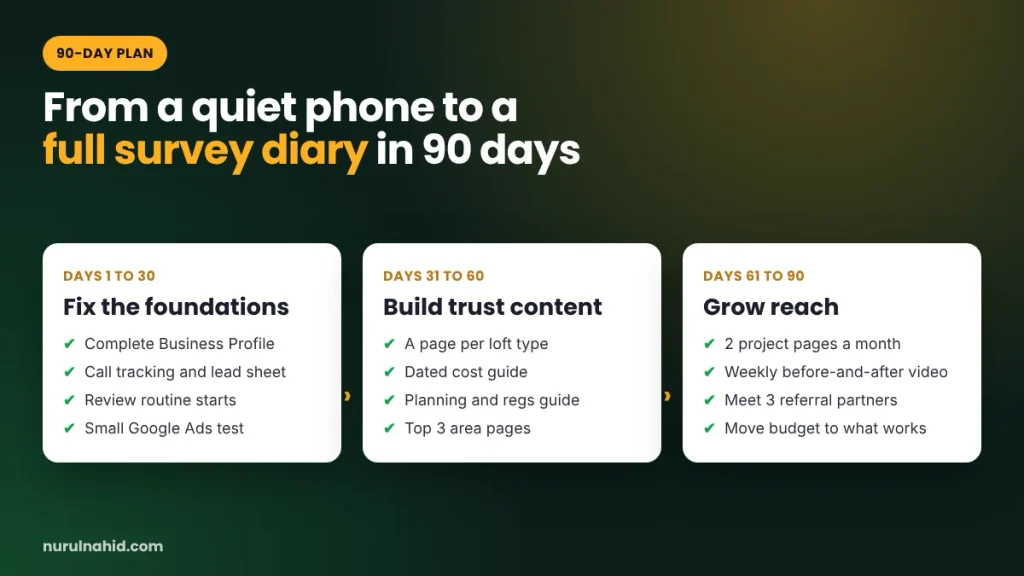
Days 1 to 30: fix the foundations
- Audit and complete your Google Business Profile: categories, services, photos, service area.
- Set up call tracking, GA4 events and a simple lead sheet.
- Rewrite your home page and top service page with answer-first copy.
- Start a review routine tied to project milestones.
- Launch a small, tightly targeted Google Ads campaign for one loft type in your best two towns.
Days 31 to 60: build the content that wins trust
- Publish separate pages for each loft type you offer.
- Publish a dated cost guide and a planning and building regulations guide.
- Build area pages for your top three towns, with real local projects.
- Add LocalBusiness, Service and FAQPage schema.
- Fix citations so your details match on every major directory.
- Start your weekly AI prompt log.
Days 61 to 90: grow reach and referrals
- Publish two local project pages a month with photos and the customer’s story.
- Post one before-and-after video a week across social and your profile.
- Meet three referral partners: an architect, a structural engineer and an estate agent.
- Add a quote follow-up email sequence.
- Review the numbers: cost per signed job by channel. Move budget to what works.
SEO takes time, usually months rather than weeks, so judge it on trend, not on the first month. My guide on how long SEO takes in the UK sets fair expectations.
How I help you build the full plan
I build and run the full plan for UK trades: local SEO, AI visibility, Google Ads, tracking and reporting tied to signed jobs.
You get one plan, one set of numbers and one person to call.
Explore my digital marketing service to see how the channels fit together.
Case study: what a joined-up home services campaign looks like
I have not published a loft conversion case study yet, so here is the closest verified one from my own work.
It is from a different trade and country: an air duct cleaning firm in Texas.
The approach is the same one this guide sets out for loft firms: ads for quick enquiries, local SEO for cheaper ones, and AI visibility on top.
Lara’s Air Duct Cleaning, Richardson, Texas (November 2025 to April 2026)
- Starting point: strong reviews offline, but no rankings, traffic or leads from digital channels, and an 8-page website with slow load times.
- What I did: Google Ads with call-only ads for mobile, Meta lead campaigns, Google Business Profile work, 48 location and service pages, 40+ citations, schema, and replying to every review within 24 hours.
- Results reported: 599 qualified leads in six months (310 from Google Ads, 171 from Meta ads, 118 from organic search), with an average cost per lead of $10.75 across channels.
- Local and AI visibility: Google Business Profile calls rose from 27 to 45, and the firm was tracked with 13 mentions and 32 citations across Google AI Mode, ChatGPT, AI Overviews and Gemini.
Figures come from Google Ads, Meta, GA4, Search Console and Google Business Profile, as set out on the case study page.
Read the full Lara’s Air Duct Cleaning lead generation case study, or browse all case studies.
Loft conversions have bigger tickets and longer decisions, so lead numbers will be lower. The aim is the same: more qualified enquiries at a cost per signed job you can live with.
Related guides
- Ultimate Marketing Guide for Roofers in the UK
- How to rank on Google Maps in the UK
- Local SEO in the UK: the complete guide
FAQ: SEO and marketing for loft conversion specialists
What is the best way to get more customers for a loft conversion business?
Combine a strong Google Business Profile, a dedicated page for each loft type, fresh reviews and a small, tightly targeted Google Ads campaign.
Then add referrals from architects and past customers. Track signed jobs by channel so you know where to spend more.
How long does SEO take for a loft conversion company?
Most firms see early movement in rankings within three to six months, with stronger results after six to twelve months.
It depends on competition in your towns, your website’s starting point and how often you publish useful content and earn reviews.
Is Google Ads worth it for loft conversion specialists?
It can be, because one signed loft job can cover months of ad spend.
It only works with tight targeting, negative keywords, landing pages that match each loft type and call tracking. Judge it on cost per signed job, not cost per click.
Can loft conversion companies use Google Local Services Ads in the UK?
There is no specific loft conversion category.
Some firms may qualify under related categories such as general contractor services. Check eligibility for your postcode in Google’s Local Services Ads sign-up flow before planning a budget around it.
How do I get my loft conversion company recommended by ChatGPT?
Make your website clear and answer-first, keep your business details the same everywhere, collect detailed reviews on several platforms and earn mentions on trusted local and trade sites.
Then test real homeowner prompts each week and fix the gaps you find.
Do I need a separate page for each town I cover?
Only if you can make each page genuinely useful. Include real projects, reviews and local planning notes for each town. Copy-and-paste town pages rarely rank and can weaken your whole site.
Should I list my business on Checkatrade and other lead sites?
They can help, especially while your own reviews and rankings grow.
Track the cost per signed job from each platform and move happy customers onto your Google reviews too, so you are not fully dependent on one platform.
What should a loft conversion website include?
A clear home page, one page per loft type, a dated cost guide, a planning and building regulations guide, area pages, a project gallery, reviews and FAQs.
Add an easy way to book a survey by phone or form.
It must load fast on mobile.
Ready to fill your survey diary for 2027?
You build the lofts homeowners dream about. The hard part is making sure the right homeowners find you first, in Google Maps, in search results and now in AI answers.
That is where I come in. I will audit your current visibility, show you where enquiries are leaking and give you a clear 90-day plan for your towns.
Book a free consultation or message me on WhatsApp. If you prefer to start small, ask for a free SEO audit when you get in touch.