Most businesses are still optimising only for Google. But your customers are also asking ChatGPT, Perplexity and Gemini before they ever type a query into a search bar.
If you have never heard of GEO (Generative Engine Optimization), there is a good chance your competitors already have, and they are quietly winning the AI-generated answers your ideal customers are seeing first.
This guide breaks down what GEO actually is, why it has become one of the most important visibility channels of 2026, and the specific, practical steps you can take to get your business mentioned, cited and recommended inside AI search results, even if you have zero technical SEO background.
What Is GEO (Generative Engine Optimization)?
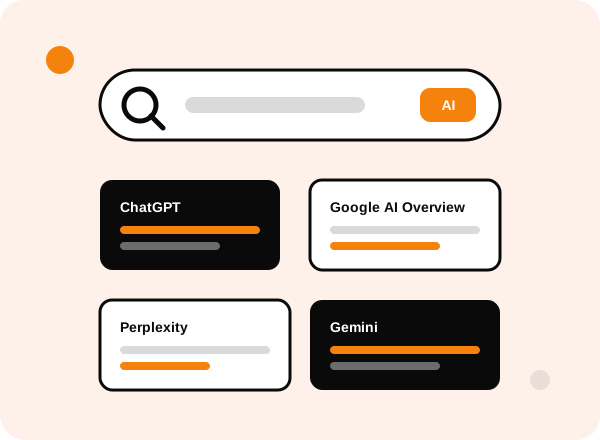
GEO is the practice of structuring and strengthening your content so that AI tools such as ChatGPT, Perplexity, Gemini and Google AI Overviews are more likely to reference your business when someone asks a related question.
Traditional SEO asks one question: will Google rank this page.
GEO asks a different one: when an AI system generates an answer to a customer’s question, does it mention my business, and does it trust my business enough to recommend it.
That distinction matters because generative engines do not work the way classic search engines do. Instead of returning a list of ten blue links for a person to click through, they read, synthesise and summarise information from multiple sources, then generate a single answer.
If your content is not structured in a way these systems can easily read, extract and trust, you simply do not exist inside that answer, even if your website ranks well on a traditional Google search.
Why GEO Matters Right Now, Not Eventually
It is easy to treat AI search as a future trend rather than a current reality. The data says otherwise.
ChatGPT alone was serving more than 900 million weekly active users by early 2026, according to OpenAI, up from around 400 million just a year earlier. That is not a niche audience anymore. That is a meaningful share of your customer base.
Google’s own Gemini app has grown in step, reaching over 900 million monthly active users by May 2026, roughly doubling in the space of twelve months.
And Google’s AI Overviews, the AI-generated summaries that now appear directly inside standard Google search results, showed up on approximately 48 percent of all tracked search queries by early 2026, according to BrightEdge data. For certain industries, such as healthcare, that trigger rate climbs even higher, sitting close to 88 percent.
That means for roughly half of the searches your potential customers run, Google itself is generating a summarised answer before a single organic listing is even visible on the screen.
Here is the part that should really change how you think about visibility. Research from BrightEdge and Ahrefs found that brands cited inside AI Overviews earned around 35 percent more organic clicks and 91 percent more paid clicks than brands that were not cited, even when both were ranking for the same query.
In other words, being mentioned inside the AI answer is no longer a nice bonus on top of good SEO. It is becoming the deciding factor in whether a customer ever reaches your website at all.
If you want the fuller picture of how this fits alongside traditional ranking work, I have broken down the distinction in more detail in SEO vs GEO, What’s the Difference.
SEO, AEO and GEO: Why the Terms Keep Multiplying
If you have started seeing SEO, AEO and GEO used almost interchangeably, you are not imagining things. They overlap heavily, but they are not the same discipline.
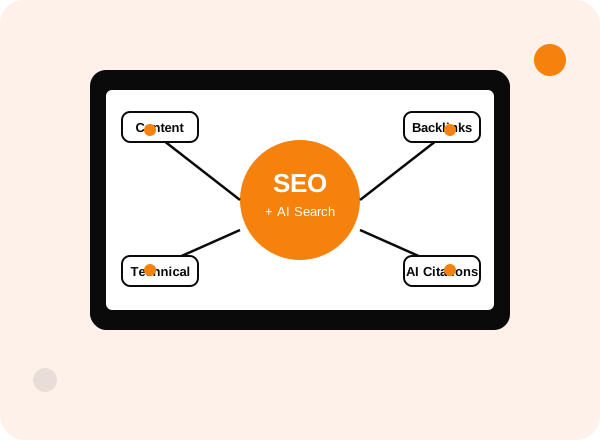
SEO (Search Engine Optimization) is the foundation. It covers technical health, on-page structure, keyword targeting and backlinks, all aimed at ranking well in traditional search results.
AEO (Answer Engine Optimization) focuses on structuring content so it can be pulled directly into featured snippets, voice search results and the short, direct answers search engines increasingly show above the fold.
GEO (Generative Engine Optimization) goes a layer further. It focuses specifically on how large language models select, synthesise and cite sources when generating a full conversational answer, whether that is inside ChatGPT, Perplexity, Copilot or Google’s AI Overviews.
In practice, none of these disciplines work in isolation anymore. A page that is technically strong (SEO), structured to answer a direct question clearly (AEO), and backed by credible, citable authority signals (GEO) has the best chance of showing up everywhere your customer might be looking, not just on a traditional results page.
I offer both as dedicated services, because they genuinely require different tactics even though they share a foundation. You can see how I approach each on my GEO Optimization service page and my AEO Optimization service page.
How AI Search Engines Actually Decide What to Cite
Understanding GEO gets much easier once you understand what is actually happening behind the scenes when someone asks ChatGPT or Perplexity a question.
Generative engines typically follow a version of this process:
They receive a query and expand it into related sub-questions, since one user question often triggers dozens of related searches behind the scenes.
They retrieve a set of candidate sources from the web, similar to how a traditional search engine indexes and ranks pages.
They evaluate which of those sources are clear, well-structured and trustworthy enough to pull specific facts, figures or claims from.
They synthesise the strongest, most citable pieces of those sources into a single, coherent answer, often crediting two or three sources rather than just one.
This is why simply ranking on page one of Google is no longer enough on its own. A page can rank well and still be completely absent from the AI-generated answer, because the AI system did not find it structured clearly enough to extract a confident, quotable fact from it.
Peer-reviewed research backs this up directly. The original Generative Engine Optimization study out of Princeton and Georgia Tech found that specific content changes, primarily adding clear citations, relevant statistics and direct quotations, could boost a source’s visibility inside generative engine responses by up to 40 percent compared to unoptimised content.
That is not a marginal gain. That is the difference between being the brand an AI system mentions by name and being invisible in that same conversation.
The Real Cost of Ignoring GEO
It is worth being blunt about what happens if you skip this.
As AI Overviews and chatbot answers continue to absorb a larger share of search behaviour, fewer users are clicking through to a full list of websites at all. Multiple industry studies through 2025 and 2026 have documented a meaningful drop in organic click-through rates on queries where an AI Overview appears, in some cases by more than half.
That traffic does not disappear. It gets redirected, almost entirely, toward whichever two or three brands the AI system decided were trustworthy enough to name.
If your competitors have already structured their content, reviews and third-party mentions around what these systems are looking for, they are the ones capturing that redirected attention right now, while your business waits on the sidelines of a conversation your own customers are already having.
The good news is that this is genuinely fixable, and it does not require you to become an SEO expert overnight. It requires a handful of specific, deliberate changes.
3 Things That Actually Help Your Business Show Up in AI Search Right Now
1. Clear, Structured Content That Directly Answers Real Customer Questions
Generative engines reward content that answers a specific question plainly, near the top of the page, without forcing the reader (or the AI) to dig for it.
That means writing in a question-and-answer format where it makes sense, using clear H2 and H3 headings that mirror how real customers phrase their questions, and stating the actual answer within the first sentence or two of a section rather than building up to it.
It also means backing claims with concrete numbers, named sources and dates wherever possible. The Princeton GEO research specifically found that adding statistics, citations and quotations was one of the single most effective ways to increase how often a source got pulled into an AI-generated answer.
If you are unsure whether your existing content is structured this way, a quick self-test helps. Pick five questions your ideal customer is likely to type into ChatGPT about your industry, then check whether any single page on your website answers each one clearly within the first 100 words.
2. Strong E-E-A-T Signals (Experience, Expertise, Authoritativeness, Trust)
E-E-A-T was originally a Google ranking concept, but it has become just as important, arguably more important, for generative engines deciding whether to trust and cite a source.
Experience means showing you have actually done the thing you are writing about, not just researched it. Case studies, before-and-after results and named client work all demonstrate this far better than generic advice.
Expertise means the content reflects real, specific knowledge of your field rather than surface-level summaries that could have been written about any business in any industry.
Authoritativeness means other credible sites reference, link to or discuss your business, which signals to both Google and AI systems that you are a recognised voice, not just a self-declared one.
Trustworthiness covers the basics that are easy to overlook: an accurate, up-to-date site, transparent information about who runs the business, secure browsing, and consistent, verifiable details across the web.
Weak E-E-A-T signals are one of the most common, and most fixable, reasons a genuinely good business gets left out of AI-generated answers in its own industry.
3. Being Mentioned and Reviewed Across Trusted Third-Party Sites, Not Just Your Own
This is the one most business owners underestimate. Generative engines do not rely solely on your website to decide whether you are worth citing.
They also weigh what independent, third-party sources say about you, including review platforms, local directories, press coverage, industry roundups and genuine backlinks from other credible sites in your space.
A business with a handful of strong client testimonials, a complete and active Google Business Profile, and a few relevant mentions on trusted third-party sites will consistently out-perform a business with none of that, even if the second business has a technically stronger website.
This is also exactly where local businesses have an underused advantage. A well-optimised, consistently updated Google Business Profile is now doing double duty. It is not just feeding traditional Local SEO, it is directly feeding the data Gemini and Google AI Mode use to understand and recommend your business, since Google has been actively integrating Gemini into Business Profile management throughout 2026.
I covered exactly how that shift changes local visibility in how Gemini’s new AI features are reshaping Local SEO, which is worth reading alongside this guide if your business relies on local search at all.
A Practical GEO Framework You Can Start Using This Week
Knowing the theory is one thing. Here is a simple, repeatable GEO framework I use with clients to move a business from invisible to citable in AI search.
Step 1: Audit Your Current AI Visibility
Before changing anything, find out where you currently stand. Ask ChatGPT, Perplexity and Gemini five to ten real questions a customer might ask about your industry and note whether your business, your competitors, or neither gets mentioned.
This single exercise usually reveals more about your actual visibility gap than a traditional keyword report ever could.
Step 2: Map Query Expansion, Not Just Keywords
Remember that one customer question typically triggers several related sub-questions behind the scenes. Your content needs to cover the full topic a customer cares about, not just a single narrow keyword.
If someone asks about your service, they are also implicitly asking about pricing, timelines, alternatives and credibility. Content that addresses all of that in one well-structured page performs far better than five thin pages that each cover one sliver of it.
Step 3: Rebuild Key Pages Around Direct, Citable Answers
Take your two or three most important service or product pages and restructure them so the core answer to the main customer question appears clearly within the first few lines, followed by supporting detail, structured with proper headings.
Add specific numbers, dates and named results wherever you can honestly do so. Vague, generic claims are the easiest content for an AI system to skip past.
Step 4: Build Citation Sources Beyond Your Own Website
AI systems weigh what reputable third parties say about you almost as heavily as what you say about yourself. Prioritise a small number of genuinely credible mentions over a large number of low-quality ones.
That could mean a case study featured on an industry site, a completed and consistently updated Google Business Profile, a handful of detailed client reviews, or a mention in relevant local press.
Step 5: Strengthen Trust Signals Sitewide
Review your About page, author information, contact details and credentials. These are small details individually, but together they form a large part of how both Google and generative engines judge whether your business is trustworthy enough to recommend.
Step 6: Measure the Right Metrics Going Forward
Stop tracking rankings alone. Start tracking whether you are being mentioned in AI answers, how your visibility compares to direct competitors (sometimes called Share of Model), and whether traffic and enquiries from AI-referred visitors are increasing over time.
This is a slower, more qualitative process than checking a keyword rank tracker, but it is the metric that actually reflects whether your GEO work is paying off.
The Content Formats That Perform Best in AI Search
Not all content earns the same weight when a generative engine is deciding what to cite. A handful of formats consistently outperform generic blog posts.
FAQ-style sections, like the one at the end of this article, map almost perfectly onto how people phrase questions inside ChatGPT and Perplexity, which makes them easy for these systems to lift directly into an answer.
Comparison content, such as “X vs Y” breakdowns, performs strongly because generative engines are frequently asked to weigh options against each other, and a page that has already done that comparison clearly is an easy source to pull from.
Original data and case studies carry disproportionate weight. A business publishing its own results, even something as simple as a before-and-after traffic snapshot, gives AI systems a specific, citable fact that generic advice content simply cannot offer.
Structured lists and numbered steps, similar to the framework earlier in this guide, are easier for generative engines to extract cleanly than long, unbroken paragraphs of prose, because the structure itself signals where one distinct point ends and the next begins.
None of this means abandoning long-form content entirely. It means making sure that within a longer page, the individual facts, answers and claims are broken out clearly enough that an AI system can lift one of them without needing the surrounding context to make sense of it.
Tracking Whether Your GEO Work Is Actually Working
Because AI visibility does not show up in a traditional rank tracker, most businesses have no idea whether their GEO efforts are paying off until they check manually.
The simplest starting method costs nothing. Run the same five to ten customer questions through ChatGPT, Perplexity and Google AI Mode on a monthly basis, and keep a simple record of whether your business appears, where your competitors appear, and how the wording of the answer changes over time.
For a more structured view, several SEO platforms have started rolling out AI Overview and AI citation tracking alongside traditional rank tracking, which can help spot patterns across a larger set of queries than manual checking alone.
Whichever method you use, the goal is the same. You are no longer just tracking where you rank. You are tracking whether you get mentioned by name inside the answer your customer actually reads.
GEO for Local and London Businesses
If you run a local business, particularly one competing in a market as saturated as London, GEO is not a separate project from your Local SEO work. It is an extension of it.
Local intent queries such as “best accountant near me” or “family solicitor in East London” are exactly the kind of question-based, decision-driving searches that AI Overviews and voice assistants trigger on most often. Question-style queries are meaningfully more likely to produce an AI-generated answer than short, generic keyword searches.
That means the businesses that win locally over the next few years will be the ones with borough-specific content, consistent and complete local listings, and genuine third-party proof, not just a generically optimised homepage.
If you want a deeper breakdown of how competitive London specifically has become and what actually creates an edge there, I cover that in detail on my SEO Expert in London page, and the full range of location-based strategy sits under my Local SEO service.
Common GEO Mistakes I See Businesses Make
Even businesses that are aware of GEO tend to fall into a few predictable traps.
The first is treating GEO purely as a content volume game, publishing more blog posts without making any of them genuinely more citable, structured or specific than what already exists.
The second is ignoring third-party trust signals entirely and assuming a strong website alone is enough, when independent research consistently shows AI systems weigh outside validation heavily.
The third is chasing every AI platform at once instead of focusing effort where your customers actually are. Visibility is not a single global ranking. A source can be well cited inside Perplexity and completely absent from ChatGPT, because each engine retrieves, weighs and synthesises sources differently.
The fourth, and probably the most common, is doing a one-off GEO push and then stopping. Because generative engines re-crawl and re-synthesise information continuously, GEO behaves far more like an ongoing authority-building process than a one-time technical fix.
The fifth is neglecting mobile and voice-driven query behaviour. A large share of the question-style searches that trigger AI Overviews and voice assistant answers happen on mobile, often while someone is already close to making a decision, which means slow-loading, poorly structured mobile pages quietly undermine GEO work even when the content itself is strong.
The sixth is forgetting that generative engines can also get things wrong about your business, pulling outdated pricing, old service details or inaccurate claims from an outdated page or a stale third-party listing. Regularly checking what AI tools currently say about your business is as important as trying to improve what they say.
How I Approach GEO With Clients
This is exactly the gap my GEO Optimization service is built to close, working alongside traditional SEO services rather than replacing them.
In practice, that means auditing where a business currently stands across ChatGPT, Perplexity and Google AI Mode, restructuring key pages around direct, citable answers, strengthening E-E-A-T signals sitewide, and building the kind of credible third-party mentions that generative engines are actively looking for.
You can see the kind of measurable results this produces in my case studies, including businesses that moved from close to zero AI citations to being consistently mentioned across multiple AI-powered search surfaces within a few months.
Why Work With Me on Your AI Search Visibility
There is no shortage of agencies now slapping “AI SEO” onto their service list overnight. Most of them are applying traditional SEO tactics under a new label, without actually understanding how generative engines retrieve, weigh and cite sources differently from Google’s classic algorithm.
I have spent 7+ years in SEO, which means I have already navigated multiple major Google algorithm shifts long before AI search existed. That matters, because the fundamentals that made a site trustworthy to Google (structure, authority, real expertise) are the same fundamentals generative engines are now checking for, just applied through a different lens.
Why It Matters Who Does This Work
GEO is still a young, fast-moving field. A lot of what gets published about it online is theory, not tested practice. I run these audits and rebuilds directly with client sites every month, across ChatGPT, Perplexity, Gemini and Google AI Mode, which means the recommendations in this guide are not hypothetical. They are the same steps I use on real businesses.
I am also transparent about the process. You get clear reporting on what changed, why it changed, and what it produced, not vague monthly updates padded with jargon.
How I Work
Every engagement starts with the same AI visibility audit outlined earlier in this guide, applied specifically to your business and your competitors. From there, I build a tailored roadmap rather than a generic checklist, because a solicitor’s GEO strategy and a local clinic’s GEO strategy do not look the same.
You can see the full process on my SEO process breakdown, and the specific results this has produced for past clients on my case studies page.
Frequently Asked Questions
What is GEO in simple terms?
GEO, or Generative Engine Optimization, is the practice of structuring your website and content so that AI tools like ChatGPT, Perplexity and Google AI Overviews are more likely to mention, cite or recommend your business when someone asks a relevant question.
Is GEO replacing SEO?
No. GEO builds on top of traditional SEO rather than replacing it. Generative engines still rely heavily on well-indexed, technically sound, well-ranked content as a starting pool of sources, then apply an additional layer of evaluation on top of that to decide what to cite.
How long does GEO take to show results?
Most businesses start seeing early signs of AI citation within a few months of consistent work, similar to traditional SEO timelines. Because generative engines continuously re-crawl and re-synthesise content, results tend to build gradually rather than appearing overnight.
Do I need a large content budget to start with GEO?
No. The Princeton GEO research specifically found that targeted changes, such as restructuring existing pages around direct answers and adding credible statistics and citations, produced meaningful visibility gains without requiring large volumes of new content.
Which AI platforms should I prioritise first?
Start with the platform your customers are most likely to actually use. For most UK businesses, that currently means prioritising Google AI Overviews and ChatGPT, given their combined reach, then expanding into Perplexity and Gemini as capacity allows.
Can a small local business realistically compete in AI search?
Yes, and in some ways local businesses have an advantage. Question-based, location-specific queries are exactly the type of search most likely to trigger an AI-generated answer, and a complete, well-managed Google Business Profile combined with genuine local reviews carries real weight in how these systems evaluate trust.
Does GEO mean I no longer need backlinks?
No. Backlinks and genuine third-party mentions remain one of the clearest authority signals generative engines use to decide which sources to trust, so link building and digital PR remain just as relevant under GEO as they are for traditional SEO.
What is the single biggest first step if I am starting from zero?
Run the AI visibility audit described in Step 1 of the framework above. Knowing exactly which questions your business is currently missing from is far more useful than guessing where to start, and it usually reveals one or two quick wins immediately.
Final Thoughts
AI search is not a future consideration you can plan for later. With ChatGPT alone reaching over 900 million weekly users and Google’s own AI Overviews now appearing on roughly half of all searches, the businesses winning right now are the ones already structured to be found, cited and recommended inside that answer, not just ranked below it.
You do not need to become an SEO expert to start. You need clear, well-structured content that answers real customer questions directly, credible trust signals across your site, and genuine third-party proof that your business is worth recommending.
Want a free check on how visible your business currently is in AI search? Book a free strategy call and I will show you exactly where you stand against your competitors across ChatGPT, Perplexity and Google AI Overviews.