By Nurul Nahid, SEO Consultant in London. On 7 July 2026, Google quietly rolled out one of the most significant updates to Search Console in years, and most UK business owners have not even noticed it yet.
Google Search Console can now track how your social and video content performs directly inside Google Search and Discover. Your Instagram Reels, your TikTok clips, your YouTube Shorts, even your posts on X, can now be measured with the same clicks-and-impressions data you have always used to track your website.
If that sounds like a small technical tweak, it is not. This is Google formally acknowledging that short-form video and social content are now part of the search results page, not a separate world that exists outside of SEO. For UK businesses, creators, and agencies, this changes how you should be thinking about visibility for the rest of 2026 and beyond.
My name is Nurul Nahid, and I work as an SEO consultant based in London, helping UK businesses stay ahead of exactly this kind of Search change. In this article, I will break down exactly what changed, why Google made this move, how to set it up, what the data actually shows you, and what UK business owners should do differently starting this month. I will also walk through real-world examples so you can see exactly how this applies whether you run a local shop in Manchester, a bridal agency, a photography studio, or a national e-commerce brand based here in London.
What Exactly Did Google Announce?
Google introduced a new Search Console property type called Platform Properties. Previously, Search Console only let you track domains and URL prefixes, meaning it was built entirely around websites. Now, for the first time, you can add a social or video account as its own property and see how that account’s content is being discovered on Google Search.
The four platforms supported at launch are:
- TikTok
- X
- YouTube
Once you verify one of these accounts inside Search Console, you unlock three new reports that mirror the tools website owners have relied on for years.
1. Performance Report
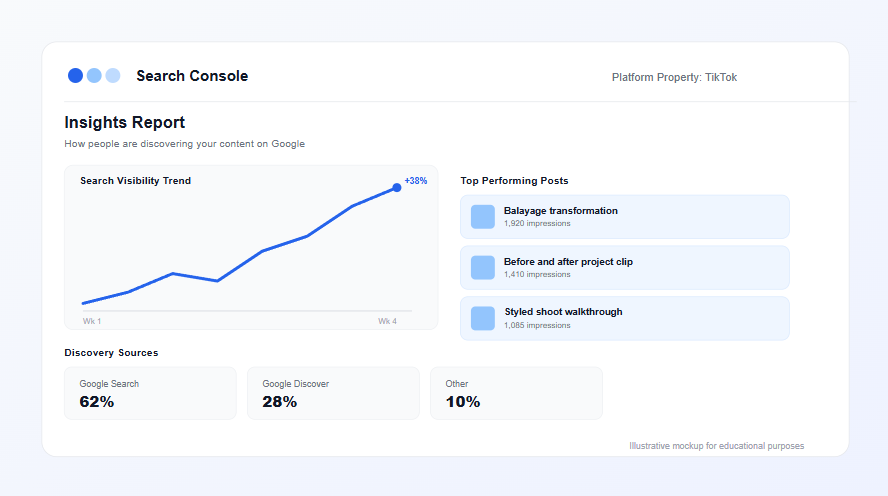
This works almost identically to the Performance report you already use for your website. You get total clicks, total impressions, average position, and click-through rate, but instead of tracking pages, it tracks individual posts and videos. You can filter and sort to see exactly which posts and which search queries are driving the most traffic from Google, and export the data if you prefer to analyse it elsewhere.
2. Insights Report
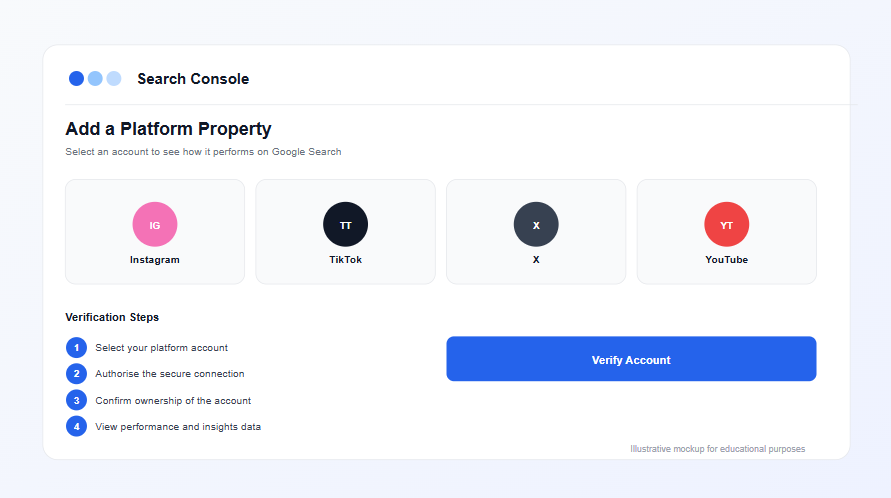
This gives you a higher-level view: your recent traffic trends, your best-performing posts over time, and a breakdown of how people are actually discovering your account through Google. This is the report most business owners will check weekly to understand what content style is working.
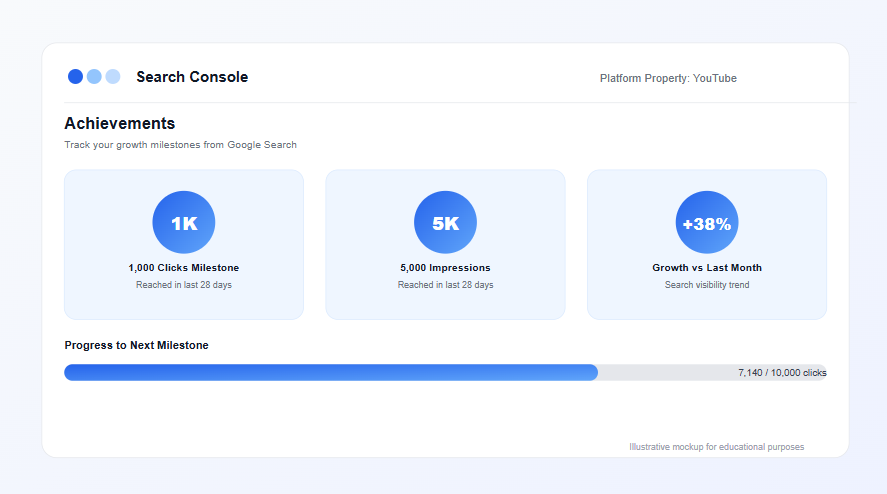
3. Achievements
This is a lighter, more motivational feature that tracks growth milestones, for example reaching a new threshold of total clicks from Google Search over a rolling 28-day period. It is a nice touch, but the real value for business owners is in the first two reports.
Why Google Built This
Google’s own announcement makes the reasoning fairly clear: people increasingly want firsthand, authentic perspectives, and they are getting them through creators and short-form content rather than exclusively through traditional websites. Google wants creators, including people who do not even own a website, to be able to see how their content performs on Search in one consolidated view.
But there is a second, more strategic reason this matters, and it is the one that should actually change your marketing plan.
Google has been pulling video and social content directly into search results and into Discover for a while now. TikTok videos have been showing up for product and “how to” queries. Instagram Reels appear in Google Image and video carousels. YouTube Shorts show up embedded in normal search results, not just on a separate video tab. Platform Properties is Google formalising something that was already happening quietly in the background: your short-form video content is being indexed and ranked, whether you are optimising for it or not.
The businesses that treat this as “just a TikTok thing” or “not real SEO” are going to fall behind the businesses that start optimising their video and social content the same disciplined way they optimise a landing page.
How to Set Up a Platform Property
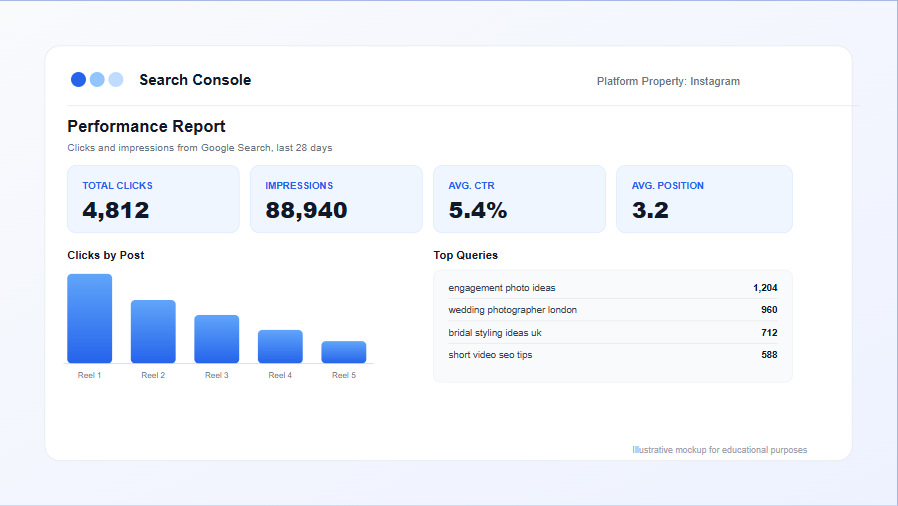
Setting this up takes a few minutes. Here is the process:
- Open Google Search Console.
- Go to the property selector dropdown in the top left and click Add property, or head directly to the verification page.
- Select one of the four supported platforms: Instagram, TikTok, X, or YouTube.
- Follow the on-screen steps to securely authorise the connection between your social account and Search Console.
Google has confirmed the rollout is gradual, meaning not every account will see this option immediately. If you do not see it yet, it is worth checking back over the coming weeks rather than assuming something is broken on your end.
One important note for agencies and multi-platform brands: if you manage content across all four supported platforms, you will need to set up a separate property for each one. There is no single unified dashboard yet that merges Instagram, TikTok, X, and YouTube data into one view, so your reporting workflow needs to account for checking multiple properties.
What This Means If You Are a UK Business Owner
Let’s move past the feature list and talk about what this actually means for your day-to-day marketing decisions.
Example 1: The Local Service Business
Imagine a boutique hair salon in Leeds that posts short before-and-after transformation clips on Instagram Reels and TikTok. Under the old system, that business owner had almost no way of knowing whether Google Search was sending any of their new bookings. All they had was Instagram’s native “insights” tab, which only tells you about performance inside the app itself.
With a Platform Property connected, that same salon owner can now see, for example, that a Reel titled “balayage transformation Leeds” received 900 impressions and 40 clicks from Google Search over the last 28 days, and that the query driving most of that traffic was “balayage salon near me.” That is a completely different, and far more useful, piece of information than an Instagram like count. It tells the business exactly which content style and which topic to double down on, because it is proven to be pulling in people who are actively searching, not just scrolling.
Example 2: The Wedding and Events Vendor
Consider a bridal or events business that regularly posts styled shoot videos and client testimonials across Instagram and TikTok. These businesses often invest heavily in beautiful video content but have no reliable way to connect that content to actual search demand. With Platform Properties, that vendor can start seeing which specific videos are appearing for queries like “luxury wedding planner London” or “bridal styling ideas UK,” and adjust their content calendar to produce more of what is actually being searched for, rather than guessing based on likes and comments alone.
Example 3: The E-commerce Brand
An e-commerce brand doing TikTok Shop style content or product demo Reels can now connect the dots between their social video output and organic Search visibility in a way that was previously invisible. If a product demo video is quietly pulling in search impressions for a specific product query, that is a strong signal to build a matching, fully optimised product page or blog post around that exact topic, creating a feedback loop between video content and traditional on-site SEO.
In every one of these cases, the underlying lesson is the same. Businesses that only measure “engagement” on social media are missing half the picture. The real opportunity is measuring search demand fulfilment, meaning how well your content answers what people are actually typing into Google.
Example 4: The London Business Competing in a Saturated Market
Here in London, I see this play out constantly with clients competing in some of the most crowded search markets in the country. Take a boutique fitness studio in Shoreditch posting short workout clips and client transformation videos across Instagram and TikTok. Before this update, that studio had no way to connect its social content to actual Google Search demand, only in-app engagement metrics that said nothing about search intent.
With a Platform Property connected, that same London studio can now see whether a clip is earning impressions for a query like “personal trainer Shoreditch” or “HIIT classes London,” and use that data to decide exactly what to film next. For businesses operating in a market as competitive as London, where dozens of nearby competitors are all fighting for the same local searches, this kind of precise, search-driven insight is the difference between guessing and knowing.
A note from Nurul Nahid: This is exactly the type of insight I build into every London client’s monthly reporting. Search demand data, whether it comes from a website, a Google Business Profile, or now a social account, only becomes valuable once it is actually acted on. Most businesses in London have access to more data than ever before and still make content decisions based on gut feeling. That gap is where the real opportunity sits in 2026.
Video SEO Is No Longer Just a YouTube Story
For years, “video SEO” meant optimising YouTube titles, descriptions, and thumbnails. That is still important, but it is now only one part of a much bigger picture.
Short-form video across every major platform is being pulled into Google’s search results, Discover feed, and AI-driven summaries. This means the fundamentals of SEO, understanding search intent, matching content to real queries, using clear and descriptive language, and building topical authority, now apply to a TikTok caption and an Instagram Reels description just as much as they apply to a blog post title tag.
Practically, this means UK businesses should start applying basic on-page SEO thinking to their social content:
- Write video captions and titles that include the actual phrases your customers search for, not just clever or vague copy.
- Use clear, descriptive language in the first line of a caption rather than burying the topic under a hook that means nothing to a search engine.
- Treat your most successful video topics as content pillars worth building supporting blog content around, and vice versa.
- Stop treating your website content strategy and your social content strategy as two separate departments. They now feed the same search ecosystem.
How This Connects to AEO and GEO
This update sits inside a much bigger shift that has been building throughout 2026. Search is no longer a single blue-links results page. It is Google Search, Google Discover, AI Overviews, and increasingly AI assistants like ChatGPT, Gemini, and Perplexity, all pulling from the same pool of content: your website, your reviews, your social posts, and now, explicitly, your short-form video.
This is exactly why Answer Engine Optimisation (AEO) and Generative Engine Optimisation (GEO) have become such important parts of a modern strategy. AEO is about structuring your content so it can be pulled directly into featured snippets, AI Overviews, and voice search answers. GEO is about making sure AI platforms understand and recommend your brand when someone asks a related question, even if they never visit your website.
Platform Properties is essentially the video and social equivalent of this same trend. Google is no longer just indexing your website; it wants a complete picture of your brand’s presence across every format your customers actually consume. A business with a strong website, strong local SEO, and now measurable, optimised video content across social platforms is going to have a significantly stronger footprint across Google Search, Discover, and AI-generated answers than a competitor who only focuses on one channel.
Common Mistakes UK Businesses Are Likely to Make With This Update
Based on how similar Search Console updates have played out in the past, there are a few predictable mistakes worth avoiding early.
Treating this as a vanity metric. The Performance and Insights reports are not there to make you feel good about growth. They exist to tell you which specific posts and queries are working so you can replicate that success deliberately.
Ignoring the data because “TikTok isn’t SEO.” This mindset was already outdated before this update, and it is even less defensible now that Google is explicitly measuring and reporting on this exact connection.
Setting it up once and never checking it again. Like standard Search Console data, this data is only useful if it becomes part of a regular reporting habit, ideally reviewed alongside your website’s Performance report so you can see the full picture of how your brand shows up on Google.
Not adjusting content strategy based on the findings. If a particular video topic is consistently pulling search impressions, that is a direct signal for what to create more of, and what to build supporting website content around. Data without action is just a dashboard.
Building a Practical Strategy Around This Update
Here is a simple framework UK business owners can start using this month.
Step one: connect your accounts. If you are active on Instagram, TikTok, X, or YouTube, set up a Platform Property for each one you use seriously. Do not skip this step just because the rollout is gradual; check back regularly until it becomes available.
Step two: audit your last three months of content. Once data starts flowing in, look for patterns. Which posts are earning search impressions? What topics, formats, or phrasing do they have in common?
Step three: match social content to on-site content. If a video is earning search visibility around a topic you have not covered on your website, that is a gap worth filling with a dedicated page or blog post. This creates a stronger, more joined-up presence across every surface Google is now measuring.
Step four: write for search intent, not just engagement. Captions, titles, and on-screen text should speak to what someone would actually type into Google, not just what sounds catchy inside the app.
Step five: review monthly alongside your standard Search Console data. Treat social and video performance as a core part of your monthly SEO reporting, not a separate task handled by a different person or team.
How I Help UK Businesses Get Ahead of Updates Like This
Search rarely stands still, and updates like this one are exactly why a reactive, “post and hope” approach to SEO and content no longer works well enough on its own.
I’m Nurul Nahid, a London-based SEO consultant who works across traditional SEO, local SEO, and the newer AI-driven search disciplines of AEO and GEO. My approach with clients has always been to make sure every channel a business shows up on, website, Google Business Profile, and now social and video content, is working together rather than sitting in separate silos.
Why this matters right now: updates like Platform Properties reward businesses that already have a joined-up strategy across their website and their content channels. If your website’s SEO foundation is not solid, connecting your social accounts to Search Console will simply reveal a gap between what your video content is earning in search visibility and what your actual website is able to convert that visibility into.
How I approach this with clients: I start with a full audit of where a business currently stands across Google Search, Google Business Profile, and, increasingly, AI-driven platforms like ChatGPT and Gemini. From there, I build a content and technical roadmap that treats every format, blog content, location pages, and short-form video, as part of one connected system rather than isolated tasks. You can see examples of this approach in my case studies, where I have worked with local businesses, e-commerce brands, and creative entrepreneurs across the UK.
Where this fits for London businesses specifically: as a London-based SEO expert, I work closely with SaaS, local, and e-commerce brands in the capital who are competing in some of the most saturated search markets in the country. For these businesses, a joined-up website and social visibility strategy is not optional, it is often the difference between being found and being buried under a hundred competitors targeting the same postcode.
The best practice I recommend to every client: do not chase every new feature the moment it launches. Instead, build a foundation, strong technical and on-page SEO, consistent local SEO signals, and increasingly AI search optimisation, so that when Google rolls out updates like this one, your business is positioned to benefit immediately rather than scrambling to catch up months later.
Why an AI-driven approach matters going forward: with tools like ChatGPT, Gemini, and Perplexity increasingly shaping how customers discover businesses, alongside traditional Google Search, having a strategy that covers AEO and GEO is no longer a nice-to-have for forward-thinking UK businesses. It is becoming the baseline expectation for staying visible as search continues to fragment across new surfaces.
If you want a clear picture of where your business currently stands across Google Search, Google Business Profile, and now social and video visibility, you can book a free strategy call or get in touch here and I will walk you through exactly where the opportunities are.
What the Data Actually Looks Like in Practice
It helps to walk through what a typical week of Platform Property data might reveal, because the reports are genuinely more granular than most business owners expect.
Inside the Performance report, you are able to sort by individual post rather than only viewing account-wide totals. This means a business posting three or four times a week can quickly identify which single piece of content is carrying most of the search traffic, rather than assuming every post contributes equally. In many cases, a single well-optimised video ends up responsible for the majority of a month’s search impressions, while several other posts contribute almost nothing. That is an important insight on its own, because it tells you that quality and search relevance matter far more than posting frequency.
The query data is arguably the most valuable part of the report. Rather than guessing what people might be searching for, you can see the literal phrases connected to your content’s appearances in Search. A photography studio might discover that “engagement photo ideas” is driving far more search traffic than “wedding photographer,” even though the business had assumed the opposite. That kind of finding directly reshapes what topics deserve more content investment.
The Insights report layers a trend view on top of this, letting you see whether your search visibility from social content is climbing, flat, or declining over time. For a business running a consistent content calendar, this becomes a simple but effective way to judge whether recent changes in content style, posting frequency, or topic focus are actually moving the needle on Google visibility, rather than relying on gut feeling.
Who Should Prioritise Setting This Up First
Not every business will get equal value from this update on day one, so it is worth being realistic about where the biggest wins are likely to come from early.
Businesses that already post consistent, topic-focused short-form video content stand to benefit immediately, because there is already a body of content for Google to measure and report on. A hairdresser posting weekly transformation Reels, a tradesperson posting before-and-after project clips, or a photographer sharing styled shoot videos will see meaningful data from the very first reporting period.
Businesses that post inconsistently or purely for entertainment value, without any topic focus, are likely to see thinner, less actionable data at first. This is not a reason to ignore the update. It is a reason to treat it as a prompt to tighten up content planning going forward, so that future data becomes genuinely useful rather than scattered across dozens of unrelated topics.
Agencies and multi-location brands managing several social accounts across different platforms should prioritise this rollout carefully, setting up each relevant property methodically rather than all at once, and building it into existing monthly reporting templates from the outset rather than treating it as an afterthought.
Frequently Asked Questions
Do I need a website to use Platform Properties?
No. This is one of the more interesting parts of the announcement. Creators without their own website can still verify a supported social account and see how their content performs on Google Search and Discover.
Which platforms are supported right now?
At launch, Google supports Instagram, TikTok, X, and YouTube. Google has not confirmed whether additional platforms will be added later, but the rollout itself is happening gradually over the coming weeks.
Does this replace my normal Search Console property for my website?
No. Platform Properties are separate from your standard domain or URL-prefix property. You will likely be managing both if you run an active website alongside social and video content.
Will this affect my Google rankings directly?
The update itself is a reporting and insights feature rather than a ranking factor. However, the data it reveals should directly inform your content strategy, which absolutely does affect your visibility on Google over time.
How is this different from checking Instagram or TikTok’s own analytics?
Instagram and TikTok’s native analytics only show you activity within their own app, likes, comments, shares, and views from users already on that platform. Platform Properties shows you specifically how your content performs on Google Search and Discover, which is an entirely different, and previously invisible, audience.
Final Thoughts
This update is a clear signal of where search is heading. Google is no longer drawing a hard line between “websites” and “social content.” Both are being measured, indexed, and surfaced together, and the businesses that adapt their strategy accordingly are the ones who will keep growing visibility while their competitors are still treating social media and SEO as two unrelated jobs.
If you are a UK business owner, the practical takeaway is simple. Set up your Platform Properties this month, start paying attention to which content earns search visibility, and use that data to build a genuinely joined-up strategy across your website, your local presence, and your social channels. Search is evolving quickly in 2026, and staying reactive is no longer a sustainable position. Being deliberate about it is.
Updates like this tend to separate businesses into two groups fairly quickly. The first group notices the announcement, sets up the new property out of curiosity, checks it once, and moves on without changing anything about how they create content. The second group treats it as a genuine data source, feeding real search insights back into their content calendar, their website structure, and their broader visibility strategy month after month. Twelve months from now, the gap between these two groups on Google Search and across AI-driven platforms is likely to be significant. The tools Google is building in 2026 consistently reward the businesses willing to look closely at their data and adjust, not the ones simply reacting to whichever feature made headlines that week.